|
Tortoise Tales: Newsletter of the Hi-Desert Nature Museum |
|
|
New Temporary Exhibition
"Quest for Fire: History of Firemaking Tools" |  Through the centuries there has been such an intimate connection of fire with the cultural growth of humanity that you cannot study one without the other. In the distant past man derived fire from natural sources. Later in time we invented processes for making fire artificially which created the need to develop increasingly sophisticated ways to control, use and preserve fire. This exhibit will explore the fascinating and inventive development of firemaking tools through history. On Display June 12 - August 13 |
|
Brown Bag Lunch Lecture, "Firemaking Tools" |  Fire has many uses, both ritual and practical, and plays an important role in our lives. In Africa, evidence for deliberate exploitation of natural fires dates back as far as 1.5 million years. From these early beginnings, humans developed the skills and equipment necessary to make and sustain fire. Join Tom O'Key, curator of the "Quest for Fire" exhibition, as he shares his knowledge of this interesting topic.
Thursday, June 24, Starting at Noon
FREE and iced tea will be served |
|
Brown Bag Lunch Lecture
"The Palms to Pines Birding and Nature Trail" |  Kurt Leuschner will discuss this useful guide and map, made possible by a grant from Southern California Edison to the Friends of the Desert Mountains, highlighting ten of the area's best-known birding sites. Included for each site are directions and contact information, a list of habitats and signature bird species, wildlife viewing opportunities and other pertinent information. All ten stops are within a relatively short drive from the trail's starting point at the Santa Rosa and San Jacinto Mountains National Monument visitor center in Palm Desert. Residents, visiting birders and nature enthusiasts will want to visit all ten stops and experience the natural wonders that make this area unique. Thursday, July 8, starting at Noon FREE and iced tea will be served |
|
Art & Science Tuesdays |  Art & Science Tuesdays provide unique opportunities for kids to explore the subjects of science and art through hands-on activities led by experienced staff. Art & Science Tuesdays provide unique opportunities for kids to explore the subjects of science and art through hands-on activities led by experienced staff.
Every Tuesday, June 29 through August 3 10:00 a.m. to Noon $5 per student, per class Class size is limited to 12 children, pre-registration required. Click here to register online or call the museum at (760) 369-7212 |
|
Upcoming Events and Exhibitions | | Thursday, June 10, Brown Bag Lunch Lecture, Noon
Spring 2010: A Season of Volcanoes and Earthquakes
Thursday, June 24, Brown Bag Lunch Lecture, Noon
Firemaking Tools
Tuesday, June 29, Art & Science Tuesdays begin, 10:00 am
Thursday, July 8, Brown Bag Lunch Lecture, Noon
Palms to Pines Birding and Nature Trail
Thursday, July 22, Brown Bag Lunch Lecture, Noon
The Buzz about Bees
Saturday, August 7, Dino Day at the Museum!
Thursday, August 12, Brown Bag Lunch Lecture, Noon
Archaeological Discoveries
Thursday, August 26, Brown Bag Lunch Lecture, Noon
The Ancient Art of Spear Making and Throwing
Saturday, October 9, Starry Nights Festival
Saturday, October 30, Halloween Spooktacular
Exhibitions
Bells of the Saints: California Missions
August 21 - October 17, 2010
Day of the Dead
October 22, 2010 - January 2, 2011
Water in the Desert
January 7 - March 6, 2011 |
|
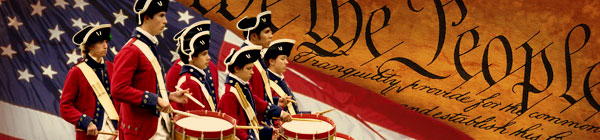
American Revolutionary War Fun Facts | * The Americans of 1776 had the highest standard of living and the  lowest taxes in the Western World. The Colonies were thriving and the British wanted a piece of the pie. They taxed the Colonists who resisted violently, convinced that their prosperity and liberty were at stake. lowest taxes in the Western World. The Colonies were thriving and the British wanted a piece of the pie. They taxed the Colonists who resisted violently, convinced that their prosperity and liberty were at stake.
* There were two Boston tea parties. Everyone knows how 50-60 "Sons of Liberty," disguised as Mohawks, protested the 3 cents per pound British tax on tea by dumping chests of the popular drink into Boston Harbor in 1773. Fewer know that the Bostonians repeated the performance in 1774. The two tea parties cost the British around $3 million in modern money. * Benjamin Franklin wrote the first Declaration of Independence. In 1775, Franklin, disgusted with the arrogance of the British and appalled by the bloodshed at Lexington and Concord, wrote a Declaration of Independence. Thomas Jefferson was enthusiastic. But many other delegates to the Continental Congress were "revolted at it." It would take another year of bitter conflict to persuade the Congress to vote for the Declaration of Independence written by Jefferson, with some astute editorial suggestions by Franklin. * History's first submarine attack took place in New York Harbor in 1776. The Connecticut inventor David Bushnell called his submarine the Turtle because it resembled two large turtle shells joined together. The watertight hull was made of 6 inch thick oak timbers coated with tar. On September 6, 1776, the Turtle targeted the HMS Eagle, flagship of the British fleet. The submarine was supposed to secure a cask of gunpowder to the hull of the Eagle and sneak away before it exploded. Unfortunately, the Turtle got entangled with the Eagle's rudder bar, lost ballast and surfaced before the gunpowder could be planted. * George Washington was the best spymaster in American history. He ran dozens of espionage rings in British-held New York and Philadelphia, and the man who supposedly could not tell a lie was a genius at disinformation. He constantly befuddled the British by leaking, through double agents, inflated reports on the strength of his army. * Benedict Arnold was the best general in the Continental Army. In 1775, the future traitor came close to conquering Canada. In 1776, he built a fleet and fought a bigger British fleet to a standstill on Lake Champlain. At Saratoga in 1777, his brilliant battlefield leadership forced the British Army to surrender. The victory persuaded the French to join the war on the American side. Ironically, Arnold switched sides partly because he disapproved of the French alliance. |
|
|
|
|
| Become a Fan on Facebook! |  | |
The Hi-Desert Nature Museum is now on Facebook! Keep up with our events and programs, make comments on your visit, share suggestions with staff, or tell us something interesting you have learned. |
| Continental Congress |  | |
The Continental Congress was a convention of delegates from the Thirteen Colonies that became the governing body of the United States during the American Revolution. The Congress met from 1774 to 1789 in three incarnations. The First Continental Congress organized an economic boycott of Great Britain. By the time the Second Continental Congress met in 1775, shooting in the American Revolutionary War had begun. They established the Continental Army, issued the Declaration of Independence in July 1776, and designed a new government in the Articles of Confederation. With the ratification of the Articles the Congress was renamed the Congress of the Confederation, which met from 1781 to 1789. When the Articles were replaced by the U.S. Constitution, the Confederation Congress was superseded by the U.S. Congress. |
|
Women and the American Revolution |
Abigail Adams | | |
Women contributed to the American Revolution in multiple ways. Like men, women participated on both sides of the war - Patriot and Loyalist. While formal Revolutionary politics did not include women, domestic behaviors became charged with political significance. Women participated by boycotting British goods, spying on the British, following armies as they marched, nursing, washing, cooking, and delivering secret messages. Some women fought in combat, a few even disguised as men. Above all, they continued the agricultural work at home to feed the armies and their families.
Abigail Adams was the wife of second President John Adams, and mother of the sixth president John Quincy Adams. Abigail Adams was an advocate of women's property rights and more opportunities for women, particularly in education. She is known for her March 1776 letter to John Adams and the Continental Congress, requesting that they, "...remember the ladies, and be more generous and favorable to them than your ancestors. Do not put such unlimited power into the hands of the Husbands. Remember all Men would be tyrants if they could. If particular care and attention is not paid to the Ladies we are determined to foment a Rebellion, and will not hold ourselves bound by any Laws in which we have no voice, or Representation." |
|
|

 Dear Museum Friends,