 1705 South Saginaw Road 1705 South Saginaw Road Midland, MI 48640
(989) 835-4041 (800) 782-4160
|
|
Winning the Case for Disability Benefits
 Ken, a Bay County resident unable to work as a result of his disabilities, has been trying to get Social Security Disability Insurance (SSDI) benefits for over two years. Government red-tape and procedural hang-ups seemed to block any potential progress at every turn. As finances became stretched to near the breaking-point, Ken turned to Disability Network of Mid-Michigan. Ken, a Bay County resident unable to work as a result of his disabilities, has been trying to get Social Security Disability Insurance (SSDI) benefits for over two years. Government red-tape and procedural hang-ups seemed to block any potential progress at every turn. As finances became stretched to near the breaking-point, Ken turned to Disability Network of Mid-Michigan.
"At first, I wasn't sure what Disability Network could do for me," said Ken. "I met with staff and I was immediately impressed. Andrea was, and has been, a calming influence during this very stressful time."
DNMM staff helped secure food, water and other essentials shortly after Ken's initial inquiry. Andrea Sneller, an Information & Referral Specialist at DNMM, was able to schedule an appeal hearing with the Social Security Administration. She acted as a non-attorney representative, advocating for Ken. After a hearing, the judge approved the appeal and awarded SSDI benefits.
And those benefits are needed now more than ever. Ken and his family recently lost their home. They are working with DNMM to find affordable housing.
"Andrea has been great. It's very reassuring to know there are people like her working for us," said Ken. "Disability Network saved us thousands of dollars in legal bills and they helped secure my benefits. I can't thank them enough."
Return to Top
|
|
How the Affordable Care Act Affects People With Disabilities
 Access to quality, affordable health care is the foundation of an independent, productive life. For people with disabilities, who often have significant health care needs, health care access is crucial. DNMM supports quality physical and mental health care that is accessible, affordable, self-determined, and responsive to individual needs. Access to quality, affordable health care is the foundation of an independent, productive life. For people with disabilities, who often have significant health care needs, health care access is crucial. DNMM supports quality physical and mental health care that is accessible, affordable, self-determined, and responsive to individual needs.
 The Affordable Care Act contains several provisions that will affect people with disabilities. The American Association of People with Disabilities has broken them down into the following categories: Accessibility, Affordability, Coverage, Home Services, Equipment, Training, and Medicaid. The Affordable Care Act contains several provisions that will affect people with disabilities. The American Association of People with Disabilities has broken them down into the following categories: Accessibility, Affordability, Coverage, Home Services, Equipment, Training, and Medicaid.
Accessibility and Nondiscrimination: - Requires individuals to have health insurance unless they are eligible for health care through government programs such as Medicare, Medicaid, Veterans Affairs or military service.
- Pre-existing conditions: health insurance providers will no longer be allowed to deny coverage, charge higher premiums or exclude benefits based on a pre-existing condition.
- Creates the Pre-Existing Condition Insurance plan to make coverage available to individuals who are uninsured, have been denied coverage due to a pre-existing condition or are otherwise ineligible.
- Prohibits discrimination based on disability under any health program or activity that receives federal funding or assistance.
- Prohibits providers from rescinding coverage after someone is injured or acquires a new condition.
- Temporary high-risk pools: between now and 2014 individuals with pre-existing conditions are eligible to purchase coverage through high-risk pools if they have been without coverage for at least six months. Pools have yet to be created.
Affordability: - No annual caps on benefits after 2014.
- No lifetime caps on benefits beginning immediately.
- Creates state-based health insurance exchanges to offer a variety of options for coverage and provides tax credits to those who cannot afford coverage.
- Places limits on out of pocket expenses and deductibles.
- Requires insurance providers to disclose and justify unreasonable premium increases.
Coverage: - Certain benefits are mandated to be covered, including ambulatory patient services, emergency services, hospitalization, maternity and newborn care, mental health and substance abuse services, prescription drugs, rehabilitative and habilitative services and devices, laboratory services, preventive and wellness services and chronic disease management and pediatric services.
- Extends certain prescription drug coverage for Medicaid recipients.
- Mandates coverage of anti-seizure, anti-spasm and smoking cessation medications.
Home and Community Based Services: - Expands home and community based services for people with disabilities and chronic conditions to be able to live at home and participate in their communities rather than living in nursing homes or institutions.
- Community Living Assistance Services and Supports (CLASS): allows people with disabilities to buy into insurance programs whereby they receive benefits to help pay for long-term supports and services.
- Substantially increases funding for community health centers.
Equipment: - Requires standards for accessible medical diagnostic equipment for people with disabilities to ensure accessibility to such equipment in doctors' offices and other medical facilities.
- Eliminates the option to purchase wheelchairs under Medicare - rentals only will be covered.
- Increases the excise tax on durable medical equipment manufacturers, which will likely result in higher costs to consumers.
- Establishes Medicare durable medical equipment bidding program whereby HHS will choose suppliers that will be covered by Medicare, limiting consumers' choices for wheelchairs and other equipment.
Training and Data Collection: - Requires disability awareness training for medical professionals.
- Requires the federal government to collect health survey data from people with disabilities in order to better understand their needs.
Medicaid: - Expands Medicaid coverage to all people under age 64 who have household income less than 133% of the Federal Poverty Line.
- Community First Choice Option: allows state Medicaid plans to choose home and community based services for people with disabilities who would otherwise require institutional care.
- Extends the Money Follows the Person program until 2016 to cover costs of moving eligible Medicaid recipients from in-patient facilities to community-based settings.
Note: The above information was obtained from the
The Affordable Care Act was also recently discussed on an episode of Access America. Click the picture below to view the episode.
|
|
Meet Brad Sullivan: DNMM's New Nursing Facility Transition Outreach Specialist
 Brad Sullivan has recently joined the staff of Disability Network's Nursing Facility Transition (NFT) program. Brad graduated from Saginaw Valley State University with a degree in computer science. He worked in that field for a number of years before becoming the Assistant Director at Camp Fish Tales. Brad Sullivan has recently joined the staff of Disability Network's Nursing Facility Transition (NFT) program. Brad graduated from Saginaw Valley State University with a degree in computer science. He worked in that field for a number of years before becoming the Assistant Director at Camp Fish Tales.
While at Camp Fish Tales, Brad spent considerable time volunteering with the STAGES youth transition program at Disability Network. He also began work as an Independent Living Assistant.
Brad has been married to his best friend, Lara Beth, for 13 years. In his spare time, he enjoys spending time with his family, his three dogs and two cats, reading and collecting comic books.
The NFT program provides an array of services to those seeking a better, more independent, quality of life. The benefits to the consumer of transitioning out of a nursing facility are many, but can be as simple as being able to cook for one's self or simply having a place to call "home." Transitioning out of a nursing facility also benefits Michigan as taxpayers save an average of $14,869 per person receiving NFT services.
For more information on the NFT program, please call at 989-835-4041 or visit our services page at www.dnmm.org.
|
|
Planning Our Futures
Disability Network of Mid-Michigan is hosting a free, informative seminar for adults with disabilities and their families. Experts will present information and will be available to answer your questions.
The seminar is Wednesday, July 25, 2012, from 9:00am to 4:30pm at Senior Services in Midland (4700 Dublin Avenue).
Schedule of events includes:
- 9:00am - What is Self-Determination? Can it work for you?
- 10:45am - Social Security, Alternatives to Guardianship, Independence & Decision Making
- 12:15pm - Lunch
- 1:15pm - Hopes, Worries & Person-Centered Planning
- 3:00pm - Services/Supports for our children and ourselves
The seminar is free. To register, please call: 1-800-782-4160. If you need a ride or other accommodation, please call before July 11, 2012.
This event is co-hosted by The ARC of Michigan, the Region VII Area Agency on Aging, Bay Arenac Behavioral Health, the ARC of Bay County and the ARC of Midland County.
Return to Top
|
|
A Spotlight on Recreation
Summertime in Michigan means great times with family and friends. Numerous ventures, agencies and communities are working together to create fully-accessible recreational opportunities for all Michiganders.
On a recent episode of Access America, we highlighted a few opportunities in Bay, Midland, Mt. Pleasant and Saginaw Counties. Click the picture below to view the episode.

Another recreational opportunity will take place Friday, August 10th. Michigan Sports Unlimited and Michigan Adaptive Sports will be demonstrating waterskiing, kayaking and handcycling at Sanford Lake in Midland County, starting at 9:00am. For more information on the event, click on the flyer below.

If you know of accessible recreational opportunities anywhere in Michigan, please feel free to share them with us. You can either email us or comment on our facebook page!
Enjoy Michigan's Great Outdoors!!!
|
|
Community Garden: First Harvest
 Participants in the STAGES youth transition program have been actively cultivating the DNMM plot at the Circle Area Community Garden in Midland. Participants in the STAGES youth transition program have been actively cultivating the DNMM plot at the Circle Area Community Garden in Midland.
Recently, the participants harvested our first batches of beets, Swiss chard, radishes, turnips, lettuce and zucchini. In addition to taking home their harvest, the students received recipe packets for delicious, nutritious, home-grown meals.
SWISS CHARD WRAPS
 9-10 Swiss chard leaves, >9inches 9-10 Swiss chard leaves, >9inches- 1 lg. tomato, slice and cut in half
- 1/2 c. mozzarella cheese, grated
- 2 tbsp. olive oil
- 1 tbsp. onion flakes
- Salt and pepper
Steam Swiss chard for a few minutes. Do not overcook. Open leaves and brush on olive oil lightly. Put tomato slice in center of leaf - top with pinch of onion, salt & pepper, and one tablespoon cheese. Fold leaf around tomato.
Put on grill until hot - can turn once. Works best if using a 2-sided grill that holds food in place. This can also be cooked in oven at 400 degrees for 10 minutes on a cookie sheet.
Baked Radish Chips
 10 radishes 10 radishes
1 tsp. chili powder
1/2 tsp. garlic salt
1/2 tsp. paprika
Thinly slice radishes. Steam in microwave for 5 minutes. Put in bowl with spices; stir. Bake at 350 degrees for 10 minutes. Flip the chips and bake for another 10 minutes.
Makes 1 very low-cal, yummy serving.
|
|
Tim's Place: American's Friendliest Restaurant
 In celebration of Father's Day this past June, CBS Sunday Morning went "On The Road" to meet a father who couldn't be prouder, and a son who couldn't be more thankful. In celebration of Father's Day this past June, CBS Sunday Morning went "On The Road" to meet a father who couldn't be prouder, and a son who couldn't be more thankful.
Keith Harris' son, Tim, was born with Down syndrome. When the pediatrician informed Keith, he wasn't sure how to react and his "world turned black at that moment," he told CBS News.
What a difference 26 years makes. Today, in Albuquerque, New Mexico, you'd be hard pressed to find a more glowing father than Keith.
Keith, and wife Jeannie, have four boys and they have raised them all with the same high expectations. As a result, they're all successful. But, none are more successful than Tim, who not only lives on his own but owns his own restaurant.
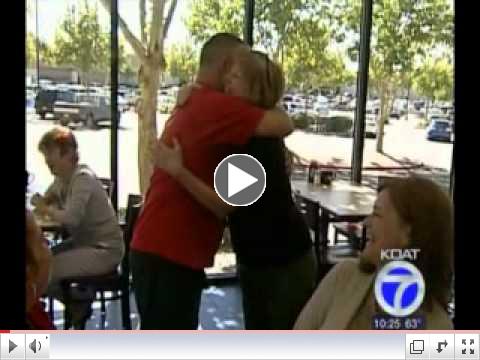 | | Tim's Place |
"He works for me," Tim said, pointing at his brother. In fact, as far as CBS knows, Tim is the only person with Down syndrome in the country who owns a restaurant.
"All of us who are dads want our kids to wind up independent, happy, secure," Keith explained. Tim's dad -- a small business owner himself -- provided the initial investment. Other people do the managing and cooking, but Tim is the front man and the genius behind it.
Tim realized what people really want from a family restaurant is a family feel. That's why here, love isn't just in the air: it's a menu item. You can actually order a free hug from Tim. And even if you don't order it, chances are you'll still get one.
 Hugs are simply his measure of success: He's given out almost 19,000 hugs. He keeps track of them all on a hug counter. Of course, profits are adding up too. Tim even has expansion plans. Yet no matter how big he gets, Tim says he will always be indebted to the man gave him his first hug. Hugs are simply his measure of success: He's given out almost 19,000 hugs. He keeps track of them all on a hug counter. Of course, profits are adding up too. Tim even has expansion plans. Yet no matter how big he gets, Tim says he will always be indebted to the man gave him his first hug.
"He's my super hero and my inspiration," he said about his father. "Thank you Dad."
Return to Top
|
|
|
|
|
|
|
|
Board of Directors
Officers:
Jerry Pritchett
President
Teresa Oliver
Vice President
Harry Leaver Secretary
Members at Large:
Tim Troy
June Price
Peter Jensen
Frank Champagne
Greg Purtell
Executive Director:
David Emmel
|
|
"There are very few people, even with the most severe disabilities, who cannot take control of their own lives. And there is no life without taking risks."
-Ed Roberts
Founder of the Independent Living Movement
|
|
Disability Network of
Mid-Michigan celebrates 22 years of promoting & encouraging independence.
|
Events Calendar
July 20-21
RIVERDAYS
Midland Tridge Area
Come visit the DNMM booth in the kids section!
July 25th
Planning Our Futures
9:00am - 4:30pm
Senior Services in Midland
1-800-782-4160
July 30th
Peer Group
Day at Camp Fish Tales
$10 / person
Call 989-835-4041 for more details.
August 4th
I am Saginaw Day
10am - 2pm
Hoyt Park,
Washington Ave. at Ezra Rust Dr.
Saginaw
Food and fun for the whole family. A Chance to learn about community organizations in Saginaw!
August 10th
Adaptive Sports Demonstrations
@ Sanford Lake
9:00am - 1:00pm
Contact:
Jeff Coupie
989-771-5530
|
|
|
 | | Click to download our core services brochure. |
|
|
| |
Click to download the AT Loan Fund Brochure
|
|
| |
|
| |
Click to download the BLN brochure.
|
|
| |
|



