| Website Launched! | |
The Great Lakes Business Leadership Network web-site is now up and running. The site contains information on the Network's mission in addition to providing resources to employers.
Please visit today!
www.GreatLakesBLN.org
 | |
Find Us On Facebook!
|
|
|
Upcoming Events
October 25, 2011
DISABILITY MENTORING DAY
For details, contact Linda Leahy at 989-835-2495 ext. 206
November 16, 2011
BEST PRACTICES MEETING
11:00am - 1:00pm
Apple Mountain
Freeland, MI
|
Great Lakes Business Leadership Members:


|
|
|
Diversifying Your Workforce
 The US Department of Labor's Office of Disability Employment Policy has published a Four-Step Reference Guide to Recruiting, Hiring, & Retaining Employees with Disabilities. The US Department of Labor's Office of Disability Employment Policy has published a Four-Step Reference Guide to Recruiting, Hiring, & Retaining Employees with Disabilities.While research shows that people with disabilities make excellent employees, not all employers know how to effectively recruit, hire and retain such individuals. That's where this booklet comes in.
It's a quick reference guide outlining the advantages of hiring people with disabilities, along with four simple steps to increasing the inclusiveness of your workforce. With numerous resources and Web links, the following pages are a helpful starting point for organizations looking to benefit from the talents of qualified individuals with disabilities.
|
| Recruiting Young People with Disabilities: A Hiring Strategy with Bottom Line Benefits
Young people with disabilities can do virtually any job that someone without a disability can perform. Expanding your workplace to include young people with and without disabilities is a positive way to help shape the future workforce-and benefit your business.
 Why Hire Young People with Disabilities? Why Hire Young People with Disabilities?
In addition to enhancing your workforce, recruiting and hiring young people with disabilities makes good business sense. Youth bring fresh new perspectives on strategies for meeting business challenges and achieving success. Hiring young people with disabilities is also a valuable way to reach out to an important market base.
Finding Qualified Candidates
Young people with disabilities can generally be found everywhere that other youth are found. Because they read and write blogs and connect to listservs to search for jobs, you can increase the likelihood of grabbing their attention by explicitly stating your desire to recruit and hire people with disabilities in your vacancy announcements.
 Don't Forget Accessibility Don't Forget Accessibility
Another important strategy is to ensure your company's online information and job applications are available in alternative accessible formats. For example, providing information in larger print or in simplified language may assist you in reaching not only young people with and without disabilities, but also older workers and individuals with limited English language proficiency.
Click here for information on designing accessible websites.
Where to Find Young People for Internships and Permanent Jobs
Workforce Recruitment Program
www.wrp.gov
Employer Assistance & Resource Network (EARN)
www.AskEARN.org
| |
|
Disability Mentoring Day
October 25th, 2011

Disability Mentoring Day (DMD) Program is a national job-shadow and career exploration program designed to link students and job-seekers with disabilities to employers interested in hiring people with disabilities. We have modeled our program after the American Association of People with Disabilities' program, which coordinates a national network of nearly 400 DMDs.
Great Lakes BLN Members have the opportunity to impact the career aspirations of students with disabilities. Students from throughout our eight county region participate in job-shadowing during this day-long event.
 Disability Mentoring Day can open up a whole new world of possibilities, both for students with disabilities and for member businesses. Disability Mentoring Day can open up a whole new world of possibilities, both for students with disabilities and for member businesses.
Great Lakes BLN Members participating this year are: Bay Regional Medical Center, Chemical Bank, Covenant Health Care, Dow Corning/Hemlock Semiconductor, Great Lakes Loons, MidMichigan Health, Tata Consultancy Services, The Dow Chemical Company. We are also pleased to announce that the Auburn Township Fire Department and the Auburn Township offices will be participating.
|
Member Spotlight
Midland Community Tennis Center
by Mike Woody, Executive Director As one of the nation's leading tennis facilities and the USTA's Best Tennis Town in the United States, the Midland Community Tennis Center (MCTC) has the resources to serve an exceptionally diverse clientele. Home of the Dow Corning Tennis Classic, now in its 24th year, winner of 13 national junior championships in the last three years, contributor to three high school state championships since 2009, the MCTC has earned a national reputation for tennis outreach. And marked by our involvement in the Great Lakes BLN, we are committed to better serving employees, members and the community with best practices, linked to participation in the game and employment at the center. Because we know 20% of adults experience some type of disability, having an effective diversification strategy will make us more successful. We feel our team's ability to achieve its goals is due to the diversity of our experiences and skill sets. We believe team members with disabilities bring unique skills and experiences and utilizing those skills and experiences places the MCTC at a true competitive advantage. 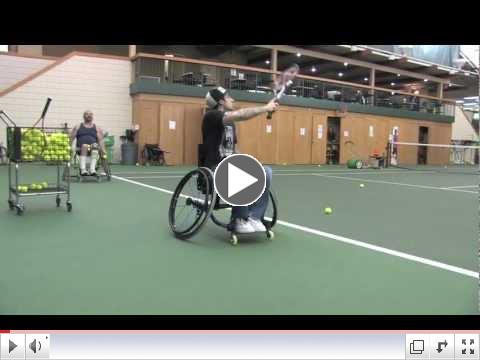 One of our new key programs is wheelchair tennis. This initiative has provided a great fitness and social experience for those who use wheelchairs. The promise tennis offers is that regardless of your circumstances, your life is about to change for the better. Our involvement with the Business Leadership Network has provided us opportunities to the best tennis center we can be for our employees and our community. Midland Community Tennis Center Plays To Win for Disability |
HIRING PROCESS DOs and DON'Ts:
Tips for Ensuring Access for Applicants with DisabilitiesThe goal of the hiring process is to attract and identify the individual who has the best mix of skills and attributes for the job available. Ensuring all qualified individuals can participate in the process is key to achieving this goal. Job Analysis 
Do: - Evaluate each candidate for the job based on whether he or she has met the employer's requirements for the job, such as education, training, employment experience, skills or licenses.
- Consider whether a person with a disability can perform the essential functions of the job, with or without a reasonable accommodation.
Do not: - Assume certain jobs are more suited to persons with disabilities.
- Assume a person cannot or does not want a particular job because of apparent or non-apparent disabilities.
- Assume a person with a disability does not have the requisite education and training for a job.
- Hire a person with a disability who is not qualified to perform the essential functions of a job, even with a reasonable accommodation.
Medical Information Do: - Check that applications and other forms do not ask disability-related questions.
- Make sure any required medical examinations are required of all other applicants. A decision to not hire an individual based on the results of a medical exam cannot be due to the individual's disability.
- Ensure disability-related information is confidential and shared only with those who need to know.
Do not: - Make medical judgments.
- Ask an applicant if he or she has a disability during a job interview.
- Assume that a work environment will be unsafe if an employee has a disability.
Accommodations Do: -
 Ensure the recruitment process is accessible to all individuals by providing reasonable accommodations that qualified applicants will need to compete for the job Ensure the recruitment process is accessible to all individuals by providing reasonable accommodations that qualified applicants will need to compete for the job - Application forms and other relevant information should be available in alternative formats for people with visual or cognitive disabilities.
- Develop an accommodations process and ensure all employees understand it. For guidance, see the Office of Disability Employment Policy publications page.
Do not: - Assume accommodations are expensive or difficult to implement. Most are not, and a number of resources are available to assist in making accommodations.
- Assume one accommodation will work for all individuals with similar disabilities.
- Assume a person does not need an accommodation because he or she does not have a visible disability.
Workplace Accessibility Individuals with disabilities must be able to participate in all aspects of the application process. Below is a list of steps you can use to check your workplace's accessibility. -
 Parking spaces for persons with disabilities should be close to the work site entrance. Parking spaces for persons with disabilities should be close to the work site entrance. - The pathway from the parking area to the entrance should not include abrupt level changes or steps.
- Ramps used to provide access should be appropriately graded and have handrails.
- Doors should be easy to open and wide enough (36 inches) for people who use wheelchairs.
- The bathroom, water fountain and public telephone should all be useable by and accessible to people with disabilities.
- Elevators should have control panels lower than 54 inches from the floor and raised symbols or numbers on the control panels.
- All signage should include the use of symbols and graphics to be appropriate and accessible for persons with visual, learning and cognitive disabilities.
- The emergency warning system should include both audible and visual alarms.
For complete descriptions and diagrams of accessibility standards, visit the U.S. Access Board's website. Additional Resources The following resources may assist you in ensuring your hiring process is inclusive of individuals with disabilities. Job Accommodation Network (JAN) 1-800-526-7234 (V/TTY) Access Board 1-800-872-2253 (V) or 1-800-993-2822 (TTY) Equal Employment Opportunity Commission (EEOC) 1-800-669-3362 (V) or 1-800-800-3302 (TTY) ADA & IT Centers 1-800-949-4232 (V/TTY) Employer Assistance and Resource Network (EARN) 1-855-725-3276 (V/TTY)
|
|
Great Lakes Business Leadership Network
Promoting Inclusion in Workplaces, Marketplaces and Supply Chains
Great Lakes Business Leadership Network
1705 South Saginaw Road
Midland, Michigan 48640
989-835-4041
|
|



