Greetings!
Total Tree Care arborists are delighted to have this opportunity to share their knowledge and experience with you every month. |
Tip of the Month
 Wind Direction Correlates to Hazard Tree Severity Wind Direction Correlates to Hazard Tree Severity
Hurricane season is a time to prepare for these tropical systems that visit our area every 10 years on average. It's important to know where your property is most vulnerable due to tree failure.
The strongest part of a hurricane is in its northeast quadrant, which produces an easterly wind component that would be most destructive for those of us whose homes lie in the path of trees and limbs that fall in the same direction as the southeasterly wind.
Locate potentially hazardous trees on that side of your house and take precautions to prepare your property and family for hazardous conditions.
As part of your disaster plan, secure young trees and survey your yard for weak tree branches that lie within crashing distance of your home. Trim these away before the storm. Properly pruned trees survive hurricanes better than un-pruned trees. Dead and sick trees should be removed. Avoid uprooting of large trees by strategically removing branches to allow high winds to flow through. |
|
 Tend to Your Tree's Weak Unions and Crotches Tend to Your Tree's Weak Unions and Crotches
Weak crotches and storm damage branch unions can be characterized as strong or weak. Strong branch unions have upturned branch bark ridges at branch junctions.
Annual rings of wood from the branch grow together with annual rings of wood from the stem, creating a sound, strong union all the way into the center of the tree.
A weak branch union occurs when a branch and stem (or two or more co-dominant stems) grow so closely together that bark grows between them, inside the tree. The term for bark growing inside the tree is "included bark." As more and more bark is included inside the tree, a weak union is formed that is more likely to fail.
Species notorious for having "included bark" include European mountain ash, green ash, hackberry, boxelder, willow, red maple, silver maple, Amur maple, cherry, littleleaf linden, and Bradford pear.
The installation of high strength steel cables between sections with weak unions will help lessen the chance of splitting. Call your arborist if you're not sure if you have this condition present in any of your trees.
|
 
Tip of the Month
 Bagworm (Thyridopteryx Ephemeraeformis) Bagworm (Thyridopteryx Ephemeraeformis)
This caterpillar lives in a silken cocoon or bag. Bits of leaves are attached to the outside of the bag. The caterpillar carries the bag with it as it feeds. A fully developed bag is about 2" long (see photo).
Full-grown bagworm larvae pupate inside the bag, which the adult female never leaves. Eggs are laid in the fall and hatch the following May or June. It's not too difficult to identify males. They are black with clear wings that span one inch.
The caterpillar stage can be treated with a contact material before substantial damage occurs. Hand picking bags may be practical in a small planting. |

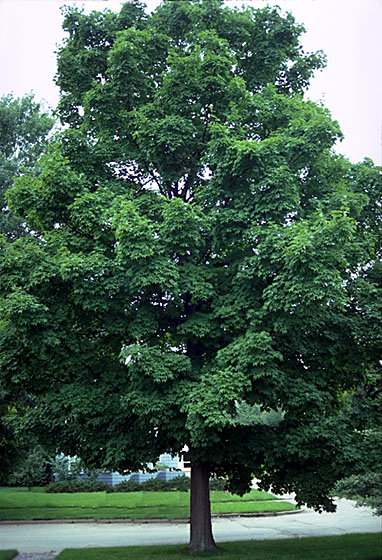 Why are So Many Large Sugar Maples Declining?Sugar maples have been planted in the landscape by New Englanders for over 300 years and still line some streets in rural areas of Connecticut. However, these beautiful trees do not flourish in our state to the degree that they did as recently as two decades ago. Why are So Many Large Sugar Maples Declining?Sugar maples have been planted in the landscape by New Englanders for over 300 years and still line some streets in rural areas of Connecticut. However, these beautiful trees do not flourish in our state to the degree that they did as recently as two decades ago.
Sugar maples prefer wet or moist soils. They do not tolerate drought very well nor exposure to salt. Has Connecticut become a less than favorable location for sugar maples to grow?
Some say that global warming plays the biggest role in our changing forest composition. However, it really appears to be much more than that. Mankind has been dramatically affecting most of the world's forests for thousands of years in a variety of ways. New England is no exception.
Click here Click here to read an article about why the red maple is benefiting in places where the sugar maple (and even oaks and hickories) are unable to compete as well in the new conditions. |



