$Account.OrganizationName
Advanced Wilderness Life Support - AWLS® - University of Utah School of Medicine
May 2008

Table of Contents
  • Cycling: A Perfect Fit
  • Upcoming Courses
  • About AWLS
  • We've got lots of great courses through the spring and summer. Register now to kick the season off right!

    As always, be safe in the outdoors,

  • Cycling: A Perfect Fit
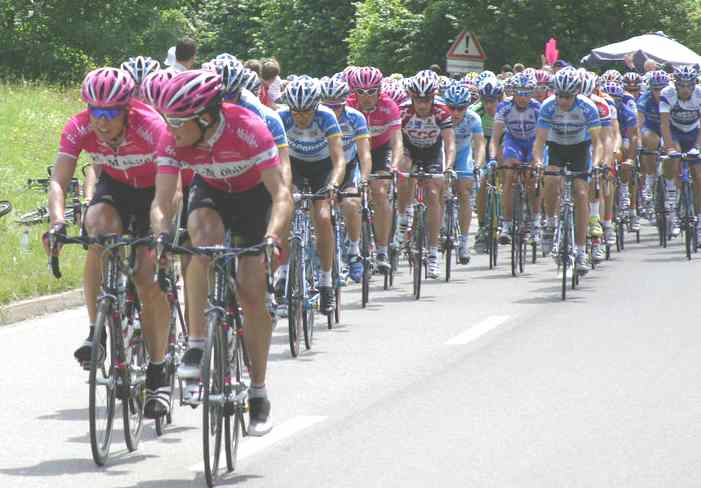
  • As cycling gains more and more popularity across the U.S., more and more outdoor enthusiasts are hitting the roads and trails. Make sure that you get the right fit to ensure that the only pain you feel is that warm burn in your legs as you finish the local hill ahead of all your friends.

    1. What is the right saddle height for me?
    2. What is a good formula for saddle angle?
    3. T or F Once I adjust my bike, I don't need to worry about positioning-related injuries anymore.
    4. T or F Once I adjust my bike, I won't have to worry about any pain or discomfort during riding.

    Answers:

    1. A good saddle height will save you from a number of back, arm, and knee issues, so its good to get it right. Though there are lots of measurements and formulas, a practical method is to sit so that:
      • The pedal is at the bottom of the pedalstroke
      • Your heel is on the pedal
      • Your leg is straight
      • You can pedal without rocking your hips
    2. There is none. Saddle angle depends on where each individual rider feels most comfortable. Most men prefer a slightly elevated nose while most women prefer a slight depression. Forward/backward saddle position however, depends on the sport. With the pedals in the 9 o'clock and 3 o'clock position, a plumbline hung from the knee should:
      • Bisect the pedal spindle for road biking
      • Fall two inches behind the spindle for mountain biking
      • Fall 1-2 inches ahead of the spindle for time trialing
    3. False Once an injury has occurred, the damage has been done and the injury should be further treated as any other. For most tendon and muscle injuries that occur in cycling, RICE is a useful technique:
      • Rest
      • Ice
      • Compression
      • Elevation
    4. False Just like it takes time for you to get in peak shape for long rides, you need to condition your muscles to sit on your bike for long periods as well. Even with a "perfect fit" some initial discomfort is expected just as with any exercise. Be careful not to overdo it and remember to take regular breaks to change positioning and stretch. If you carefully and consistently train your body for sustained efforts, then you'll soon be watching the hours tick away on your favorite trail or highway.

    So, as you and your patients suit up for lots of spring and summer rides, ensure a good fit and smart training techniques. Use your head, and above all put a helmet on it! Happy Trails!

  • Upcoming Courses
  • AWLS Courses

    Moab, UT- May 28-31, 2008

    This AWLS course is taught in the spectacular red rocks area of Moab Utah. You will learn the practical hands-on skills of wilderness medicine in a warm weather setting, with a focus on hiking, biking, rafting and climbing related medical issues. You can certify in AWLS and obtain CME credits.

    Joe Wheeler State Park, Alabama - June 20 - 22, 2008

    The forests, lakes and rivers of Northwest Alabama are the setting for this AWLS® course being held at Joe Wheeler State Park Lodge with immediate access to outdoor teaching in a wilderness setting. This is a weekend course available for 17.5 hours of CME credits and Wilderness Medical Society FAWM credits.

    Cyr, Montana - June 27 - 29, 2008

    Cyr and Alberton Gorge near Missoula is the location for this course with an emphasis on swift water education. This is a weekend course available for 17.5 hours of CME credits and Wilderness Medical Society FAWM credtis.

    We've got our full summer course schedule up on our website!

    Click here to learn more about AWLS courses
  • About AWLS
  • The Advanced Wilderness Life Support certification course was originally developed at the University of Utah School of Medicine and has grown significantly since its creation in 1997. The increasing demand for certification resulted in the creation of a new organization, AdventureMed, to promote the responsible growth of the AWLS program. AWLS certification is available to anyone with a medical degree or certification including: MD, DO, RN, DDS, DPM, PA, EMT and Paramedic.

    The Wilderness Life Support Institute, a nonprofit organization, was founded by Paul S. Auerbach, MD and Richard Ingebretsen, MD to oversee the content and quality of the AWLS certification program.

    The mission of AWLS is to create competence in medical professionals, enabling them to effectively manage emergency medical situations outside traditional medical facilities.

    Click here if you are interested in hosting an AWLS course
       
    Wilderness Medicine of Utah
    358 South 700 East B509
    Salt Lake City, Utah 84102
    888-521-2957
    Email Marketing by