|
The NatureConservancy, Hawaiian Legacy Hardwoods Partner to Restore Koa Forests
 
Agreement will also benefit other native forests in Hawai'i
September 27, 2011 |
|
Honolulu, HI - A groundbreaking agreement between The Nature Conservancy and Hawaiian Legacy Hardwoods aims to restore Hawaii's dwindling koa forests and benefit other native forests across the state.
Koa, considered by some the "mother tree" of the Hawaiian forest, as well as one of the world's most valuable tropical hardwoods, has been severely depleted by feral cattle, land clearing, invasive pests and unsustainable harvesting.
"Over time, the loss and removal of this monarch tree, with no replanting, has diminished our koa forests and the quality of other native forests," said Suzanne Case, the Conservancy's Hawai'i executive director. "This partnership seeks to address both of those concerns."
Founded in 2008, Hawaiian Legacy Hardwoods has been implementing an aggressive program of replanting koa on hundreds of acres of land that was once a koa-dominated forest. The reforestation project was launched at the Big Island's Kuka'iau Ranch, on the northeast slopes of Mauna Kea, and may be expanded to other areas and islands. Owned by David and Josephine DeLuz, the ranch was once the personal property of King Kamehameha I.
Hawaiian Legacy Hardwoods CEO Jeff Dunster said the company operates on both a conservation model and a commercial one. Donors can participate in a Legacy Tree program, which stipulates that the trees are never harvested and become part of a new, permanent Hawaiian forest. Participants in the Forest Investment program finance the planting of trees that will eventually be logged, providing a return on their investment.
The Nature Conservancy is participating in the Legacy Tree component, in which participants pay $60 for each tree planted. Of that sum, $1 goes to The Nature Conservancy, and $20 to the charity of the donor's choice. If no charity is designated, this contribution also goes to The Nature Conservancy. Hawaiian Legacy Hardwoods has promised The Nature Conservancy a $50,000 minimum contribution annually, beginning this year.
With each planted tree, a scannable electronic chip is placed in the ground. The chip contains the serial number of the tree and is linked with its GPS coordinates in a database along with information on when it was planted, the name of the donor, and the name of the individual the tree was planted to honor.
All money donated to The Nature Conservancy will be used to preserve existing native forests. "It's a partnership that is both helping to create new koa forests and preserve existing native forests," said John Henshaw, the Conservancy's director of Land Protection and Conservation Partnerships.
Added Dunster: "You're not just growing a tree, you're helping to grow an entire forest."
Hawaiian Legacy Hardwoods' forestry programs have been warmly received. One participant, the Four Seasons Resort Hualālai, has signed up for the planting of 500,000 legacy koa trees in conjunction with their 50th anniversary. Hawaiian Legacy Hardwoods also has partnerships with the Boy Scouts, Big Brothers Big Sisters, Martin and MacArthur, Hagadone Printing and others.
The hardwood company is entering its third season of active planting (planting is done during the wet months). The firm hand selects seeds from old growth koa trees that reside on the property, raises them in their own nursery and outplants the seedlings when the conditions are right.
Its crews planted some 20,000 trees on 40 acres in its first year, and 35,000 trees on 84 acres in its second. This winter season it expects to plant 150,000 koa trees on 322 acres, and another 300,000 trees during the 2012-2013 season.
On some legacy forest lands, Hawaiian Legacy Hardwoods is planting other native forest species, including māmane, naio, 'ōhi'a and 'iliahi or sandalwood.
The koa tree, Acacia koa, is native to the Hawaiian Islands. It provided ancient Hawaiians with timber for building canoes, spears, bowls, construction materials and even fishhooks. Along with 'ōhi'a, it is one of the signature trees of the Hawaiian forest, with a broad canopy that provides a rich, protected zone for understory plants.
"As a dominant canopy tree, koa can form the framework for biological restoration," said Sam 'Ohu Gon III, the Conservancy's Senior Scientist and Cultural Advisor.
Added Henshaw: "Once we get the koa forest re-established, it becomes the nursery for other species. We have found elsewhere that if we can get the koa forest back, other natives reappear, including some of the native bird species." |
|
From the Fields
Darrell Fox, CEO
October 2011 |
|
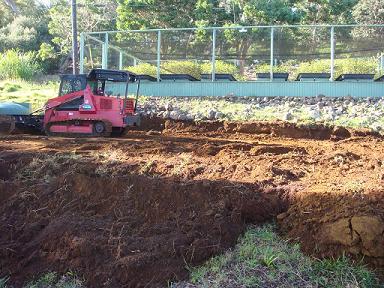
Construction of nursery buildings #2 and #3 is underway. Building #2 will be identical to Building #1 and Building #3 will be 50% larger than buildings #1 and #2. After a successful year of operation with subirrigation as our primary watering system we are continuing with that design philosophy. There are many benefits to this system. Each building has its own water reservoir allowing complete customization of nutrient blends tailored to the growth stage of the plants. Additionally, since the water returns to the reservoir after each watering cycle, only the water actually used by the plants or lost to evapotranspiration needs to be replaced from our catchment pond. This water savings allows us to run the nursery entirely with catchment water. By storing each nursery's water supply in light tight tanks we avoid the problem of algae growth in the nursery water. By not returning the water to the pond we avoid algal growth in the pond as well. Automation of this system provides consistent watering throughout seedling development.
The cataloging and collection of biometric data on our mother trees is being refined and built into out tree management database. These refinements to our seed collection and logging system will provide a wealth of data on the relative roles played by genetics and environment. This year will also mark the beginning of outplanting other native trees that were once a component of the koa ecosystem. Nursery stock for mamane, naio and sandalwood are being timed for interplanting with the koa already established as part of our legacy program. Understory plants such as mountain pilo, aalii and akala (the Hawaiian raspberry) will be planted in conjunction with the tree species. Building a complete ecosystem is an exercise in patience and timing.
Non-native invasive plants are being cleared from the fields scheduled for planting this year. Agriculture and ranching as practiced over the past century has opened the way for these alien invaders. Many of these plants are much more aggressive than the Hawaiian indigenous plants and it takes persistence to control the pests while the native ecosystem is reestablished.
Within the next few weeks the nursery buildings will start to fill with sprouts and seedlings in preparation for the rainy season. Our goal for this year is 150,000 trees. When the winter rains come planting will begin once again. We often say that the best time to plant a tree is 20 years ago, but the second best time is when it is raining and miserable. The trees love it, the crew tolerates it, but the reward of seeing an expanse of returning forest makes it all worthwhile.
|
|
With Deaths of Forests,
a Loss of Key Climate Protectors
By Justin Gullis
Published: October 1, 2011 |
|
WISE RIVER, Mont. - The trees spanning many of the mountainsides of western Montana glow an earthy red, like a broadleaf forest at the beginning of autumn
But these trees are not supposed to turn red. They are evergreens, falling victim to beetles that used to be controlled in part by bitterly cold winters. As the climate warms, scientists say, that control is no longer happening.
Across millions of acres, the pines of the northern and central Rockies are dying, just one among many types of forests that are showing signs of distress these days. From the mountainous Southwest deep into Texas, wildfires raced across parched landscapes this summer, burning millions more acres. In Colorado, at least 15 percent of that state's spectacular aspen forests have gone into decline because of a lack of water. The devastation extends worldwide. The great euphorbia trees of southern Africa are succumbing to heat and water stress. So are the Atlas cedars of northern Algeria. Fires fed by hot, dry weather are killing enormous stretches of Siberian forest. Eucalyptus trees are succumbing on a large scale to a heat blast in Australia, and the Amazon recently suffered two "once a century" droughts just five years apart, killing many large trees.
Experts are scrambling to understand the situation, and to predict how serious it may become. Scientists say the future habitability of the Earth might well depend on the answer. For, while a majority of the world's people now live in cities, they depend more than ever on forests, in a way that few of them understand.
Scientists have figured out - with the precise numbers deduced only recently - that forests have been absorbing more than a quarter of the carbon dioxide that people are putting into the air by burning fossil fuels and other activities. It is an amount so large that trees are effectively absorbing the emissions from all the world's cars and trucks.
Read more on this article click on link below
http://www.nytimes.com/2011/10/01/science/earth/01forest.html?_r=1&hp |
|
|
What do trees and people have in common - lots!
J Howe, Ph.D.
September 2011 |
|
Climate change is a hot environmental topic, and carbon sequestration, reducing carbon footprints, and carbon trading are among the solutions that are being discussed to mitigate man's impact on global climate. For the past two hundred years man has poured literally billions of tons of carbon based "greenhouse" gases such as carbon dioxide and methane into the atmosphere. While there is still some debate (in some regions) over the degree to which man actually can influence the global environment, there appears to be general alignment behind the idea that behaviors that lead to increased long-term storage of carbon, particularly of atmospheric carbon, are a good thing. Some have even been suggested that halting the harvest of trees might be an effective way to increase carbon storage. However, this simplistic solution to the atmospheric carbon problem is misguided.
Carbon is a critical element and forms the basis for all life on earth. The two most important chemical characteristics of carbon are that it has four chemical bonding sites and that the energy required to make or break a bond is just at the appropriate level for building molecules that are both stable and reactive. Thus, carbon atoms bond readily to other carbon atoms to form long and complex molecules.
The chemical composition of wood is often referenced when discussing carbon storage in the forest. Dry (moisture-free) wood is about 48-50% carbon, 38-42% oxygen, 6-7% hydrogen and a number of other elements, such as nitrogen and sulfur in very small percentages. These percentages are based on the weight of the elements as a percentage of dry wood mass.
Living trees, however, are very wet. In fact, although there can be great variation between tree species (and seasonally), a living tree may be made up of more than two thirds water by mass. Thus, a living tree is made up of 15-18% carbon, 9-10% hydrogen, and 65-75% oxygen by mass.
Interestingly, human beings are also mostly water (two-thirds) and carbon-containing organic molecules. In fact there is a striking similarity in the proportion of elements in the composition of humans and trees. By mass humans are composed of about 18% carbon, 10% hydrogen, 65% oxygen, and 3% nitrogen, 1.5% calcium, 1.2% phosphorus and a number of elements in amounts less than 0.2 %.[1] Obviously, humans are more than the elements they are made of, but with respect to carbon storage there is a marked similarity between humans and trees.
Though obviously plants are not warm-blooded creatures, trees are nonetheless actually very much like people in other ways as well. As seedlings, for instance, they are very fragile, and when young grow rapidly in both height and in volume. As they age, however, they gradually lose vigor, and over time become more susceptible to disease. ...and eventually they die. Unlike humans, however, there is no "average" life span for trees as the age at death varies greatly by species. Some tree species struggle to live past 60-70 years, while others commonly live into the hundreds of years. Select trees of a few species live very long lives - into the late hundreds and even the thousands of years; but these are the exceptions rather than the rule. In general, most tree species show measurable signs of aging after the age of 100. In addition, communities of trees - forests - are subject to periodic, unpredictable, sometimes catastrophic, disturbance events that impact the life spans of trees and forest stands.
In the same way scientists evaluate human populations rather than individuals, some key statistics are more appropriately measured by looking at forests rather than at individual trees. As an example, the carbon dioxide exchange of individual trees may vary greatly by age. While young established forests tend to capture carbon at a rapid rate, very mature forests tend to give off approximately as much carbon dioxide as they take in. In fact, one way to define "old growth forest" would be to say that it is a forest in balance, or that it is giving off as many resources (such as carbon dioxide) as it is taking in.
Storing carbon in living trees is an attractive carbon mitigating strategy, and certainly one component of any solution to reducing man's impact on the atmosphere. Similarly, it could be argued that storing carbon in humans is an option; they are made up of similar elemental proportions. Certainly, an increase in the human population by another few billion will increase the amount of carbon "sequestered" in humans. In fact for every billion people added to the population we would store about 22.5 billion pounds of carbon.[2] But it could be argued that humans are the problem that started this discussion in the first place. Humans require so many other resources to live that adding more just to store carbon is probably not a good idea.
But trees require resources as well. Every billion pounds of carbon stored in a living tree requires about 2 billion pounds, or almost 250 million gallons, of fresh water. There are few regions of the world today where fresh ground water is in great excess and many regions where it is in critical short supply. To offset the current 29 gigatonnes of carbon dioxide put into the air by humans each year by sequestering carbon in trees we would need to put into storage on the order of one point five trillion gallons of fresh water, annually.
Wood, on the other hand and as mentioned earlier, is approximately one-half carbon by weight, and for interior use contains generally only about 7% water by mass....or roughly that of the surrounding atmosphere.[3] Thus, if the forests from which wood is harvested are growing at least as rapidly as the rate of wood removal[4] , utilizing wood in relatively permanent usage such as in wooden furniture and buildings represents an excellent means of storing carbon. All of the resources required in the production of wood can be compared directly for net carbon impacts with those of other raw materials and appropriate selection.
Storing carbon in living organisms such as trees is one part of the carbon solution, but it is not as simple a solution as it may seem. Like humans, trees have finite life spans and require lots of fresh water to survive. Thus, carbon in forests cannot be considered to be in permanent storage. Putting sustainably harvested wood and the carbon it contains into permanent and durable uses, complements carbon storage within forests Climate change policies that recognize the importance of maintaining forests, but also the value of carbon storage within durable goods, quality engineering, and designs that enhance the long-term performance of wood houses, make more sense than policies aimed at simply letting forests grow.
[1] Chang, Raymond. 2007. Chemistry, Ninth Edition. McGraw-Hill, p. 52.
[2] Assuming an average weight of 125 lbs. per human
[3] In fact dry wood in most usages will acclimatize itself to its surrounding environment, meaning it will take on or give off moisture depending on the relative humidity - hence the terms shrinkage and swelling of wood.
[4] Forests of the United States and Canada have for many decades been growing far more rapidly than the rate of harvest, with the result that forest area, standing volume, average diameter, and net carbon storage are all steadily increasing.
|
|
|
|
|
|
Did you know?
The best reason to invest in timberland is the simple fact that trees grow. Silently and unattended, the average North American forest produces about 8% more timber every year. But the forest isn't just a no-cost factory; it's also a profit-spinning warehouse. As trees get larger, their value increases. Consider southern pine: Wood from 12-year-old trees is used for pulp, and a cord sells for about $20. When those same trees are 24 years old, they're saw timber, worth perhaps $60 a cord. These are beguiling numbers, but it gets better. Though timber prices fluctuate, research indicates that real prices for timber have steadily risen for more than 100 years - better performance than any other commodity (with the possible exception of fish). Why? Think of it this way: Timber isn't like oil, where new discoveries expand supply. There are no hidden timber deposits, and demand is robust. Despite substitutes as diverse as steel, plastic, hard-disk storage and CDs, people still want wood and paper."
PRICE INCREASE
Effective November 1, 2011 our 100 tree units will be increasing to $7,807 per unit.
|
|
Sponsor the planting of a Koa Legacy Tree and make a difference. Visit www.LegacyTrees.org to learn how.
.
|
|

You can even find us on Twitter.
|
|