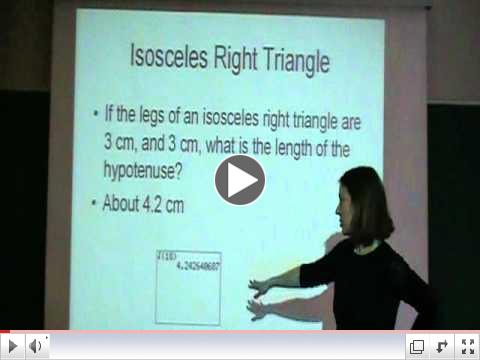
Math Confidence Video on You Tube
 | |
The Pythagorean Theorem
|
|
|
Quote of the Month
"Optimism is the faith that leads to achievement. Nothing can be done without hope or confidence"
Helen Keller
|
|
|
|
As students do not write term papers in Math, tests are an important component of learning and teaching Math. How do people feel about tests and how does it affect the way they feel about Math? Many students, parents and teachers feel that tests are overemphasized at the cost of learning. This month's book focuses on how to use standardized tests to improve instruction. This month's video is on the Pythagorean Theorem and Math Confidence FAQs will be answered in each e-newsletter for the remainder of 2011.
|
|
Pythagorean Theorem
If you know two sides of a triangle, how can you calculate the third side? If it is a right triangle, it can be solved with the Pythagorean Theorem as a^2 + b^2 = c^2 and often, we must then take the square root of c^2 Simplifying Radicals (Square Roots). Students usually first see the Pythagorean in middle school, and then again in coordinate geometry as the distance formula, and up in Algebra 2 as the Pythagorean trigonometric identities. If it is not a right triangle, then one must use much more complex Non-Right Triangle Trig from All About Circuits trigonometry (Law of Sines and Law of Cosines).
Pythagorean Triples on Mathsisfun
Pythagorean Theorem in the Media (incl Wizard of Oz)
Pythagorean Theorem on answers.com
Pythagorean Theorem Online Game
|
|
FAQ: How Can People Build Math Confidence?
This section of the newsletter will highlight common questions about Math, confidence and peak performance.
People can build math confidence by:
1. Practice!! Solve Math problems (Math opportunities) including multiple choice as compare/contrast with "good wrong answers" can increase knowledge, skills, attitude and scores!
2. Treat Math exams like athletic events -- prepare by studying but also by eating breakfast, getting a good night's rest and packing up the night before.
3. Embrace Math mistakes! Learning from errors can be challenging emotionally but will improve critical thinking, build confidence and expand educational and career options.
If you have a question that you would like featured. please send an email to Robin.
|
|
|
|
|
Brain Teaser
When I divide it by 2, the remainder is 1.
When I divide it by 3, the remainder is 2.
When I divide it by 4, the remainder is 3.
When I divide it by 5, the remainder is 4.
When I divide it by 6, the remainder is 5.
When I divide it by 7, the remainder is 6.
When I divide it by 8, the remainder is 7.
When I divide it by 9, the remainder is 8.
When I divide it by 10, the remainder is 9.
Find the smallest number that satisfies these conditions.
Answer to May's Brain Teaser: 6060 |
Thanks for reading! How can we make this newsletter better? Please send comments and suggestions to Robin mathconfidence@aol.com |
|
Sincerely,
Robin "the Math Lady" Schwartz
|
|
|






