UPCOMING EVENTS
Photo of Howard Thurman Dr. Peter Eisenstadt Independent Scholar, Historian
"From Rochester to Gandhi: Howard Thurman's Pilgrimage to India and the Origins of African-American Nonviolence"
Tuesday, December 6
4:30-5:30 pm
The Brennan Room in the UR Interfaith Chapel
This talk is co-sponsored by the Frederick Douglas Institute for African and African- American Studies and the Office for Minority Student Affairs.
Book signing after the talk!
*Visions of a Better World (2011) was listed as one of the Top 10 books by Booklist in the religion and spirituality category.

Gifts for Peace This holiday season consider contributing to the Gandhi Institute as a gift for someone you care about! We'll send a holiday card to celebrate them as well as a handmade ornament assembled with love by Gandhi staff members. Any size gift donations are welcome. Make a Donation! Enter 'gift donation' into the purpose line--we'll follow up with you to get address details for your friend, colleague or loved one. Or send a check along with the name of the gift recipient and their contact information to: MK Gandhi Institute for Nonviolence 500 Wilson Blvd Rochester, NY 14627 P.O. Box 270501 
Transforming Conflict, Building Community: Restorative Rochester Join us for our monthly meeting on December 15, 7-9:00 pm @ 111 Hillside Avenue We're a group of volunteers working to create a restorative community* in and around Rochester, NY. We use public education and grassroots organizing to support the growth of restorative systems in courts, schools, and neighborhoods. *A restorative community is one that uses restorative processes to promote safety, peace, and equality and to address conflict and harm. 
Please feel free to join us on Monday, December 12 at 7:15 pm for our first Talking Circle. We will gather together in the Village Gate lobby on 274 N. Goodman Street. This event is sponsored by Restorative Rochester 
The Power of Nonviolence Philosophy seminar on M.K. Gandhi & Dr. King All are welcome! Last class is Thursday, December 8, 2011 6:00-8:30 pm Gandhi Reading Room in UR Rush Rhees Library Instructor: George Payne is a peace educator with the M.K. Gandhi Institute  Visit your local Occupy Movement! http://www.facebook.com/OccupyRochester
You can always follow the Gandhi Institute on Facebook and by visiting our website
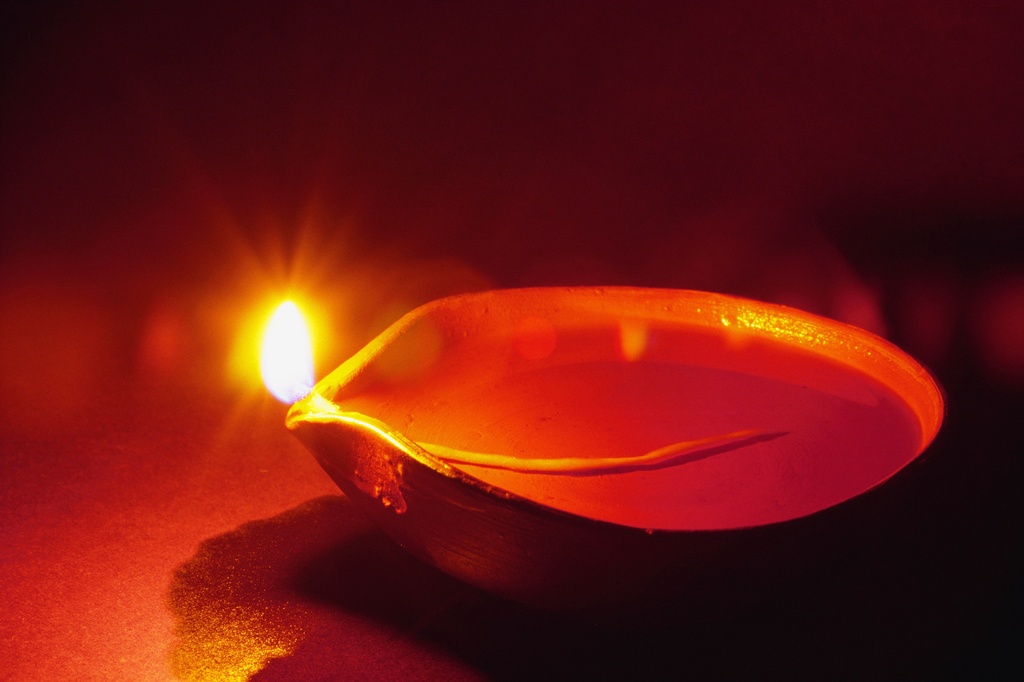
Stop for Air
Noon-1pm
December 19-21, 2011
Gandhi Reading Room
(Rush Rhees Library)
Open to all UR students, faculty and staff.
Stressed out by finals?
Try meditation!

The 2012 Season for Nonviolence steering committee includes:
- Art Peace
- Center for Dispute Settlement
- Center for Youth
- Central Library
- Colgate Rochester Crozer Divinity School Black Student Caucus
- Education for Peace
- Monroe County Health Department
- Mt. Olivet Baptist Church
- RIT
- Rochester Ad Council
- Rochester Center for Community Leadership
- Rochester Friends Meeting House
- Teen Empowerment
- The University of Rochester Women's Caucus
 

| |
MK Gandhi Institute for Nonviolence
211 Interfaith Chapel
Box 270501
Rochester, NY 14627
p. 585-276-4962
f. 585-276-0203
|
|
|
|

Dear Friends,
We are busy this month at the Gandhi Institute prepping for the annual celebration of the Season for Nonviolence, January 30-April 4.
We are thrilled to have the support of a major media campaign by the Ad Council for the Season this year, and the support of 15 local groups involved with planning the Season since last summer.
Highlights of the 2012 Rochester
Season for Nonviolence include:
*A partnership with Monroe County Health Department to distribute materials about nonviolence, conflict resolution and anger management to all of their home visit clientele;
*An initiative to train 100 Monroe County youth (suburban and urban) in the principles and skills of nonviolence;
* Outreach to incarcerated men and women in the local community and beyond;
*Community events such as a lecture by legendary civil rights leader Rev. James Lawson, a colleague of Dr. King's (Feb 3-4);
* The return of the Americans Who Tell the Truth art exhibit at Central Library (March 7-April 2).
We are looking for sponsors to cover the remaining direct costs for the campaign. Most of the funds have already been raised! If your faith community, school, workplace or agency wants to be involved, we invite you to learn more about the benefits. To start with, I encourage you to watch the video down below and request one of our sponsorship packets by clicking here: SNV Sponsorship
Help make this campaign a success in Rochester-because while conflict is inevitable, violence is not.
In peace and hope,
Kit Miller
Director,
MK Gandhi Institute for Nonviolence
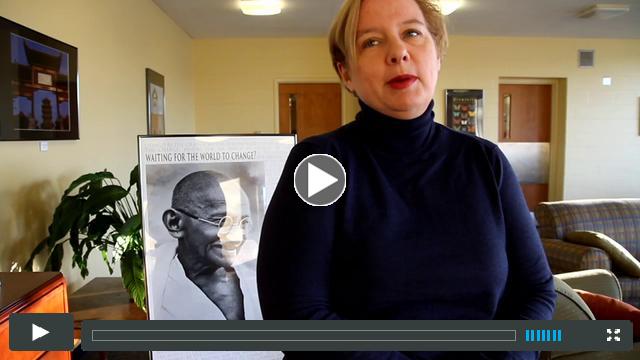 | | Season for Nonviolence |
This issue is dedicated to Tariq Aziz, a 16-year-old boy who wanted to draw attention to civilian deaths caused by U.S. drone strikes in Pakistan. On October 31, he and his 12-year-old cousin were themselves killed by a drone missile strike in the North Waziristan region on the Afghanistan border.
|
"I am part and parcel of the whole and cannot find Truth apart
from the rest of humankind." -MK Gandhi
|
| |
Gandhi Service Fellows
Class of 2011-12
Joseph Gardella
Hometown: San Diego, CA
College and Academic Pursuits: Joseph is a Kauffmann Entreprenurial Year (KEY) senior at the University of Rochester. He is currently studying Human Development and Psychology.
Nature of Gandhi Service Project: Joseph has selected three students from the University of Rochester to receive extensive training in nonviolence and ahimsa (the force of acting based on truth) principles, methodologies and applications in the classroom. Currently these students are working in an In- School Support (ISS) room at nearby Wilson Foundation Academy.

Anupa Gewali
Hometown: Las Vegas, Nevada
College and Academic Pursuits:
Anupa is a senior at the University of Rochester. She is pursuing her major in Health, Behavior and Society, and a minor in Journalism.
Nature of Gandhi Service Project: Along with Gandhi Fellow Lendsey Achudi, she is working with the refugee community in Rochester, understanding what they need and how the college student community can best work to understand the unique population of refugees in Rochester and use the resources college students have to empower one another.
|
Gandhi River Keepers
In Action!
| |
"I liked the River Keepers event because it brought to my attention how simple acts by individuals such as throwing candy wraps, plastic soda bottles, cigarette remains and plastic bags at the river bank could accumulate into amounts that endanger both the beauty and the life in the river." -Lendsey Achudi (UR Sophmore) 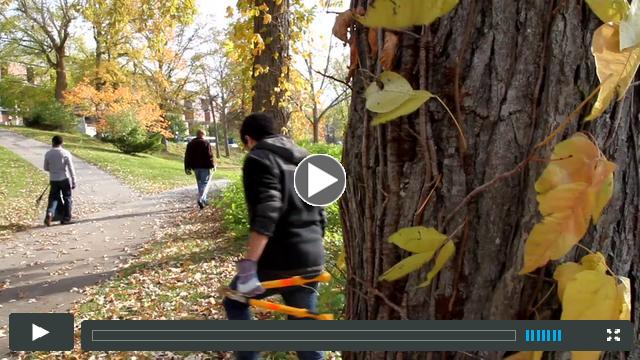 | | Gandhi River Keepers |
|
 2011 M.K. Gandhi Fall Intensive University of Rochester Interfaith Chapel Nov 10-12 Philosopher Robert Holmes speaking at the Fall Intensive 

Intensive facilitator David Sanchez |
|
. Some feedback from our participants: "The atmosphere was full of generosity and kindness. The topics and activities were interesting, and the food was delicious. The peace circle was an amazing experience because we could find the honesty in our histories. I also enjoyed the meditation and the session on mindful eating."
"I thought The Children's March was a wonderful film!"
"I was fortunate to be able to attend part of the Fall Intensive at the M.K. Gandhi Institute for Nonviolence, held at the University of Rochester. I experienced my time there as a bounty of learning and connection, and I was deeply inspired to meet many people who I would describe as calmly passionate about using nonviolence as a means to make the world a better place." " The lessons learned are invaluable.
I think about and tell people about the training daily." 
Participants from the Fall Intensive gather for a group photo* Special thanks to Anna- Kristina Pfeifer for contributing these photographs from the Fall Intensive. |
|
Interview with Professor Dena Swanson
| |
Dr. Dena Swanson is Associate Professor of Counseling & Human Development at the Warner School of Education.
Through her collaboration with Gandhi Fellow Joseph Gardella, University of Rochester students can now earn academic credit when they volunteer with the M.K. Gandhi Institute! Institute: We understand that you recently read Arun Gandhi's book Legacy of Love. Has this book influenced your understanding of nonviolent education? Swanson: In growing up in the south during the Civil Rights Era and living as an adult in cities struggling with mitigating violent crimes, I have witnessed the immediate and residual devastation of physical violence. The book, however, reminded me that not all violence is physically inflicted; some of the most damaging influences of violence on relationships and humanity result from passive violence that is cumulatively experienced. It also conveys a strong message that anger, in and of itself, is not the problem, but rather how we chose to direct the energy associated with it that influences the outcome. It was personally enlightening to reflect on nonviolence as more than behavior that is acceptable or proactive, but rather as a way of thinking and being that ultimately reflects how we interact with others to demonstrate acceptance, understanding, and respect. Institute: Speaking as a professor of adolescent development, what do you hope to achieve by working with the M.K. Gandhi Institute? Swanson: Research on adolescent identity development demonstrates that the strategies youth develop to deal with stress and conflict remain fairly consistent well into their young adulthood years. Reactive responses, such as acting out and hyper-masculine behaviors, provide protection against immediate threats, but often create problems, like school suspensions or incarceration, that undermine future options. Even emotionally withdrawing from situations may have short-term effectiveness, but can also contribute to disengagement from even supportive activities or depressed tendencies that, again, impact future options. It is my desire to provide effective alternatives for young adolescents that contribute to their repertoire of options for dealing with conflict. The focus on the word effective is to acknowledge that this is about more than just managing students' behaviors or facilitating emotional regulation- it's about helping students to identify and try options relevant to them that are also consistent with principles of nonviolence that have a longstanding history of effectiveness. Institute: What are some of your goals for the Nonviolence Education Program (NVEP) at Wilson Foundation Academy? Swanson: Given my research focus and work as a faculty member of the Warner School of Education where social justice is central to our research and student training, I believe the collaboration with the M.K. Gandhi Institute in providing the NVEP at Wilson Foundation Academy offers an opportunity to address several goals. The following are particularly significant to me: - To offer young adolescents an enhanced understanding of the types of violence that can be imposed on others, effective strategies for responding to them, and perspectives to mitigate inflicting them;
- To collaborate with teachers to identify effective approaches for establishing and encouraging nonviolence, particularly in addressing behavioral problems;
- To encourage a cultural shift that inspires creativity, reinforces nonviolence, and facilitates youth's engagement in their academic progress;
- To encourage and train young adolescent middle school students as co-facilitators of nonviolence education.
|
|
|
|
|



