 Celebrate Your Independence -with Pork! Celebrate Your Independence -with Pork!
Independence Day is the peak of summer grilling season and there is nothing better than the sounds and smells of pork sizzling on the grill.
Check out these featured recipes to make the most of your backyard gathering this July 4th.
All-American Pork Baby Back Ribs
If you don't have a favorite homemade sauce, "doctor" up purchased sauce with flavorful ingredients like chili powder,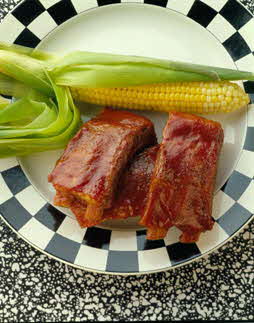 orange marmalade, grated ginger root or hot mustard. Serve these ribs with Grilled Corn on the Cob, Peppery Potato Salad, and finish with Caramel Frozen Yogurt Pie with Grilled Peaches. More... orange marmalade, grated ginger root or hot mustard. Serve these ribs with Grilled Corn on the Cob, Peppery Potato Salad, and finish with Caramel Frozen Yogurt Pie with Grilled Peaches. More...
Brats and beer are a great combination. Serve with potato salad and in seasoned fruit for your next get together.
More...
Honey Pork Tenderloin Kabobs
 Give your grill a new thrill with these spiked pork kabobs. Serve with favorite potato salad, grilled corn on the cob and cold melon for dessert. More... Give your grill a new thrill with these spiked pork kabobs. Serve with favorite potato salad, grilled corn on the cob and cold melon for dessert. More... |
|
Pork Industry Seeks Producer Input
Strategic Planning Session to be held in Clinton on July 27th
With a wide array of challenges facing pork producers today, the National Pork Board is seeking input from pork producers across the country for a new plan to shape the future of the U.S. pork industry. The objective of the planning process is to find new solutions to the economic, social, and scientific challenges facing the pork industry. To ensure the plan is focused on critical day-to-day needs of pork producers, a series of regional meetings is planned for July to get pork producer input from three distinct geographic areas of the country.
The meetings are open to all pork producers and to others with an interest in the future of the pork industry. The meeting will be from 10 A.M. to 3 P.M. on Monday, July 27 at Sampson Community College.
During 2010, the National Pork Board will celebrate the 25th anniversary of the creation of the national Pork  Checkoff. The strategic planning process is motivated in part by a desire to look at the role of the Pork Checkoff with fresh eyes, just as the pioneering producers who created the Checkoff did 25 years ago, said National Pork Board Chief Executive Chris Novak. Checkoff. The strategic planning process is motivated in part by a desire to look at the role of the Pork Checkoff with fresh eyes, just as the pioneering producers who created the Checkoff did 25 years ago, said National Pork Board Chief Executive Chris Novak.
The big questions, Novak said, are, "What are the industry's needs, concerns and priorities now, and what will they be five years from now and even 25 years from now? And what should the National Pork Board be doing to address these needs through the Pork Checkoff?"
At the regional meetings, producers will hear a brief overview of the National Pork Board, its role in the industry and its statutory obligations. There will be a progress report on the planning process to date. And then producers will have the opportunity to provide their own ideas and to discuss others' ideas. The best of those ideas will go to the task force of producer leaders who are working with the farmer-leaders of the National Pork Board to craft a new plan for the future. The board is expected to approve a new strategic plan by the end of 2009.
Producers unable to attend one of the regional meetings can still participate in several ways, Novak said. They can provide their ideas to their state office or to state leaders who will attend the meetings. They also will have the opportunity to participate in an online survey that will be available on Pork.org.
Lunch will be provided at the regional meetings. To assist with meal planning, anyone planning to attend one of the regional meetings is asked to call (toll-free) the Producer Service Center at the National Pork Board - 800-456-PORK before July 17, 2009. Customer service representatives will have details.
Here is a link to directions to Sampson Community College: http://www.sampsoncc.edu/DrivingDirections.asp
|
|
 N.C. farmers don't hog water, first statewide survey of agricultural water use shows N.C. farmers don't hog water, first statewide survey of agricultural water use shows
RALEIGH - North Carolina farmers use but a fraction of the water consumed in the state each day, according to the first-ever statewide survey of agricultural water use.
Among water users withdrawing at least 10,000 gallons a day, farmers accounted for about 1 percent of all withdrawals, the survey showed.
"Up until now, basic water use information for agriculture was limited in most areas of the state," said Agriculture Commissioner Steve Troxler. "Our survey found that farmers withdrew an extremely small portion of the water used in North Carolina on a daily basis. While farmers might be watering hogs - or cattle or crops - they aren't hogging the water."
The General Assembly last year passed a bill requiring the N.C. Department of Agriculture and Consumer Services to do an annual survey of agricultural water use. The department's Agricultural Statistics Division contacted 9,000 farms and received responses from 86 percent. From those responses, statisticians found 1,500 farms that used 10,000 gallons or more of water on at least one day during the year.
The department submitted the report to legislators Wednesday.
The report focused on water from surface sources, such as on-farm irrigation ponds, and ground sources, such as wells. The data collected by the NCDA&CS represent a variety of water uses on farms, including water for livestock, crop irrigation and aquaculture operations.
The survey showed that average daily withdrawals by farmers totaled 108 million gallons from surface waters and 41 million gallons from ground water. Combined, they accounted for about 1 percent of the more than 15 billion gallons of water used daily in North Carolina.
Heaviest usage occurred between May and September, which is peak growing season and the hottest time of year. July saw the highest water usage, with farmers collectively withdrawing an average of 365 million gallons per day. Water usage was lowest in January, when farmers collectively withdrew 34 million gallons per day on average.
The percentage of water used by farmers may be even smaller, Troxler said. That's because the N.C. Department of Environment and Natural Resources, which tracks non-agricultural water use, primarily records withdrawals of 100,000 or more gallons per day, whereas the NCDA&CS surveyed farmers using 10,000 gallons or more per day.
Survey information can be found here. |

The Other White Meat Tour Gives Back to Local Communities
Not only is The Other White MeatŪ Tour sharing the secret of the grill this summer, but America's pork producers are also giving back to local communities.
The most recent NC stop on the Other White Meat Tour was the Taste of Charlotte event on June 6-7.
At this event, the Other White Meat Tour donated a total of 530 lbs. of Pork Donated to the Second Harvest Food Bank of Metrolina!
| |
|

News from Washington Find out what's going on in Washington that affects the pork industry. Click here to keep up to date on NPPC's press releases. |
|
Didn't get a chance to voice your opinion at the public hearings on the EMC proposed monitoring rule?
There's still an opportunity to weigh in on the issue.
We encourage NCPC members to participate in the public comment period. Written comments can be submitted until July 15, 2009, to the following:
Keith Larick
Animal Feeding Operations Unit
Division of Water Quality
1636 Mail Service Center
Raleigh, NC 27699-1636
keith.larick@ncdenr.gov
(919) 715-0588 - Fax
Background:
In 2007, the Waterkeepers Alliance petitioned the NC Environmental Management Commission seeking the development of rules to assess alleged water quality impacts from animal feeding operations.
In 2008, the EMC approved the petitions and directed the Division of Water Quality, with input from various stakeholder groups, to develop rules to establish and implement a surface water monitoring program addressing the petitioners concerns.
The proposed rules define the process for establishing sampling locations at EACH subject animal operation. Specifically, the proposed rule would require farmers to collect up to three samples per year from three different sites. The samples are intended to determine the level of animal waste discharged into drains, ditches, and streams. Farmers would need to contract with outside commercial laboratories and it would cost livestock farmers about $2,200 annually to comply.
Now the rule-making process has moved to the public comment period. That process includes the opportunity for any citizen to comment by submitting remarks to the Division of Water Quality.
If you have any questions or concerns on this issue, please contact Tommy Stevens at NCPC: 919/781-0361 or tommy@ncpork.org.
| |


