| Notes From the Field | |
Linking Health to Conservation: Webinar Review
by Karishma Patel
On July 18, FRAMEweb members joined us for the webinar "Linking Conservation to Health" with Dr. Anila Jacob of USAID's Biodiversity and Forestry Office, and Janet Edmond, Director of Population Environment at Conservation International. Moderated by our very own Carmen Tedesco, the webinar raised the importance of conservation to health and revealed how linking the two sectors of health and natural resource management could be mutually beneficial for development.
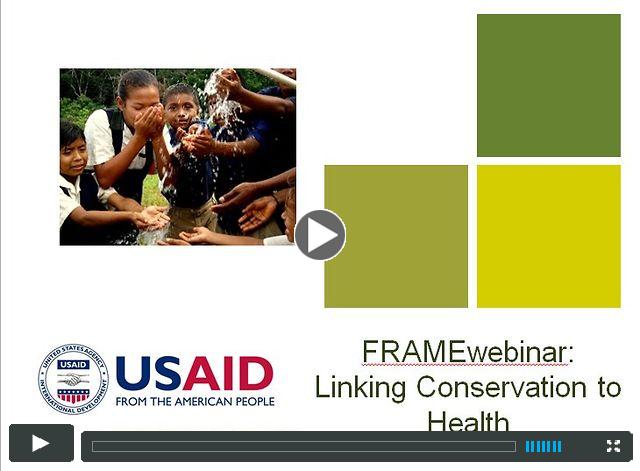 | | FRAMEwebinar: Linking Conservation to Health (2012-07-18) |
Dr. Jacob's presentation, entitled "Biodiversity, Human, Health, and Development," began with an overview of the current state of biodiversity in the world, pointing out that species extinction has accelerated recently at an alarming rate. Dr. Jacob made clear why conservation is important to the health sector and why it is a priority for USAID. Among the relationships she mapped out with case studies are: biodiversity conservation and infectious diseases with a special focus on malaria; food security and nutrition; resilience to natural disasters; drug development; and climate change.
Janet Edmond brought the discussion to the Water, Sanitation, and Hygiene (WASH) sector, illustrating the linkages between biodiversity conservation and a more specific health topic through experiences and case studies from sub-Saharan Africa. In her presentation she spoke about how USAID and NGOs are working together to not only tackle the issue but also "build the evidence for how projects that integrate freshwater ecosystem conservation and WASH interventions in sub-Saharan Africa (SSA) achieve simultaneous goals through holistic approaches." You can find the report to which she refers here.
Overall, both presenters' conclusions emphasized that research on the linkages need to continue and with greater integration and collaboration to be successful. As Dr. Jacob and Ms. Edmond have shown here, by promoting and sharing successes and lessons learned, experts of various specialties will be better able to build avenues for collaboration and bring best practices for health and conservation projects to scale.
|
Discussion Spotlight
|
Here are some of the issues FRAMEweb members are talking about:What alternatives are used instead of Methylbromide (as a pesticide in Africa)? I just read the post about phasing out of Methylbromide in Africa. I'm not familiar with this chemical, but I'm wondering why it has become such a common, subsidized pest-control, and what other options are out there that can be used instead.
Does anyone know of a serious effort to promote the use of insect protein as an alternative to bushmeat?
I know that entomophagy is in the buzz but what about serious activity for conservation and development? if you have program sites, in particular where insects are raised for protein, please let me know!! (This was a follow-up question to the webinar Linking Health and Conservation). Click here to respond.
Do you have a question or comment you want to post on FRAMEweb? Sign-in, click on a Community Topic or Partner Page and click on the ask button or icon:  
Need help? Send us an e-mail and we will walk you through it!
|
| Take A Look |
Expand your knowledge on health and conservation with these helpful resources . Interactions between HIV/AIDS and the environment : a review of the evidence and recommendations for next steps 
This Fauna and Flora International report looks at the implications
and applications of mobile phone technology on conservation and development initiatives in the developing world. It takes into account the integration between mobile phones and other Information and
Communication Technologies (ICTs), identifying ways in which mobile phones play a role in the digital divide debate. Having considered the policies of governments, donors, businesses and non-governmental organizations
(NGOs) towards mobile phones and other ICTs, the report details a number of case studies where they are being applied to development and conservation work. Click here to access the report. Health Matters: The Importance of the Interface between Wildlife, Domestic Animal, and Human Health for Conservation Success in Africa

HIV/AIDS and Natural Resource Management Linkages
The HIV/AIDS pandemic is having unprecedented and tragic impacts on all sectors of society in sub-Saharan Africa, causing untold human suffering, serious economic effects, and social disruption. It is also affecting the environment: there are very close linkages between HIV/AIDS, rural livelihoods, human capacity and conservation. The Africa Biodiversity COllaborative Group has put together a page with many resources on this topic.You can also check out the presentations from a symposium held in 2011 on the topic.
Click here to visit the site
Emerging Infectious Diseases in Africa: What Can the Conservation Community Do to Prepare? 
Emerging infectious diseases (EIDs) represent a significant strain on conservation initiatives, directly threatening wildlife and human health as well as the capacity to generate sustainable livelihoods, food security, and promote environmental conservation. The majority of EIDs are zoonotic, meaning they are transmissible from animals to humans, and are becoming more prevalent and increasing in impact due to a variety of factors. Examples of EIDs in Africa include Ebola, Monkeypox, Marburg, Avian Influenza, and HIV/AIDS. mpacts of these diseases pose a diverse set of challenges to the conservation community. In addition to the threat to wildlife and human health, EIDs can lead to loss of conservation capacity and funding. Economically, EIDs can be devastating on both the local and national level, especially for livestock-dependent populations. Ultimately, EIDs may create cycles of illness, malnutrition, and poverty, further impacting sustainable land use, natural resource management, and conservation initiatives. Members of the Africa Biodiversity Collaborative Group (ABCG) are actively addressing the threat of EIDs through targeted projects throughout the region. VIsit the page on FRAMEweb for many helpful resources!
Click here to visit the site.
Linking Biodiversity Conservation and Water, Sanitation, and Hygiene: Experiences from sub-Saharan Africa 
The paper, authored by David Bonnardeaux and commissioned by Conservation International (CI) in collaboration with ABCG members and development partners, is an evidence-based review of how implementers have integrated Water, Sanitation and Hygiene (WASH) a nd freshwater ecosystem conservation to date in sub-Saharan Africa (SSA). The report takes stock of a selection of experiences from projects taking a more holistic approach to conservation and development.
Click here to access the report
|
New on FRAMEweb
| |
To celebrate our members and our collective work in Natural Resource Management around the world, we hosted a photo contest on FRAMEweb last month. Members shared inspiring stories so we could showcase their work in pictures with the community. Here's the first place winner!
CPALI is a a Conservation through Poverty Alleviation program. Its goal is to develop wild silk production as a conservation enterprise that can be adapted to any developing country where individual income is less than $2, where governments are unstable and where the conservation approaches that are currently being applied by international conservation organizations are not working. Here, a team in Maroantsetra, Madagascar, shows off a raw textile sample in November, 2010 before it is made into a skirt designed by Tara St. James of StudyNewYork for the New York runway in February 2011 (Submitted by Catherine Craig, President, Conservation through Poverty Alleviation, International)
|
Experts on FRAMEweb
| 
Find a colleague who shares an interest in Heatlh and Conservation.
Log-in to FRAMEweb and click on the link below to find 86 experts on FRAMEweb related to health.
Health and Conservation Experts
Note: you won't see the results until you are logged in!
|
|
| Featured Member |
FRAMEgram features a member in the newsletter who has been exceptionally active!  This section will also give you a chance to learn more about other FRAMEweb members. This Edition's Featured Member is...  Ryan Nupen Ryan Nupen
I have a degree in Geological Engineering and have been working as an engineer for the USDA Forest Service for 10 years with the majority of my work taking place in Southern Alaska and Northern California. For the last 6 years my primary focus has been on sustainable low-volume road design, design and implementation of Aquatic Organism Passage (AOP) structures at road/stream crossings as well as stream, riparian, meadow and whole watershed restoration.
My interest in FRAME stems from the desire to learn and collaborate with the broadest spectrum of peers. The programs, policies and techniques used throughout the world are available to all participants in this format and it is wonderful resource tool for developing solutions to common problems.
* To see Ryan's profile, login at the prompt when you click her name.
|
|