|
|
|
Issue: 25 August 12th, 2012
|
|
Greetings from everyone at Beiers!
|
|
|
Dear ,
 THE SEASON IS WINDING DOWN! Shop our AWESOME deals on ALL Plants, Hanging Baskets, Containers, and Garden Art! We never know what day will be our last... SO STOP BY TODAY! THE SEASON IS WINDING DOWN! Shop our AWESOME deals on ALL Plants, Hanging Baskets, Containers, and Garden Art! We never know what day will be our last... SO STOP BY TODAY!
 End-Of-Season Hours: End-Of-Season Hours:
Weekdays 9AM-6PM
Weekends 9AM-5PM
|
|
(CLICK ON THE SECTION NAME TO GO TO THE SECTION!)
|
 |
|

The Itasca County fair is now only days away. Here are a few tips and tricks to help you exhibit your cut-flowers, houseplants and arrangements to their best advantage.
Cut-Flowers
"Spike" forms: If you are going to be exhibiting spike-form flowers such as Snapdragons or Gladiolus, cut them when the bottom florets are open and in perfect condition. The ideal choice has about one-third of the florets fully open, about one-third showing color as buds, and about one-third that are still green. Florets should be mostly present and in good condition, (not shriveled) none should have browned petal edges or have faded color. The spike should be straight to the tip, and the stem should be sturdy. Use a wedging device such as foam, plastic wrap or waxed paper to help keep the bloom straight in the container.
"Round" forms: Examples are Dahlia, Marigold or Zinnia. Cut when fully developed as indicated by the outer petals folding out gracefully. Center petals are tighter than the outer petals, but not an immature green. Avoid exhibiting over-mature flowers where the pollen is heavily developed or the petals have begun to shrivel, fade or curl. If showing Marigolds, the blooms should be in different stages of development (fully open, showing color, tight bud.)
"Spray" forms: Examples are Lily, shrub Rose, Petunias or decorative-type Chrysanthemum. A spray is a single, main stem with blooms on side branches. Judges look at the number of buds, the branching and vigor of the spray as well as the quality of individual flowers. Lilies should be exhibited with as many open flowers as possible, cut the petals should be clean and in good condition with stamens removed from the open flowers. When the premium list call for a spray of Petunias, select a spray that has blooms in various stages of development (fully open, showing color, tight bud.) Again, follow the instructions in the premium listing as to number of blooms, sprays, etc. are allowed.
Houseplants
All potted plants should be free of insects and diseases. Flowering plants are judged for their display of flowers but not show obvious foliage damage. Foliage plants are judged on the quality and appearance of leaves and stems. Colors should be bright and typical of the cultivar. Plant shape should be symmetrical. A one-sided plant indicates that it has not been rotated regularly. The pot should be clean and in proportion to plant size. The color, texture and style of the pot should complement the plant, not detract from it. Plants must be grown by the exhibitor a minimum of 3 months. Include a label with common and scientific name if known.
Arrangements
The Judge is looking for the arrangement to be "pleasing to the eye." Color, space, texture, and shape are important. Use high quality plant materials in good condition. Plant materials should be in proportion to each other and to the container. A general rule of thumb is the plant material should be approximately 11/2 times the height of the container, except in low-bowl designs, and in good proportion to each other and the container. Store-bought plant materials are permitted according to the premium list for that class.
Best of luck to all Exhibitors at this year's fair. Your hard work and eye for details will surely have you bringing home many blue, red or white ribbons!
Submitted by Vicky Fall, Itasca County Master Gardener
Beier's Greenhouse Would Love to give a big thank you to Vicky Fall For Submitting these wonderful articles on how to prepare your flowers for success in the fair! Thank You!
|
|
   
Blogger * Facebook * Pinterest * Email US!
*Email: beiersgreenhouse@hotmail.com
|
We Love Our Customers and Would Love To Share All Of Your Wonderful Feedback!
Send Us Your Thoughts to beiersgreenhouse@hotmail.com PEO Members- Nancy O'Toole Dear Bonnie & Staff, Thank you so much for all of your help with our "Picnic at tyhe Greenhouse" event. We loved having lunch amoung the flowers. They just make people feel happy! ... Thanks to your generosity, we raised almost the full amount of the scholarship for a Grand Rapids High School Girl ($400). The Itasca County Master Gardeners Dear Bonnie & Blake, Thank you for your generous donation of pansies to our plant sale. Much Appreciated! Itasca Hospice- Stephanie Stevens Kootasca Community Action Thank You for your donation of vegetables to our Men's House Program. They will Be learning how to plant and care for a garden. ... Thanks Again. |
 The Perennial Landscape The Perennial Landscape |
|
This Weeks Perennials Are...
Here's a quick overview of fall-blooming perennials that are hardy in our Northern Minnesota zone.
Plan now for fall color!
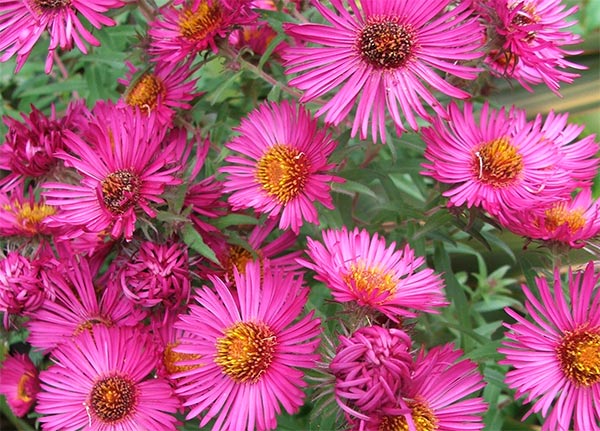 Aster (Michaelmas Daisy) Aster (Michaelmas Daisy)
Asters are the respected standby for all fall-blooming gardens. They are most familiar in purple shades but also bloom white, pink, and blue. Their fine-petaled flowers are between half an inch and two inches across. Asters begin to bloom in August and continue until frost. Pinch the tops in early summer to promote bushy growth and dozens of flowers. Asters like to creep through the perennial garden but they blend nicely with other flowers.
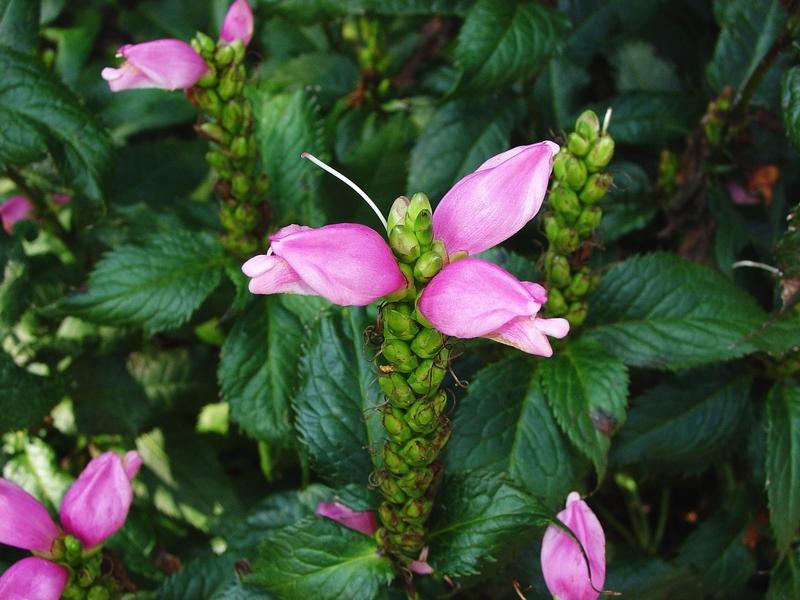 Chelone (Turtlehead) Chelone (Turtlehead)
The chelone is a joy in the perennial garden. It stays put without invading its neighbors, grows in a dense mound, and blooms red, pink, or white. The flowers are indeed shaped like turtle heads and the fine leaves look great before blooming sets in. Partial shade is OK for chelone, and protect from excessive heat if planted in full sun. Keep well watered. Divide chelone every three years in the spring.
 Chrysanthemum Chrysanthemum
Choose hardy mums for the perennial garden. In Northern Minnesota, many mums are grown as annuals. Transplant as early as possible so they have time to establish good root systems. Mums bloom in almost every color, can be tall or short, and generally keep to themselves without spreading. It's very important to mulch hardy mums heavily after first frost to protect them from our harsh winters. Water well, give them full sun, and they'll be reliable fall bloomers for many years.
 Eupatorium (Joe Pye Weed) Eupatorium (Joe Pye Weed)
Eupatorium is a native plant that does extremely well in northern perennial gardens. They tend to grow tall so plant at the back of the bed to provide structure. The plants have a dense appearance with typically purple flowers and look nice all summer before blooming really gets going. Joe Pye Weed is an adaptable plant that doesn't mind being a little dry or growing in poorer soils. It's absolutely perfect in cottage-style gardens. Formal-style gardeners may not like its weedy appearance.
 Heliopsis (False Sunflower) Heliopsis (False Sunflower)
Heliopsis blooms small, happy yellow flowers. It begins a little earlier than most fall-blooming perennials and continues for weeks until first frost. Plant in masses for best effect (three or more plants in a group).
False Sunflower stems tend to be fine and somewhat fragile, so grow this plant in a perennial cage to help it stand up. If you like, allow the plants to trail on the ground. Some varieties are lower-growing on sturdier stems so they flop less.
 Sedum (Stonecrop) Sedum (Stonecrop)
Sedums are awesome. Their foliage is deeply colored from lemon yellow to deep green and they bloom profusions of flowers later in the season. The Autumn Joy variety is perhaps the finest example of the sedum.
These plants tend to spread slowly through the garden and require minimal attention. Water occasionally if there's been a dry spell, but otherwise you can leave sedums alone and they'll thrive. They look best when interplanted with each other so foliage and flower colors can contrast.
|
|
|
|
|
Gazing Balls!
Add Some POP to Your Garden With a Gazing Ball!

History of the Globe
Its history, as colorful as the ball itself, had its roots in the 13th century when it was made in Venice, Italy by skilled craftsmen. It was hand-blown then just as it is still done today. Antonio Nier, a fifteenth century priest, called it a Sphere of Light and, as time passed, the colorful ball became a permanent fixture in the European garden and home. King Ludwig II, King of Bavaria during the 1800's, adorned his palace, a replica of Versailles, with the globe.
Legend of the Globe
Legends formed about the mysterious powers of the ball. A globe was said to bring happiness, good luck and prosperity to those who owned it. The globe was known to ward off evil spirits, misfortune, illness and, of all things, witches!
The ball is purposed to keep witches away but the methods vary from story to story. Some say the ball should be placed near the entrance to the house so that if a witch came to your house she would not be able to get past her reflection as she cannot tear herself away from her own image. There are other accounts that say a witch cannot bear to see her own reflection so she will not come near a "witch's ball". A witch cannot sneak up on a person gazing into a globe as he can see if a witch approaches from behind. The smaller ball made of colored glass as opposed to the reflective kind was believed to attract and trap evil spirits.
Spiritually speaking, as one peers into the globe he can experience "oneness" with the universe, a basic existentialistic view.
Purpose of the Globe
The gazing globe had practical purposes in a southern antebellum garden. Placed strategically by the path from the front gate, southerners could see from the veranda who was calling before the caller could see them, allowing plenty of time to prepare refreshments for their guest or to hide - whichever was fitting. In Victorian times, the "Butler Ball" served as a mirror for servants to see when guests were needing assistance without staring at them throughout the meal. Another practical use was in the foyer of the home. Parents could keep a close eye on their daughter and her date as he bid her goodnight.
Care of Your Globe
Quality globes, such as the ones we carry, will last for many years with proper treatment. The most important thing to remember is the seal at the neck of the ball should never be loosened or removed. The color of the ball is on the inside of the glass. If moisture were to ever get into the globe the reflective color would peel off. Gazing globes should be taken inside during winter to keep them from freezing and cracking. Although rain does not harm the ball in any way, a violent storm may send tree limbs flying and crack the glass.
Displaying Your Globe
The gazing globe today is used as an enhancement to the flower garden. The reflective orb allows the whole garden, including the sky, to be viewed with one glance. A single large globe sitting on a stone pedestal adds elegance to your garden while a wrought iron holder gives strength. A grouping of different colored balls set at different heights peeking out from between shrubs gives a playful appearance. Your only limitation is your imagination when displaying the colorful gazing globe.
From Premier Edition of What's Up, Doc?, September, 1998
DON'T MISS OUR EXCLUSIVE GAZING BALL COUPON FOR OUR LOYAL EMAIL SUBSCRIBERS AT THE BOTTOM OF THIS EMAIL!
|
|
The Next Generation of Beier's Mom and Grandma With Karsten on His Dedication Day!

PRECIOUS MEMORIES... |
| Let Us Know What YOU Think |
We value our customers' opinions -
we want to know what YOU think!
What do you like to read about in our emails?
Articles? Recipes? Upcoming Events? New plants/products?
EMAIL us at beiersgreenhouse@beiersgreenhouse.com and let us know what you think about our emails - we want you to have some great information and tips about all the happenings at Beier's Greenhouse! Help us out - email us now! |
Thank you for your time! We appreciate our customers so much.
Feel free to email any time, for any reason!
Bonnie, Blake and the whole Beier's Greenhouse team
VISIT OUR WEBSITE! www.beiersgreenhouse.com |
|
|
|
|
35% OFF
Gazing Balls!
|
Coupon Only Valid
August 12th- August 19th Must Have Coupon Present at Time of Purchase!
Limit 1 Coupon Per Customer! Some Exclusions May Apply!
| Name:____________________ Date Redeemed:________
Offer Expires: August 19th, 2012 |
|
|
|




