| PVC & cholorine: Water treatment the Nicaraguan way | |
 Officials in the Matagalpa health ministry in Nicaragua convened late last year to announce that infant deaths to gastrointestinal disease had dropped to zero, down from six in 2010. The news coincides with a surging public water chlorination program. In the agrarian villages in the region's temperate mountains, community leaders have installed handmade chlorinators in the town water supply. Working with international volunteers and non-profits, dozens of villages have formed water committees to build, install and maintain the devices. Read on. Officials in the Matagalpa health ministry in Nicaragua convened late last year to announce that infant deaths to gastrointestinal disease had dropped to zero, down from six in 2010. The news coincides with a surging public water chlorination program. In the agrarian villages in the region's temperate mountains, community leaders have installed handmade chlorinators in the town water supply. Working with international volunteers and non-profits, dozens of villages have formed water committees to build, install and maintain the devices. Read on.
|
| Ten low-cost ways to treat water | |
 Having money helps, but clean water doesn't have to be expensive. Until everyone has easy access to clean drinking water from a tap, there are other, cheaper clean water solutions. Having money helps, but clean water doesn't have to be expensive. Until everyone has easy access to clean drinking water from a tap, there are other, cheaper clean water solutions.
We've rounded up ten low-cost ways to treat water, and not one requires boiling. Do you know of other methods? Please let us know in a comment below. Read on. |
| Five questions with Jim Hallock | |

Jim Hallock is America's spokesman for earthen construction. He crafts beautiful and beautifully low-cost buildings with compressed-earth blocks, and teaches the art to students at his facilities in
Texas and Mexico.
Earthen construction may have no better spokesperson in America: Hallock is passionate about sustainable building and passionate about talking. He has encyclopedic knowledge of soils, clays, stabilizers, block-making machines and the other elements of his trade, and he has a vision of a shining future of cities made of earth.
We asked him five questions. Read on
. |
| Meet Kelly Lin, E4C's Member of the Month |
 | | Kelly Lin, right, asked that we post this group photo of the UCSB sorghum press team to demonstrate engineers come in all sizes. |
Sorghum is a hardy, drought-resistant cereal crop that, when pressed and boiled, makes a sweet syrup that is nutritious and sought-after in countries such as Mali. Pressing sorghum, though, is difficult. To help, Kelly Lin and a team of fellow students at the University of California, Santa Barbara, are developing a press. The prototype of their human-powered device crushes the crop between rollers cranked with a long 4in by 4in board. Lin posted the device as an E4C workspace and invites interaction.
Lin is an active member of UCSB's Engineers Without Borders-USA chapter and he's also teaching himself Japanese, "partly because they have cool robots," he says. For his work to solve problems on farms in Mali, and for his love of Japanese robotics, we are proud to feature Kelly Lin as our Member of the Month.
E4C: Can you tell us more about the press?
KL: The mission of the EWB-UCSB Sorghum Press Team is to improve the nutrition and incomes of farmers in Dissan, Mali and similar communities with a human-powered, low-cost and locally-manufactured design. The press needs to be human powered since it is the most reliable source of energy in the Dissan community. It needs to be inexpensive, reliable, and manufacturable in Mali so that it can be economically sustainable and doesn't rely on financial aid from outside organizations.
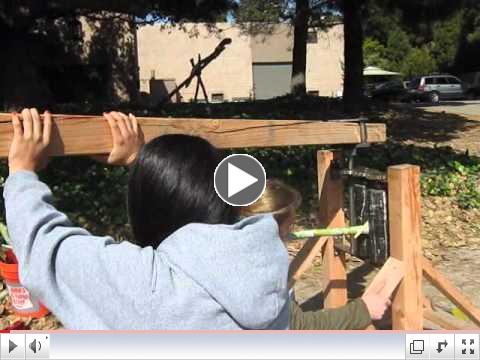 E4C: How does it work? E4C: How does it work?
KL: There is a lever arm which the user pushes in a circle. The lever arm drives gears that which drives two rollers. Another user feeds the sorghum stock in between the rollers. Then the roller squeezes the juice out of the sorghum and the juice drops down into a bucket.
E4C: What have been the results of prototype tests so far?
KL: We have spent six months designing and building a prototype with three gears made in Mali. We were able to achieve a through-put rate of 10 inches of sugarcane stock per second. We used sugar cane for the test because sweet sorghum is not in season and sugar cane is stronger than sorghum.
E4C: What do you have left to do?
KL: In terms of the scope of my project, we need to improve the design by making the rollers adjustable, optimize the rollers to be the right size, lower the cost by simplifying the design, do an fatigue test, and make manufacturing and operation illustrations. After we are done, people will have free access to our design as well as all of our prototyping, testing, modeling, and analysis information.
E4C: So, how did you hear about E4C?
KL: I heard about E4C through a TED talk on ted.com.
Thank you for all your recognition. However, the sorghum press project is a team project and would not have come this far without my excellent teammates: Hunter, Erika, Adam, and Marcela, who have worked just as hard if not harder than I have. I would also like to thank the following people: Prof. Laguette for running the UCSB ME senior projects. Advisor Mr. Bothman for starting this project and for advising us on technical issues. Prof. Lacy for advising us on everything relating to Mali and for taking our gear design to Mali and having it made by the local machinist. |
|
About Us | |
E4C is a dynamic and growing community of engineers, technologists, social scientists, NGOs, local governments and community advocates whose mission is to improve quality of life in communities around the world by facilitating the development of affordable, locally appropriate and sustainable solutions to the most pressing humanitarian challenges. Read more about us.
E4C is founded by:
   |
|
|
|
|
|
E4C/Webinar | |
How ICT business models are reducing poverty
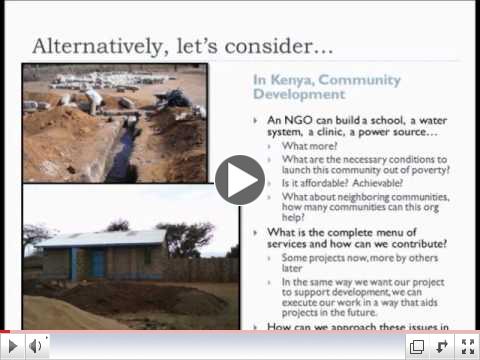
The long-term success of infrastructure projects in developing countries depends on how they are delivered. Matt Sisul, lead structural engineer at YCF Group in Port-au-Prince, Haiti, shares lessons from his experience in carrying out projects that have a lasting impact.
This is the latest presentation in our Humanitarian Technology Webinar series.
|
|
E4C/Prototypes | | A modular irrigation pump that grows with the farm

An experimental water pump starts small and builds up with modular upgrades. Small-plot farmers can pay for more irrigating power as their farms grow and they earn money from their investment.
"We need to create something that's initially inexpensive. As it's used, the view of what's affordable changes," says Patrick Lewis, who is developing the pump at Brigham Young University in Provo, Utah.
Read on. |
|
E4C/How-to | |
How to build a household aquaponic system

You can turn a small yard, a corner in a community garden or an unused space in your home into a thriving vertical farm for vegetables and fish. A household-sized vertical aquaponic system can fit into a 3ft by 5ft (1m x 2m) area and feed a family year-round.
Sean Brady, the aquaponics projects coordinator at the Center for Sustainable Aquaponics in Denver showed us how to build a system from scrap he found around his greenhouse.
Read on. |
|
Event Calendar | |
NCIIA Open 2012
March 22-24
San Francisco, Calif. USA
*
Engineers Without Borders-USA annual conference
March 22-24
Las Vegas, Nev. USA
*
SWE Mid-Atlantic Conference
March 30-April 1
New York City, New York
*
National Sustainable Design Expo
April 21-23
Washington, DC, USA
*
Sustainatopia
April 19-25
Miami, Flor. USA |
For the latest information and meaningful Engineering for Change news and community updates please

|
|
|



