|
THE MONTHLY CAUCUS
The Episcopal Women's Caucus:
Advocating for women since 1971, theologically, spiritually and politically.
MAY 2011 |
|
|
In this issue: Resources for women interested in circle leadership - from articles to videos.
Please Note: The EWC is planning to have a daily prayerful presence at our General Convention Booth. We are looking for a few good women who will help to write a short 10 minute prayer service for noonday, using expansive/inclusive language. These prayer services will be collected together in a booklet we hope to distribute. If you are interested, please contact Elizabeth Kaeton: motherkaeton@gmail.com If you will be at General Convention - lay or clergy deputy, bishop or visitor - and would like to take part in leading a prayer service, please also contact Elizabeth Kaeton.
Also - we are interested in what kind of leadership conferences or what issues are of interest to you. We would love it if you would copy the sentence below, answer the question and email to gigipriest@prodigy.net
Imagine that you have registered for a women's conference/ retreat. Upon registration, you receive a schedule for the event. As you imagine this schedule in your mind, please list below all the experiences that would fully meet your spiritual and physical needs.
The Episcopal Women's Caucus strives to offer views from different women, lay or ordained, throughout the Church and to hold up celebrations, events, achievements, or struggles that involve women. If you are interested in contributing - whether through an article you have written or a newsworthy item - please contact either Karen Bota, the editor of RUACH KDBota@aol.com or Gigi Conner, The Monthly Caucus gigipriest@prodigy.net
The Episcopal Women's Caucus is on Facebook and we have a website website: www.episcopalwomenscaucus.org.
Please feel free to pass along articles to friends or forward this email ... and let us hear from you. And if you are a member and would like to "re-up" your membership, please do so by filling out the coupon at the bottom of the page. If you are new to the Caucus and would like to be a member, please use the same form.
|
|
Running in Circles 
by Elizabeth Kaeton (for full text of this article go to Elizabeth's Blog)
For the past three years, The Episcopal Women's Caucus has embraced a new way of leadership. We call it "Circle Leadership".It's a new way of imagining religious organizations, but it's hardly a new idea. Some religious orders of women in The Episcopal Church, like the Community of the Holy Spirit and the Order of St. Helena have been modeling themselves like this for over a decade. There are not many books or resources describing how this concept works out, practically and pragmatically. The closest one comes to this is to look at the work of "Circle Connections". Circle Leadership, at least as I understand it, looks more like an image of people holding hands, circled around the globe.
People are connected, each to the other, in mutual concern for "Mother Earth" and her children and creatures and creation. They share a common vision and a common goal, but each works it out in her own location, coming together in smaller circle as often as possible for mutual support, encouragement, inspiration, participation and assistance. Circle Leadership is more organic to women. We have always come together in a circle of some sort - around the fire, gathering at the village well, in corn and wheat and cotton fields and rice paddies, in our homes around the kitchen table and with our families.
We have been pressured to function in our circles under the assumption of a predominantly hierarchical model of structures and leadership. It is a 'top-down' model that is still the structure found in most schools, churches, organizations, corporations, businesses and in traditional families. In the hierarchical model there is a top, a middle and bottom. The top is the CEO (bishop), president, principle, director and in traditional families father. The top knows best and tells others what to do. There is a middle. This is the manager (priest), supervisor, teacher chairperson and in traditional families mother. The middle conveys the decisions and messages from the top to the bottom. They make sure those on the bottom do what they are told. And, there is a bottom. They are the workers (deacon), members (laity), students (seminarians), and in traditional families children.
According to Circle Connections, The Circle Model . . . is a more collaborative model that has room for an emergent design. It is an egalitarian way of being with one another where everyone works together and is honored for their gifts. The power, the resources, the decision-making, and the work all are shared. This ensures full participation, personal growth and unlimited creativity.
It seems to me that Jesus practiced Circle Leadership. Here's but one example: When there was a gathering of thousands (four? five?) of people who had come to hear Jesus, his disciples wanted to send them away. "We don't have enough to feed everyone," they lamented. (Matthew 14:13-21) Jesus said, "What do you have? Go and see?" (Mark 6:32-44) Educator, author and Quaker, Parker Palmer, maintains that this was the first recorded community organizing event in history. It's not that there wasn't enough food for everyone to eat. It's that, once Jesus got everyone seated in small circles (Luke 9:10-17), they began to see what they might have to share with each other. This is the only miracle story reported in all four gospels (see also John 6:5-6:15), and all four evangelists tell us that, not only did everyone eat, but that there were baskets of bread and fish left over. That's what Circle Leadership can do.
It has been said that every revolution begins in a circle of people conspiring - con/spiring = breathing together. I'm hoping that this little essay will begin to start a wider conversation in small, revolutionary groups, about the way women lead and the gift and challenges this new style brings to our church.
|
|
STARTING A 'CIRCLE' GROUP 
by Gigi Conner (currently the Vicar of a parish in Woodstock, New York)
In the mid-90's I was an assistant clergy at St. Michael's on the Upper West Side of New York. I invited the women of the parish to meet and discuss the first four chapters of Dr. Christian Northrup's book, Women's Wisdom, Women's Bodies. Aobut 15 women showed up, a wonderfully diverse group of women. I would present some questions from the readings but the women really took off with the conversation which was lively, revealing, and energizing because there was a great collective of wisdom in the room. After the third week the women said, "We want to keep on meeting every week." I said, "Great- the group should have a name. What do you want to call yourselves?" (this is from the Liberation Theology class at seminary). They said, "The Sisters of the Circle".
The sisters met weekly with a shared leadership. Each session would begin with prayer. Then we would go around the room with each woman saying her name and checking in. This allowed anyone who was new to quickly be included. A circle image is great because it expands or contracts, depending on who is there, so it always feels complete. The women took turns presenting the topic of the evening. We always ended with prayer.
The same thing happened when I moved to St. Petersburg, Florida. In 2000 we began with the same book, the same four chapters, and after the third chapter the women said, "We want to keep on meeting." It was quite an experience to sit with women who said to each other, "I've seen you in church lo these past 20 years but I never knew you." Some of the oldest women had more to say about what their mothers didn't teach them about life than the younger ones. There is a lot of freedom in finding out that other women have had similar experiences or dreams or challenges in life. We are not alone and we are not silenced. Much of the work done in the church today around the issues of child molestation or misconduct came about because women started talking to each other.
When women meet in a circle it is counter to the social order - that which says there is superior to inferior, or those who are more 'in' than others. Each woman has a physical position that is equal to every other woman in the circle, each takes her turn to speak and the circle turns to hear her speak and she is heard. The boundary of the circle is trust and the ability to keep what is said in confidence, confident.
Eleven years later the groups in St. Petersburg and New york are still meeting. Friendships have been formed. Every topic you can think of has been discussed. Hard issues, like human trafficking, modern slavery, and job parity have been thrashed out and disentangled. We women need support each other. None of us can ever be fully, spiritually, healthy women if we do not or will not give support to each other.
Here are some 'ground rules' to promote start a group and to promote good group discussion. First, begin with a non-threatening but compelling topic...like what is the meaning of circle leadership. If the first gathering is about Human Trafficking (which is extremely rampant in our country today) the work will not have been done to build up trust within the group for honest discussion. So start with a milder topic. Lay out some norms or ground rules for discussion - (see below) and then the group can develop its own norms. Plan on who will lead the first two or three sessions and then move into sharing the leadership. Collect ideas from the group as to what they would like to discuss. Don't shy away from hard topics - and don't assume that everyone already knows about liberation theology, feminist theology, or the status of women in the world today. Do provide resources for the group so women can be looking beyond what the group provides. Invite women who have expertise in certain areas to come speak to the group. If possible - for the purpose of a discussion group - keep the presenters to women...the discussion will be richer and more honest.
If you begin a group you may want to lead up to a viewing and discussion of 'Pray the Devil Back to Hell' which is about the efforts of Christian and Muslim women working together to bring peace to Liberia. PBS will offer a series about Women, War and Peace in October. And informed group always has deeper conversations which many times lead to action against injustice. See the article below about the series and the documentary.
A SAMPLE OF 'GROUP NORMS' for DISCUSSION
1. We want to create and maintain an atmosphere for rigorous intellectual analysis and dialogue
2. We will speak in the first person singular.
3. We each have an obligation to actively combat stereotypes so that we can break down the walls which prohibit envisioning the well- being of us all.
4. We will assume that people are always doing the best they can.
5. We cannot be blamed for the misinformation we have learned, but we will be held responsible for repeating misinformation after we have learned otherwise.
6. We will share information about our own racial, gender, social strata groups with other members, and we will not demean, devalue, or in any way "put down" people for their experiences.
7. At times, members may wish to make a comment that they do not want repeated outside of the room. If so, the person will preface her remarks with a request and the group will agree not to repeat the remarks.
|
|
WOMEN, WAR & PEACE - PBS SERIES IN OCTOBER
In October 2011, PBS will premiere Women, War & Peace. This groundbreaking five-part primetime special series will reframe our understanding of modern warfare through deeply moving human stories about women in the midst of conflict, peacemaking, and post-conflict rebuilding in Colombia, Bosnia, Afghanistan and Liberia. (Tuesday nights at 10PM October 11, 18, 25, Nov. 1, and 9 on PBS)
About the Issue: Women have become primary targets in today's armed conflicts and are suffering unprecedented casualties. Simultaneously, they are emerging as necessary partners in brokering lasting peace and as leaders in forging new international laws governing conflict. Yet the image of war portrayed by the media covers very little of either end of this spectrum- until now. Discussions about the multiplicity of women's roles in wawr and peace are udnerway in boardrooms, conference halls, and on the floor of the U.N., but the media has lagged behind, offering images of women in conflict situations that are rarely nuanced and portraying them solely as collateral damage - when they are seen as "a story" at all.
About the Series: THIRTEEN and Fork Films are producing a bold new mini-series Women, War & Peace to challenge the conventional wisdom that war and peace are men's domain and to place women at the center of an urgent dialogue about conflict and security.
Women, War & Peace will present its groundbreaking message across the globe using all forms of media, including U.S. and international primetime television, radio, print, and web. PBS is proud to be the first to bring this conversation to primetime national television. Planned for broadcast in early 2011, Women, War & Peace will be the most comprehensive global media initiative ever mounted on the roles of women in war and peace
Women, War & Peace is spearheaded by Executive Producers Abigail E. Disney, Pamela Hogan, and Gini Reticker. The 5-part series will include the U.S. television premiere of Reticker and Disney's previous collaboration, the acclaimed Pray the Devil Back to Hell, about the role women played in bringing peace to Liberia after 14 years of civil war. The film won the Best Documentary Prize at the 2008 Tribeca Film Festival and the Silverdocs Witness Award, among others, and was the first film to be shown at The World Economic Forum at Davos. Hogan and Reticker won an Emmy for their previous collaboration, WIDE ANGLE's Ladies First, about the leadership role of Rwandan women 10 years after the genocide.
|
|
Women and Peace: Pray the Devil Back to Hell
Pray the Devil Back to Hell extraordinary story of a small band of Liberian women who came together in the midst of a bloody civil war, took on the violent warlords and corrupt Charles Taylor regime, and won a long-awaited peace for their shattered country in 2003.
As the rebel noose tightened upon Monrovia, and peace talks faced collapse, the women of Liberia - Christian and Muslims united - formed a thin but unshakable white line between the opposing forces, and successfully demanded an end to the fighting- armed only with white T-shirts and the courage of their convictions.
In one remarkable scene, the women barricaded the site of stalled peace talks in Ghana, and announced they would not move until a deal was done. Faced with eviction, they invoked the most powerful weapon in their arsenal - threatening to remove their clothes. It worked.
Their demonstrations culminated in the exile of Charles Taylor and the election of Ellen Johnson Sirleaf, Africa's first female head of state, and marked the vanguard of a new wave of women taking control of their political destiny around the world. This remarkable chapter of world history was on its way to being lost forever. The Liberian war and peace movement were largely ignored as the international press focused on Iraq. Moreover, the women's own modesty helped obscure this great accomplishment.
Pray the Devil Back to Hell reconstructs the moment through interviews, archival footage and striking images of contemporary Liberia. It is compelling testimony to the potential of women worldwide to alter the history of nations. The women of Liberia are living proof that moral courage and non-violent resistance can succeed, even where the best efforts of traditional diplomacy have failed.
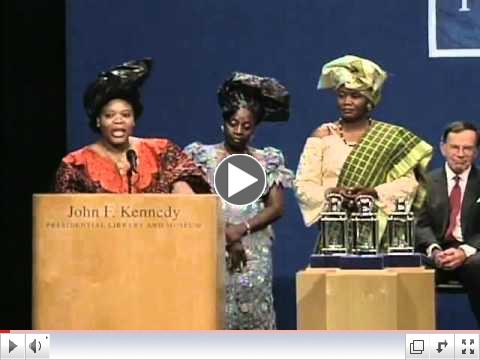 | | Leymah Gbowee's acceptance speech at the JFK Profile in Courage Award® ceremony, May 18, 2009 |
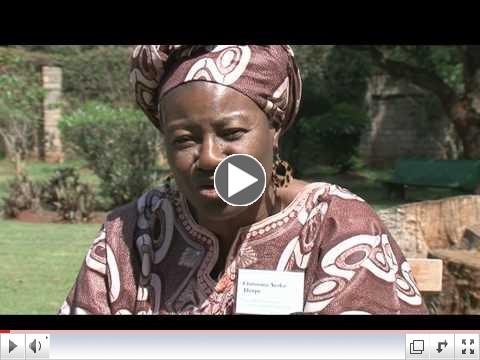 | | Women In Peacemaking |
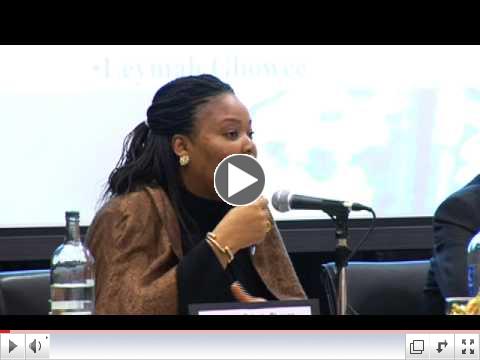 | | Leymah Gbowee |
 | | PRAY THE DEVIL BACK TO HELL - trailer |
This documentary can be purchased from Amazon.com and below is the web site for a study guide.
Study Guide for Pray the Devil Back to Hell
|
|
The International Center for Research on Women
http://www.icrw.org
The International Center for Research on Women (ICRW) is a global research institute with headquarters in Washington, D.C., and regional offices in Nairobi, Kenya, and New Delhi, India. We also have a project office in Mumbai. ICRW is comprised of social scientists, economists, public health specialists and demographers, all of whom are experts in gender relations. We are thought leaders driven by a passion to alleviate poverty and rectify injustice in the world. And we believe that women and girls - in collaboration with men and boys - are essential to the solutions. We know that when their quality of life improves, families are healthier and economies are stronger.
ICRW's mission is to empower women, advance gender equality and fight poverty in the developing world. To accomplish this, ICRW works with partners to conduct empirical research, build capacity and advocate for evidence-based, practical ways to change policies and programs
ICRW kicked off its 35th anniversary celebration on March 8, International Women's Day, with "Game-changing Innovations for Women." Part I featured ICRW President Sarah Degnan Kambou and the Champions for Change award presentation to Gap Inc. for its innovative factory-based education program for female garment workers. Part II featured the evening's discussion, moderated by NBC News Chief Foreign Affairs Correspondent Andrea Mitchell. The panel included USAID Administrator Rajiv Shah; Cherie Blair, former British first lady and founder of the Cherie Blair Foundation for Women; Tim Hanstad, president and CEO of Landesa; and Bobbi Silten, chief foundation officer for Gap Inc. This event launched Passports to Progress, a year-long series to discuss critical issues likely to shape the lives of women and girls in developing countries in the coming years.
Other programs include:
|
|
|
|
|
|
|
|
|
The Caucus Board: Who we are in our 'real lives.'
Karen Bota who is the editor of RUACH, our quarterly publication is also
director of the Leaven Center in Lyons, MI, where they offer workshops and hospitality to individuals and groups under the mission of nurturing the relationship between spirituality and social justice. Karen has been here three years, and for the past two years has run the center herself, doing everything from organizing the programs to paying the bills to fundraising to cooking for groups to cleaning up after they leave. (Sounds a lot like church work).
To see the work they do and some of the communities they serve (the LGBTQ, disabilities, feminist and anti-racism communities) and take note of the three summer workshops for girls, because "girls have so few places to go where they can be safe and be themselves" -- go to LEAVEN
|
|
|
|
Be a Caucus Companion:
* Pray daily for the inclusion and acceptance of all people.
* Develop a spiritual discipline
* Support the EWC through a yearly donation.
* Support the ministries of women in your own parish and diocese.
* Forward the Monthly Caucus to a friend. Just click the blue space
marked forward at the bottom of the entire page.
AND | | | The Episcopal Women's Caucus wants to know: In what ways might we gather (in person or online) to support one another, the Caucus, and all Women's Ministries? Over the next few months, help the Caucus board envision how to grow our important advocacy work in new and lively directions. Please send your thoughts, ideas or insights to ewcaucus@yahoo.com. We'll share your comments in upcoming "Monthly Caucus" e-mails and in future issues of Ruach.
|
Use this form to join the EWC, renew your membership, or make a donation. Make check out to EWC and mail to: Episcopal Women's Caucus, 413 Buffware Court, Charleston, SC, 29492-8212.
|
|
|




