 |
Greetings!

Ranger hopes everyone had a fun and safe Halloween and hopes you have a great Thanksgiving too. He hopes you don't eat too much.
Click on "Like" to be a friend. We are starting a Question of the Week contest. You can win a prize or your pet's photo featured on our Facebook page if you have the best answer.
Let us know what you would like to see in future newsletters. We would love to answer your pet questions! Our email address is okawvetstaff@mchsi.com. Our phone number is 253-3221. Sincerely,
The Okaw Vet Clinic Staff |
Rescue my Rescue - How to Help your Rescued Pet Adjust to a New Home
Many people are going to shelters and pet rescue organizations to adopt a new family member. This can be a great way to add a pet to your home. Many of the pets are screened for health problems and have had vaccinations, heartworm testing and other wellness care. What can be difficult to know ahead of the adoption is how easily this pet will adjust to your home. There are steps you can take to help your new rescued pet adjust to your home. Dogs and cats like to be able to predict or know when good things are going to happen. So feeding, walking, play, and greetings (when you come home from work) should be on a regular schedule. When walks or playtime are haphazard, or your times of coming and going vary frequently this can add anxiety to the pet adjusting to your home. If there are many different people coming and going at all hours or different days without much pattern, this too will make it hard for the pet to adjust. So, if your life is very unpredictable, make it more regular. Have your pet's own bed, food bowls, leash and crate or area of happy confinement set up before they come to you. When they arrive show them these areas and reward them verbally or with a food item whenever they go there for the first few weeks. Do not assume they will figure it all out. They have had a lot of change and do not know what the rules are for this home. Also if you have another pet, make sure you follow the recommendations for introductions. You can find out how to introduce new cats to cats, and dogs to dogs on my website. Meetings at the shelter may have been fine, but in the new home things may be a little different. If your new pet is not eating, hiding, or having trouble toileting in the right areas, they are very anxious about the transition. Contact the rescue to find out if there is anything in particular that this pet likes or needs to be happy. If that does not help, then seek the help of your veterinarian to find out ways to reduce this pet's anxiety. Often calming pheromones such as DAP or Feliway are recommended for the adjustment period. Sadly, many dogs end up in rescues due to unruly or other undesired behaviors that only show up in a home setting. This can be very frustrating for the new owners. We do not know if there has been outright abuse, or escalating anxieties due to so much change for the pet. The good thing is that these pets can often times still be helped even if we do not know their whole history. When your new rescue is causing some kind of distress in your new home such as biting or housetraining problems, call a veterinarian. A complete examination may reveal a health problem that was not addressed or recognized at the rescue. These problems often worsen behavior. If there needs to be more complete behavioral management, your veterinarian is the best person to recommend a training or therapy plan through their office or referral to a veterinary behaviorist. Force, or traditional training techniques often worsen the fear based problems. These problems need to handled in the right way with the correct diagnosis. There are medications to help these pets learn, which only your veterinarian can prescribe and recommend for safe use. Opening your home to a rescue pet can be a rewarding way to add to your family. Sometimes it can also be a challenge. |
It amazes many pet owners how their dog or cat can get into things on the counters, especially in the kitchen. Sometimes the foods or medications a pet can knock off the counter and chew up can be harmful. Even non harmful items (say a loaf of bread) can be very frustrating to lose to your pet. There are ways to keep your pets off the counter that do work without resorting to punishment. A little understanding about why our pets get up there, even when we tell them no, may help us humans to keep the pets off the counters.
Your family may think you are crazy, but try this. Crouch down to about the height of your pet's eyes and nose. Take a look at your counter now. Take a look at the floor directly below the edge of the counter. Do you see food crumbs? If you could smell 100 - 1000 times better than you can as a human, do you think that counter would be really enticing? If what you smelled and ate off the floor smelled like the counter would you want to get up there to investigate? All the answers to these questions are yes. This is our pet's view. Even cats and toy dogs have a pretty good idea of what is on the counter even though they cannot see it. They can smell it.
For the toy breed dogs, they really can't get much off the counter. This is where they may wait for the cat to get up there and knock something down or if you have a bigger dog, the big dog knocks something over and the little dog eats it up before the big dog gets much. They may be working like partners in crime. The little dog may be calling attention by pawing at the cabinets or barking at the counter when you are gone, thereby alerting the other pet to get up on the counter. So be ware when you have small dogs that the little one is not always innocent.
Any dog who's nose can come within inches of the edge of any counter is in smell heaven. Not only the food presently on the counter, but past foods, hands touching the counter and the sight of bowls, cereal boxes, and plates tells them food is near. Certain foods such as chocolate, cinnamon, cheese, or anything with meat in it is very enticing. If it smells good to you, it smells fantastic to your pet. No matter how far back you push the item on the counter, it is so rich in smells it is too much for many pets resist. If you could watch a video on how a dog or cat will stretch it's paws while standing on the hind legs to get at the corner of the saran wrap around leftover pizza you would not believe it. I have even seen dogs that pull out a lower drawer and stand on it to get more height to get at wrapped food on the counter. Certain foods are toxic to pets. The big concern near Halloween is chocolate. This is very rich in smells and will entice even the most uninterested dog. Keep all your chocolate up on a wall shelf or in a cabinet. This includes chocolate baked goods.
Cats are usually more picky than dogs, but will still get up on the counter for certain things. Any meat, fish or cheesy smell will usually get them up there. Cats are very agile and can climb into the most unusual areas, including the top of the refrigerator. Chocolate is a problem for cats too, but a big problem is medicine left out on a plate, or bottles that caps come off easily. The cat may not be going after the medication but will knock it down on the way to the tuna salad left on the plate in the sink. Now the dropped pill is interesting, and the cat may go over and mouth or eat the medication. Cats can not metabolize many medications so keep all meds up in a cabinet with tops secure.
How do you keep your pets off the counter without resorting to punishment? First of all keep all food off the counter when it is not being prepared or eaten by family. Have snap tight containers on shelves or ones that lock so if they get knocked over they do not open. I found a retro cake safe by Mirro made out of metal. It not only snaps close, it locks completely shut! See it on our face book and website page. This is great because the smells do not leak out and it cannot be chewed like plastic. So try to find metal holders for baked goods. Store the baked goods in the refrigerator if possible or on a high cabinet shelf.
While you are eating enforce that the pets stay off the counters by baby gating them out of the room, praise them for not getting on the counter, and offer them something good on the floor (they eat when you eat) so there is not much fun or point on going to the counter. You can also tie your dog to a leash at the table to enforce no counter cruising. Motion activated air spray cans that work for cats and dogs that do not depend on you to shoot at them so the negative (which is mild) is not associated with you. If your pet can not get into eating the food at all, there is not reward for getting on the counter so they will learn to stay off.
Screaming, yelling, hitting the counter, and jerking the collar does not teach them anything but to avoid counters while you are there. It can also increase anxiety and other problems such as swallowing the evidence which leads to bigger health problems such as a poisoning. It is better to find the chewed up chocolate wrappers than nothing and not knowing they ate the chocolate.
You can find videos and articles about pet care and behavior at our website or see our facebook page. |
|
What are Tapeworms? Tapeworms are a type of worm that lives in the intestines of animals. They are very simple worms. They have a head and segments. Each of the hundreds of segments contains an egg. Dipylidium caninum, Taenia crassiceps, Taenia hydatigena, Taenia multiceps, Taenia pisiformis, Taenia serialis, Echinococcus granulosus and Echinococcus multilocularis are the scientific names of the worms that can live in your cat or dog. The worms are a white and can grow several feet long. These worms survive by absorbing nutrients from the food your pet eats.
How do I know if my pet has Tapeworms? Bring in a fresh poop sample to our office. We add a solution to a sample of the poop. The solution causes the eggs to float to the top of the container and attach to a small piece of glass. We will look at the glass under a microscope and look for the worm eggs. You may see some of the segments in your pet's poop. If the segment has just passed out of your pet's body, it will move and look like orzo or risone pasta noodles. If the segment has been exposed to the air for some time, it will dry out and will look like a piece of rice. Some signs that your pet has worms are a lack of weight gain or growth, diarrhea or scooting on the floor or grass.
How did my pet get Tapeworms? In order for your pet to get Tapeworms, he or she has to eat another insect or animal. One type of Tapeworm, Dipylidium, is carried by fleas.The other types of Tapeworms, Taenia and Echinococcus, is carried by rodents and rabbits. For example, your dog Annie goes outside and meets a stray dog that is covered in fleas. Some of the fleas jump onto Annie. Annie bites at and eats the fleas that have jumped onto her. The fleas are digested and the tapeworm larva are released into Annie's intestines. The larva attach to Annie's intestines. The larva grows into an adult and starts to grow segments. The segments, which contain eggs, exit Annie's body when she poops.
Can I get Tapeworms? Yes. People can also get Tapeworms. People can get worms by eating infected rabbits, rodents or fleas. People often get other types of Tapeworms by eating under-cooked meat. You can prevent getting Tapeworms by following a few simple rules.
1) Wash your hands after petting your dog.
2) Always cook your meat thoroughly.
3) Do not let children lick or mouthe your pet.
4) Pick up your dog's stool each time he or she goes outside.
How do you treat Tapeworms? Treating Tapeworms is easy. We will give you pet medication, such as Drontal, to kill the worms. If your pet has a large amount of worms, we may need to give another dose of the medication. If Tapeworms are not treated, they will continue to multiply in your pet's intestine. Your pet's intestines can get blocked by the clumps of worms. Your pet won't be able to absorb all the nutrients from his or her food.
How do I prevent my pet from getting Tapeworms? Keep your pet on year round flea pevention. Revolution and Frontline protect your pet from fleas. Do not let your pet eat wild animals. Pick up your dog's poop each time he or she goes out.
CDC's website. |
Get to Know our Doctor - Why I Became a Veterinarian
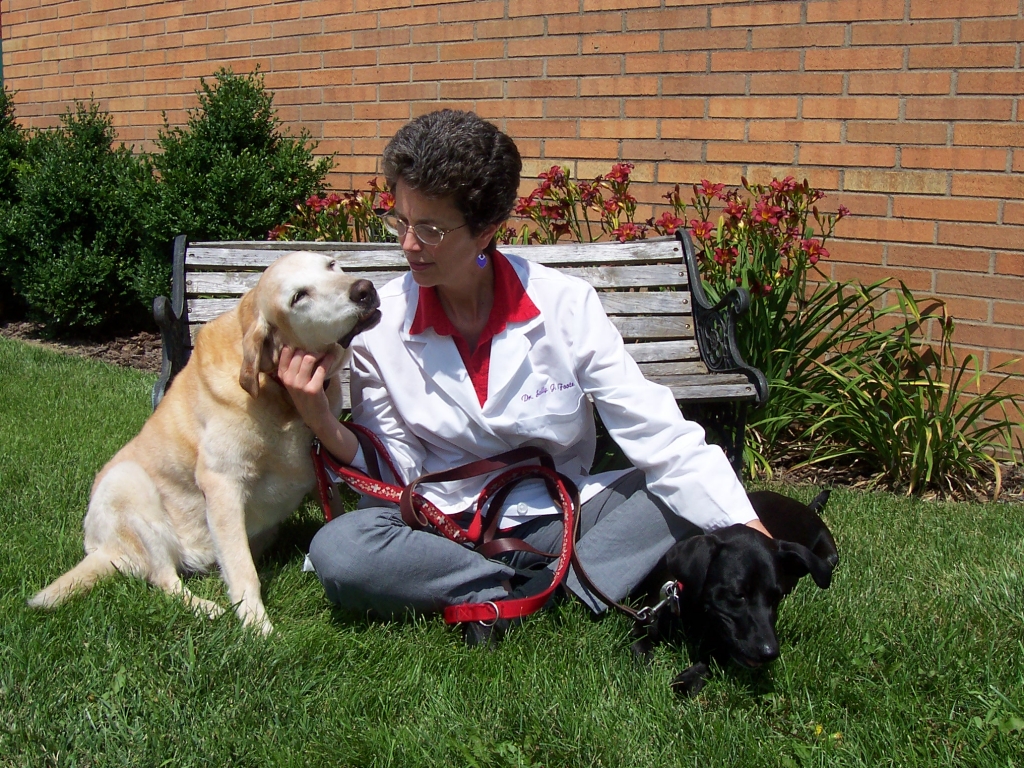
From the time I was 12 years old; I made a decision to become a veterinarian and never really seriously considered anything else. I did look into other medical science related fields as a backup plan in case I did not pass the rigorous admissions tests, applications and interviews for veterinary college admission. My heart and soul was always to become a veterinarian.
How I came to this decision was a culmination of a couple of factors. I really liked science, especially biology. I liked being around people and helping them solve problems. I also felt that animals had a special way of communicating with humans, and I wanted to be a part of understanding that. When I was 12, I was at our Scotty dog's check up and realized that Dr. Berglund did all this. Watching him work and finding out about what he learned to become a veterinarian put it all together for me. We did not have loads of animals growing up, but Sean really helped me to know the importance of having a companion animal in one's life. I worked hard at my studies, found the opportunities to advance and made the grade for acceptance into veterinary college. I continue to be fascinated and challenged by this profession, and its importance to our everyday lives. I cannot imagine a day when I would not be somehow engaged in veterinary medicine.
Dr. Sally J. Foote - Graduate of the University of Illinois College of Veterinary Medicine - 1984
|
Thanksgiving and Autumn Safety
Here are a few tips to help keep your pet safe during Thanksgiving and Autumn.
1. No candy - Pets can get sick eating chocolate and other sweets. Sugar free candy contains Xylitol, which will make your pet sick.
2. No Thanksgiving food - Resist the temptation to share your thanksgiving dinner with your pet. Dogs and cats can have vomiting and diarrhea from eating people food. They can also get pancreatitis from eating people food.
3. No nuts - Walnuts, acorns and other nuts are falling off the trees. Pets are tempted to eat the nuts. The shells and nuts can upset your pet's stomach. The shells and nuts can also scrape your pet's intestines and possibly get stuck in your pet's intestines.
4. No bones - Bones can get splinter and get stuck in your pet's intestines. Bones can also puncture the intestines. |
About Okaw Veterinary Clinic
Thank you for reading our newsletter. We strive to make our pet parents informed about pet healthcare. If you have any concerns or questions, please let us know.
140 W. Sale St.
Tuscola, Illinois 61953
Okaw Veterinary Clinic
217-253-3221
|
|
|
Treat Recall
Hartz has recalled their Hartz Naturals Real Beef Treats in a 8 oz bag with lot number BZ0969101E. The treats may be contaminated with Salmonella. Salmonella can cause your pet to be lethargic and have diarrhea or bloody diarrhea, fever and vomiting. Some pets will have only decreased appetite, fever and abdominal pain. Infected but otherwise healthy pets can be carriers and infect other animals or humans. If your pet has consumed the recalled product and has these symptoms, please contact us.
If you have purchased a recalled bag, please call 800-275-1414 to get a refund. |
Pet U Classes
The U of I and the CARE Center are presenting a series of pet classes. The classes will be held at the U of I Small Animal Clinic in Champaign from 6:30 - 8:00 p.m. Visit the Pet U website for more information about classes and how you can register.
Selecting the Right Pet for You
Thinking of adding a dog, cat, or small animal to your family? Discover which type(s) of animal companions best suit your lifestyle and budget. Dogs will receive the most attention given their popularity and great variability, but cats and non-traditional pets will also be explored. You will have the opportunity to complete a lifestyle survey and ask questions regarding your specific needs.
This class will be held on Nov 8. The class fee is $8 if you register before Oct 27. If you register after that date, the fee is $13.
The Basics of the Pet Food Label
Have you ever had difficulty interpreting or comparing pet food labels? This session will provide a brief overview of the pet food label, including a list of items that are required on all labels and those that are optional. Information on items such as guaranteed analysis, ingredient definitions, feeding guidelines, and nutritional adequacy verification will be provided.
This class will be held on Dec 13. The class fee is $8 if you register before Dec 1. If you register after that date, the fee is $13. |
Did your Dog get Sprayed by a Skunk?
Use this recipe to bathe your dog. If your dog's breath smells bad too, try yogurt. Your dog can eat 1/4 to 1/2 cup of plain yogurt, NOT fat free, twice a day.
2 Quarts Hydrogen peroxide
1 Cup Baking soda
1 Tablespoon Dawn dish soap (other soaps do not work as well)
Mix the ingredients together and wash your dog. Leave mixture on for 5 minutes, then rinse off. You can repeat if needed.
*Peroxide may damage carpet, towels and other materials. |
|
Remind My Pet
Sign up for this free service to get reminders of when your pet is due for their heartworm, flea or other medication. You can have the reminder sent as an email or text message.
| |
|






