|
HAWAIIAN EVENTS
February 5, 2010 (Friday)
Island Sol Productions presents "Aloha Friday"
Featuring Rebel Souljahz and Kapakahi
Avalon Nightclub, 777 Lawrence Expressway, Santa Clara 9:00 pm February 5, 2010 (Friday) 8:00 - 10:00 pm Herb Ohta, Jr. Santa Clara University Recital Hall www.HawaiimMusicLive.com February 14, 2010: (Sunday) Valentine's Day
February 21, 2010 (Sunday)
Hawaiian Native Voices presents
"Kanikapila Sunday -- Ka Ehu Kai Hawaiian
Band CD Release Party"

Tiki Tom's, 300 29th Avenue, Oakland
12:00 noon - 6:00 pm
Information: Tennyson (510) 750-7471 or Tihanai (510) 914-1414
Reservations: (510) 532-9202
|
POINT OF INTEREST: KAHOOLAWE-
THE SACRED ISLAND

Kah'oolawe is visible
from the south shore of Maui. It is a relatively small island measuring in
at just 11 miles long and six miles wide. The land is dry and arid;
receiving no more than 25 inches of rain annually.
The tale of Kaho'olawe
is as intriguing as it is appalling. In the 1830's King Kamehameha I
established a penal colony where men were banished for crimes including
promoting the Catholic faith, rebellion, theft, divorce, breaking marriage
vows, murder and prostitution.
In the late 1840's King
Kamehameha II introduced the "Great Mahele;" the western legal concept
of land ownership. Kamehameha II divided the Hawaiian lands among the
royalty, and elite. A small portion was reserved for the government.
Kaho'olawe was considered government land.
The island was then
leased to several ranches. This led to an uncontrollable sheep and goat
population; resulting in accelerated erosion and devegitization. The
ranches and government spent the next 70 years attempting to eradicate the
animals, and revegitate the island. These efforts promptly concluded on
December 8, 1941, the day after the infamous attack on Pearl Harbor. On
this day, the United States government placed Hawaii under martial law.
It was then decided by
the United States Government that Kaho'olawe would be used for target
practice, and other military exercises. Ship to shore bombardment of the
island commenced immediately. For this reason Kaho'olawe is often
referred to as "the target island."
During the next 50 years
the land of Kaho'olawe suffered a seemingly endless barrage of munitions
testing. By the mid 70's a coalition to save Kaho'olawe was formed,
and members of the Protect Kaho'olawe Ohana filed suit requesting that
the United States Navy be required to issue an environmental impact
report, as well as survey the island to protect all historical sites. In
1981, Kaho'olawe was listed on the National Register of Historic Places.
This still wasn't enough for a cease fire. The military was allowed to
continue their practices, however this time limited to just a portion of
the island. It wasn't until 1990 that President George Bush issued a
memorandum directing the military to cease using Kaho'olawe as a weapons
range. Kaho'olawe and its surrounding waters were returned to the state,
and the Hawaiian people.
Unfortunately the aina
(land) was soiled with contaminants and riddled with unexploded ordnance.
The island was deemed unsafe and uninhabitable. In 1998 the United States
Navy began a federally funded 10 year cleanup program which fell far short
of its goal of restoring the land. At this time portions of the island are
now safe but many others remain unsafe.
Today,
Kaho'olawe preservationists are working very hard to remove the
remaining unexploded ordnance, resoil & revegiate the land, and
rejuvenate its cultural and spiritual value. The island is strictly off
limits to visitors, including the near shore waters surrounding the
island.
http://adventuremaui.com/kahoolawe.htm |
K ilohana Trivia ilohana Trivia
Hawaiians eat more Spam per capita in the world. If you're Hawaiian, you know a hundred ways to cook Spam.
At Kilohana Grill, we serve Spam on our menu. Our Poor Boy is Spam, Eggs and Rice. We have Spam saimin (noodle soup
) and Spam Musubi (see picture).
Believe it our not, we go through about a THOUSAND cans a year!
(
We almost didn't have Spam on the menu when
we
opened. Myron said who
would buy it when you can make it at home!)
We did an order for 300 musubi's for a picnic. It took one person FIVE hours to make.
Check out our Spam display at the restaurant: BBQ, Hot & Spicy, Bacon flavored, Turkey, Honey Spam, low salt, etc. You'd be surprised at the different varieties that are available.
|
|
|
|
HAPPY VALENTINE'S DAY!
Bring your sweetheart in to Kilohana Grill on Saturday (we're closed on Sunday). We appreciate your kind comments about how you love our food. We feel it's our responsibility to serve you quality food for your hard earned dollars. Our fresh, not frozen chicken is still the same natural, hormone free, no preservatives, no water added product. Our beef is thinly sliced rib-eye. We skin and individually portion the fresh salmon. We make our potato salad fresh every day. Our kalua pork is slow cooked for hours and made with fresh pork. We do not use ANY MSG in any of our recipes. We believe this quality is what makes our food taste so good! Thanks again for your continued patronage and it is always a compliment when you refer your friends and family to us. Hope you are all well - Malama Pono - Take care, Pam and Myron Kashima and all of the staff at Kilohana Grill |
|
|
DAYS OF MY YOUTH - MYRON KASHIMA
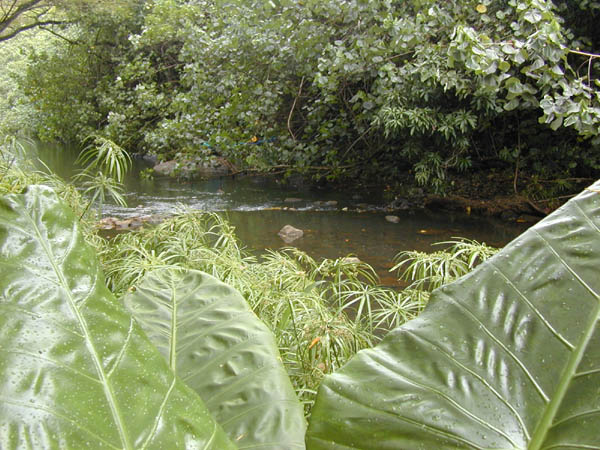 Huleia River Huleia River
Recently, I took my kids and grandkids down to the river where I used
to spend hours playing - swimming, jumping into the water, catching
opae (river shrimp), and all kinds of fish. It sure was a simpler
time back then. (Portions of the movies Jurassic Park and Indiana Jones were filmed on parts of this river.)
My grandparents on both my dad and mom's side lived in Huleia Valley near the river.
I can still remember the sweet smell of gardenias outside of my tutu's (Hawaiian grandmother's) kitchen window. We used to climb the mountain apple tree in the front yard. We would go hiking into the mountains from her house to get mokihana (green berries only found on Kauai) or maile (a vine with leaves) to make lei's.
My dad's parents had a bigger house than tutu's. The kitchen had a dirt floor and you had to step up into the other living areas. They were rice farmers and their back yard was actually acres and acres of rice fields. The fields were irrigated with water from the streams that fed the river. They worked these fields between approximately 1913 - 1955. I remember the adults were ALWAYS working. It was a hard life - all the aunties and uncles and older cousins all helped out. It was our job to try and stay out of trouble, which was not always easy. I even had a little baby pig as a pet! The fields are long gone. Most of the natural vegetation has returned and is now part of a national wildlife preserve.
My dad in turn, farmed in the same area after he retired from Grove Farm Plantation. He raised ti leaves and papayas. Unfortunately, due to health reasons, that lifestyle has come to an end. My brother continues to work a small part of the farm today.
We have pictures in the restaurant of my grandparents outside of their house back in the early 50's, dad's papaya plantation and his fruit stand.
Aloha, Myron |
|
PIDGIN CORNER - LEARN SOME LOCAL "SLANG"
geev um
(gheeve 'uhm)
Definition: try your best; go for it; don't give up
You gonna ride dis nex wave or wot? GEEV 'UM!
In English?: Are you planning on catching this big wave? Go for it, give it all you've got! http://www.e-hawaii.com/pidgin/geev-um |
|
HAWAIIAN WORD OF THE MONTH
 Puka - poo kah: Hole
In the '70's puka shell necklaces became the rage. The shells had a hole in the center that were strung into necklaces or bracelets. The shells were collected and sorted by size and strung by hand. These necklaces were pricey until the influx of the imitation, manufactured variety that are sold in discount stores or street vendors. |
|
|
KILOHANA CHILI SOUP
or Quickie Portuguese Bean Soup
- 2 cups Kilohana chili
- 1/4 onion, diced
- 1 celery diced (optional)
- 1-2 carrots, cut into chunks
- 1 potato - diced
- 1 can Chicken broth
- Salt, pepper to taste
Brown the onions and celery in a little oil, add the rest of the ingredients and boil for 15-20 minutes or until the carrots and potato are cooked. Serves 4-6 people Serve with bread or top with cheese and add tortilla chips for a tortilla soup. NOTE: Chili is only served on Thursdays and we often sell out, so come early. (You can also freeze the chili.)
This recipe is quick and easy and SOOOO DELICIOUS!
|
|
I hope you enjoyed our newsletter. I welcome your feedback and you can unsubscribe at anytime. Until next month.....
A hui hou - until we meet again
Aloha,
PAM KASHIMA
KILOHANA GRILL
|
|
|




