| |  |
The Holidays are a great time to think about one's blessings - family, friends, of course. I'm grateful, too, to have a home, enough food and water, things so many people on the planet lack. A few years ago, I might not have thought to be thankful for these basics. And as always, I am blessed to work with the Peace Flag Project, the work of my heart.
Two dear friends recently had reason to write about their lives and their values, and I want to share their gracious stories with you. Debbie Block and Bill Harley are an amazing couple. Bill is a marvelous entertainer - a storyteller, singer, musician for both children and adults. He has won two Grammy awards and recently was awarded a Lifetime Achievement award by the RI Council for the Humanities. His acceptance speech is a gem, and part of it is included below.
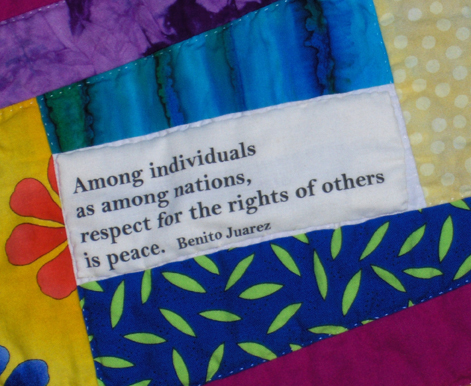
Debbie is also a treasure. One of her many gifts is quilt making. When Debbie created a gorgeous quilt for our recent Month of Peace Art Exhibit, she wrote an essay about what quilting means in her life. Like the quilt, the essay is an exquisite piece from a beautiful heart.
There's one more story: it's about Ben Franklin, our Founding Father. I include this story as a reminder for all of us to renew our spirit of tolerance and understanding.
I hope these stories engage you and hearten you. Despite difficult times, there is much good in the world; it's all around us if we look. Good people, kindness and generosity are everywhere.
 |
I wish you wonderful and peaceful celebrations full of love and joy. And I hope you will make creating peace part of your holidays. Do one small act of generosity or compassion each day, and see what happens. We are the peace makers. Peace is in our hands.
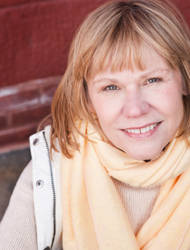
In peace and gratitude, Ginny |
 | Bill Harley's Acceptance Speech |
Bill Harley
| |
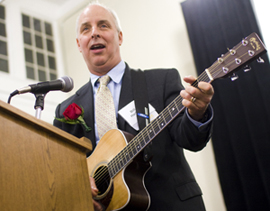 I have never been able to distinguish my art from my vision of the way I think the world might be if we were to listen and act with greater intention and care. Much of my work is about the great question of how do free individuals live in community with each other. What underlies all of my work is the search for what we hold in common. As an artist, and a student of the humanities, it's my job to try and make my audience look at the world in a different way. I am quite glad to use whatever tools I have to do that; story works for me, and so does song... I have never been able to distinguish my art from my vision of the way I think the world might be if we were to listen and act with greater intention and care. Much of my work is about the great question of how do free individuals live in community with each other. What underlies all of my work is the search for what we hold in common. As an artist, and a student of the humanities, it's my job to try and make my audience look at the world in a different way. I am quite glad to use whatever tools I have to do that; story works for me, and so does song...
Being given this award has caused me to think a lot about the humanities... For all their "squishiness," their inability to provide hard data, the humanities - arts and letters, the history of our time here on earth, the strivings and failings of humans - is the proper locus for the study of questions that are increasingly crucial to our life on this planet. They are questions that are hard, perhaps impossible, to answer definitively. As a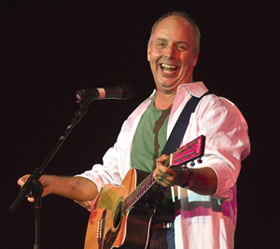 storyteller, I understand that we are, in the end, contextual beings, creatures of time - our acts, our thoughts, our dreams, bear no meaning without what came before, and what they imply for the world that will follow - this is what we, as humans, as storytellers, do -- we live in a context, and make sense of the world through our narrative, the telling of our stories. It is the job of the humanities to listen to these stories and to ask the questions that, as Rilke said, "have no answers." storyteller, I understand that we are, in the end, contextual beings, creatures of time - our acts, our thoughts, our dreams, bear no meaning without what came before, and what they imply for the world that will follow - this is what we, as humans, as storytellers, do -- we live in a context, and make sense of the world through our narrative, the telling of our stories. It is the job of the humanities to listen to these stories and to ask the questions that, as Rilke said, "have no answers."
And of course, in the end, there is the question of how we should live our lives, and what does it mean to live a good life. These are questions that must be asked every day. This is our calling - this is our charge - this is what those of us who live in the world of the humanities, should strive to do. We are better when we ask these questions, and when we reach beyond the boundaries of what we know and who we are to make the circle bigger.
Thank you. Thank you. Thank you.
And of course, my thanks, most of all to my wife and work 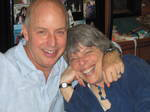 partner, Debbie Block - my anchor and compass. What I present as an artist is really a shared vision of the way we would like the world to be - those of you who know me, know that it is not just me up here. partner, Debbie Block - my anchor and compass. What I present as an artist is really a shared vision of the way we would like the world to be - those of you who know me, know that it is not just me up here.
Please click here to read the whole speech. You'll be glad you did. Also, check out Bill's website www.billharley.com |
| Handmade Peace Quilt |
| Debbie Block |
|
I am inspired by color, by words and by the smallest acts of kindness, generosity 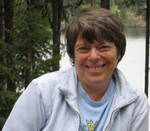 and love. I have always been a quilter at heart.... and love. I have always been a quilter at heart.... [Quilting] is calming and invigorating at the same time. I enjoy all the steps and love knowing that someone I might not ever meet will stay warm under the quilt or simply enjoy its colors and design. Each stitch is a blessing, and each quilt has its own story and memories - one made during the build up to the war in Iraq, another when our first son left for two years in Wales, and one when our younger son left for college. Quilting became a way for me to pray for peace during the military buildup and a way to hold my boys close when they were far away.
I was delighted when Ginny Fox asked me to make a quilt for the collection of Peace Art in the Atrium. In planning the quilt I found myself thinking metaphorically about peace. I believe that we will only have peace when we are able to hold hands with those who are very different than we are -when we are stitched together with people whose beliefs and values are not our own. I believe that we all have much more in common than we think or care to admit. In the end, we all want and need the same things.
The fabrics in this quilt do not naturally belong together. They are scraps from other quilts I've made. But, when fastened one to the other and joined as a whole piece, they seem to fit. The quote in each "crazy quilt" block speaks about the world I know is possible. It took all of them - the words, the variety of color, design and texture to create the whole. And, it will take all of us with our varying sizes, shapes, colors, beliefs, traditions, history and imaginings to create a peaceful world.
Please click here to read all of Debbie's essay. It is a special treat |
| Tolerance and Understanding |
| Benjamin Franklin |
|
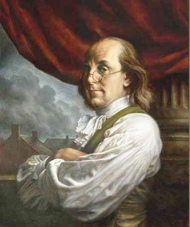 "Benjamin Franklin's greatest contribution to our nation was his emphasis on the "Benjamin Franklin's greatest contribution to our nation was his emphasis on the
-- From American Sketches: Great Leaders, Creative Thinkers, and Heroes of a Hurricane by Walter Isaacson. |
|