|
|
|
Happy Minyan Newsletter
|
October 2009
|
Greetings!
In honor of the holiday, I am posting here the Chabad.org article on Sukkot.
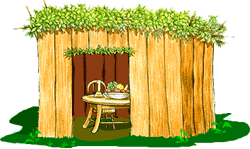 Sukkot in a Nutshell Sukkot in a Nutshell
The Sukkah, the Four Kinds, the "Water-Drawing Celebrations," the meaning of unity, the dynamics of joy...
For forty years, as our ancestors traversed
the Sinai Desert prior to their entry into the Holy Land,
miraculous "clouds of glory" surrounded and hovered over them,
shielding them from the dangers and discomforts of the desert.
Ever since, we remember G-d's kindness and reaffirm our trust in His providence by dwelling in a
sukkah--a hut of
temporary construction with a roof covering of branches--for the duration of the Sukkot festival (Tishrei 15-21). For seven days and nights, we eat all our meals in the sukkah and otherwise regard it as our home.
Another Sukkot observance is the taking of the Four Kinds:
an etrog (citron), a lulav (palm frond),
three hadassim
(myrtle twigs) and two aravot (willow twigs). On each day of the festival
(excepting Shabbat), we take the Four Kinds, recite a blessing over them,
bring them together in our hands and wave them in all six directions: right, left, forward, up, down and backward.
The Midrash tells us that the Four Kinds represent the various types and personalities
that comprise the community of Israel, whose intrinsic unity we emphasize on Sukkot.
Sukkot is also called The Time of Our Joy; indeed, a special joy pervades the festival. Nightly
Water-Drawing Celebrations, reminiscent of the evening-to-dawn festivities
held in the Holy Temple in preparation for the drawing of water for use in the festival service,
fill the synagogues and streets with song, music and dance until the wee hours of the morning.
The seventh day of Sukkot is called Hoshaana Rabbah ("Great Salvation") and
closes the period of Divine judgment begun on Rosh Hashanah. A special observance
is the Aravah--the taking of a bundle of willow branches.
Wishing you all Shabbat Shalom and Chag Sameach!
Rachel
|
|
|
Rebbe Nachman's
Yahrtzeit Sukkah Party
|
|
Yahrtzeit of Rebbe Nachman of Breslov & "Simchat Beit Hasho'eva" Water Drawing Ceremony
Date: SUCCOT 5770 : October 6th
Time: 4:30 pm - 6:30 pm
Location: Aish Tamid Succah - A Carlebachian, Chassidut House set amidst the Urban jungle....
5909 W 3rd St, [3rd & Poinsettia]
Los Angeles CA 90036
Please come and join us for an evening of inspiration, with music, food, stories, Torah in honor of R. Nachman of Breslov.
Bring
yourself, secular jews and/or frum jews, and perhaps something that may
inspire others, and come enjoy the good fortune of Holiday waters
flowing .
About the Water drawing Ceremony , Simchat beit Hashova, the sages said: The Sages noted that, "Whoever never witnessed theSimchat Beit Hashoeva has never in his life seen true joy. "
RABBI Chaim Kramer: LIVE from the Breslov Institute in Jerusalem - a prolific Breslov publisher and impactful Torah scholar will be speaking via Webcam.
Sponsored By: Aish Tamid, Naftali Burstyn & Brian Hannan
|
|
Pizza-in-the-Hut
Potluck Sukkah Party
|
Come celebrate Sukkot together before our annual Hoshanna Rabba All Night Learning!
Live music * Kids' Activities * Acrobatics * Food * Friends
Date:
Thursday, October 8, 2009
Time:
6:00pm - 9:00pm
Location:
The Tofler's 8835 Key Street Los Angeles, 90035
The price for admission is only whatever you're able to bring for the potluck.
Please RSVP to Lisa Tofler and let us know.
The food will be strictly kosher, dairy or pareve.
|
|
|
 Sukkot: Carrying the Torah Forever Sukkot: Carrying the Torah Forever
Rabbi Shlomo Carlebach
Oct. 10 1989 - י"א תשרי תש"ן
After Yom Kippur we feel homeless in our own homes. We don't want to
live in a house where the protection is made out of stone or wood. We
want to live in a house where it's clear to us that G-d Himself is
protecting us. I don't want to live in a house where I cannot see the
stars in the sky. I want to live in a house where every little star can
send me a message of light. I don't want to live in a house where maybe
even one Jew does not feel at home. I want to live in a house where
every Jew, and eventually the whole world, feels at home.
When I was in Russia on Sukkot,
two non-Jewish girls in Moscow showed me the way to the synagogue. They
stayed with us half the night in the Sukkah and then walked me back to
the hotel. When they said goodbye, they said something prophetic to me:
"Maybe there shall never be peace in our days -
maybe we shall never taste a peaceful world, but we shall always
remember those few hours in the Succah of Peace, sitting in Paradise in
the shade of G-d".
My beautiful friends, every second in the Sukkah
you can taste Paradise in the most eternal way. Once a year we sit with
our holy Mothers and our holy Fathers in the Sukkah. I bless you and
me, let it also be with our children - all the children of Israel and
eventually all the children of the world.
All year long the Torah is such a burden. Every word weighs ten
thousand tons and how often do we think it is really too much, but
after being in the Sukkah for eight days, living in G-d's world again -
a cleansed and purified holy world - I suddenly realize how light the
Torah is. It's not I who carries the Torah; it's the Torah that carries
me. So I run out from the Sukkah straight to the Holy Ark. I dance with
the Torah for forty-eight hours. Before Sukkot I could barely carry the
Torah four steps. After Sukkot I can carry the Torah forever.
Transcribed by (Rabbi) Samuel Intrator
Brooklyn, New York
Original version in Connections Magazine
Volume IV Number 1 - Succos 5749
Copyright (C) 1988 The Inner Foundation
|
Sukkot 5770
Rav Sholom Brodt, Rosh Yeshiva of Simchas Shlomo
As is well known, Sukkos is known as Zman Simchateinu - the season of our joy.
"V'SAMACHTA B'CHAGECHA ... V'HA-YEETAH ACH SAMEY-ACH - And you shall rejoice on your holiday ... and you shall be entirely joyous." Devarim 16:14-15.
We dwell in our Sukkot
to remember Hashem's kindness that when took us out from bondage in
Egypt He had us dwell in temporary huts to protect us from the harsh
heat of the desert sun. The Zohar refers to the shade of the Sukkah as Tzilla d'meheimanutah
- the shade of faith, the protection and comfort one feels in knowing
and realizing that Hashem is really the ultimate source of our
protection and security.
According to one opinion in the Talmud these 'huts' were actually the ananei hakavod - the six clouds of glory that encircled us from all sides. The 'sukkot'
that we live in during this holiday are more than memorial structures.
In our 'sukkot' we dwell in the same 'space' that we dwelt in when we
were in the desert. This Zohar calls this space, "Tzillah d'Mehemnutah", the shade of faith. This is the place of true joy and real 'ahavat Yisrael'.
Wherever your sukkah may be, the air in the sukkah is the air of
Yerushalayim. And so all the Jewish people are 'dwelling' in one
Sukkah, as it will be when Moshiach comes.
Sukkot is also very much about unity. The mitzvah of the "four species" - the taking of the Etrog, lulav, hadassim and aravot, holding them together and waving them together also symbolizes the unity of the Jewish people. The Etrog
which is both fragrant and has good taste symbolizes the Jew who is
both a Torah scholar [taste] and does good deeds of loving kindness for
others [fragrance]. The lulav has taste but lacks fragrance, symbolizing the Jew who has Torah knowledge but is lacking in good deeds. The hadassim have fragrance but no taste and they symbolize the Jew who is rich in good deeds but lacks in Torah knowledge. The aravah
twigs have neither good taste nor fragrance and they symbolize the Jew
who is lacking both in Torah knowledge and good deeds. By taking all
four species together we symbolically embrace and unify all the Jewish
people together.
Clearly the etrog, the lulav and the hadassim contribute either taste or fragrance to the community. But what do the aravot contribute? Reb Shlomo zt"l says that by including the aravot everything else looks more beautiful, and this is so not only because of the contrast offered by the aravot.
What makes you more beautiful is that you can recognize the beauty even
in one whose beauty is not immediately apparent. And if you are not yet
capable of doing that, even the very admission that Hashem created
every person beautiful, makes your beauty deeper and more beautiful.
Have a very joyous Shabbat and Sukkot,
b'ahavah ubivracha
Sholom
|
 David Sacks teaches every Shabbos morning at 8:30am at the Happy Minyan, and every Sunday morning at 10:30 am at Mogen David, 9717 W. Pico Blvd David Sacks teaches every Shabbos morning at 8:30am at the Happy Minyan, and every Sunday morning at 10:30 am at Mogen David, 9717 W. Pico Blvd
 You
can also listen to David Sacks online anytime by down-loading his
Torah on iTunes, or you can read some of his best articles - check out
his fantastic site Spiritual Tools for an Outrageous World. You
can also listen to David Sacks online anytime by down-loading his
Torah on iTunes, or you can read some of his best articles - check out
his fantastic site Spiritual Tools for an Outrageous World.
The Light of Succos 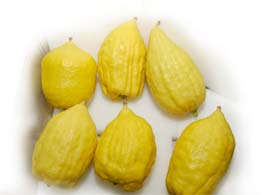
In this talk we look at Succos as the creation of the physical world.
The Light of Succos
|
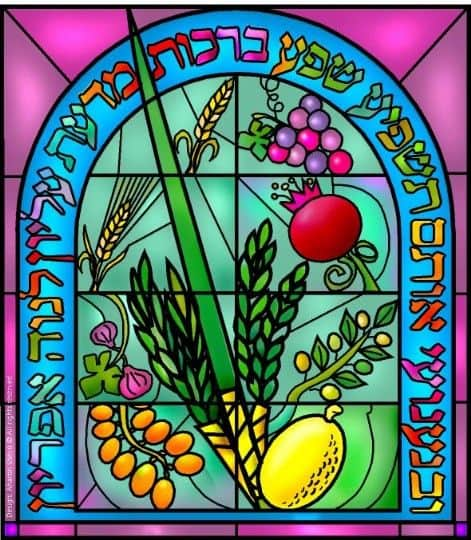 Harvesting in Sukkot Harvesting in Sukkot
Rachel Espana
Another name of the festival of Sukkot is "Chag HeAsif", commonly understood as "the Harvest Festival". The word "asif" literally means the gathering or collecting of something. While
certainly this is a time we feel gratitude for all the physical
blessings with which we are blessed, as a fruitful harvest season
represents, this is also a time to gather in the abundant non-material
blessings as well. It is interesting to note that only five days ago,
it was Yom Kippur - the Day of Atonement, the day wherein we are
cleansed, our sins are removed - a purging of sorts. Now G-d tells us to gather things in, collect things. In
this vein, it makes sense that Sukkot follows Yom Kippur: now that
there is a clearing within us, so to speak, we have room to take in all
the goodness G-d has to offer.
In the
kabbalistic tradition, Sukkot is the time of emunah - faith. What does
faith have to do with Sukkot and harvesting? The Torah actually gives
us an explanation as to why we must sit in Sukkot for a week,
specifically during the harvest season. To paraphrase, we are told that by doing so, we will not succumb to the human tendency to boast and take credit for the bounty. Rather,
by being somewhat vulnerable out in the elements, and also witnessing
the fields where our crops were once planted, we are humbled. Our
faith is restored. It is odd when you think about it, that we can
forget that we are not the ones who made the harvest what it is. And
not only do we tend to forget that G-d is the One Who gives us our
bounty - just as important, we seem to forget our role in receiving
that bounty....
Let's
say you would take a seed and plant it in the best soil, in a place
where it is sure to get the right amount of sunlight, and you water it
regularly, and so on. When the plant grows, do you think you're the one who actually grew it? Perhaps at first. But once you think about it logically, you realize quickly that you're not the one who makes the seed grow. You don't know how to alter the state of a seed into a plant. All you do is make it possible for the seed to grow.
This is
real faith, understanding that G-d is the One who makes a dead little
seed grow into a large living plant or tree, and that we are the ones
who make it possible for G-d to work that miracle. As much as this is a
time to recognize G-d's Hand in our lives, it is the time to recognize
that we are the ones who create the condition in which we can receive
G-d's gifts. In this manner, it is possible to harvest all the
blessings G-d has in store for us.
So what blessings are you going to harvest this year?
May G-d bless us with abundance, and with the awareness of the Source of the abundance.
Chag Sameyach - Happy Sukkot!
Rachel
|
About Happy Minyan - Los Angeles
Please join us for davening every Shabbat!
Friday night: Mincha begins at
candle-lighting time, followed by Kabballat Shabbat and Maariv.
Saturday morning:
David Sacks' class begins at 8:30am, followed by Shacharit at 9am, then
Torah reading and Musaf. There is a Kiddush after davening at around
12pm.
Saturday afternoon:
Mincha and Seudah Shlishit are usually around an hour and a half before
Shabbat ends and followed by Maariv and Havdallah at the conclusion of
Shabbat.
We also meet for davening on all major Jewish holidays.
The Happy Minyan is located at
the Karate Academy
9218 West Pico Blvd (at Glenville)
Los Angeles, California90035

Good Shabbos! Good Shabbos!
The Happy Minyan |
| |
|
|
|
|
|
|
|


