Greetings!
 I don't know if I believe in New Years Resolutions. I have been thinking that for some of us, it is a recipe for disaster. Set lofty goals that are difficult to achieve, expect that we can achieve them quickly, and then great disappointment when we do not reach the expected goal. It makes me think about parenting. Are we setting realistic goals for our children? Are we supporting them and giving them the tools they need to accomplish those goals? I know that I have found myself in conflict with my growing children and the wisdom and maturity they seem to show at times and then what I expect them to be able to do and what they are actually capable of doing at ages 9 and 10. I tried to think of some resolutions that might help me in this parenting question. What I realized that even simple sounding goals - like remember to take each day as it comes - can be difficult once the pace of life comes rushing in on our day. So, maybe it is enough to tell myself, "I resolve to do the best I can and don't sweat the small stuff." I wonder at the peace we might find, if we are able to accept our own best, and model that acceptance for our children. Sincerely, Royale Lockhart North Queen Anne Child Care |
|
|
Children and Boundaries
by MaryAnn Abbott, Parenting Consultant NSCC |
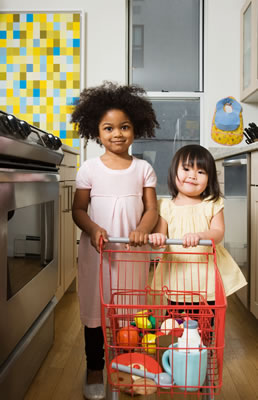 Boundaries are a big conversation piece in our society. Discussions about how to achieve workable boundaries between people and things occur in the workplace, in families, and with friends. Boundaries are also a big concern for young children. Parents know that children need boundaries to be safe. When my three-year-old son was learning to ride his tricycle on the sidewalk, we placed three bricks in the middle of the sidewalk as a mental/physical boundary that reminded everyone of that boundary. Children need boundaries with other children. Parents can recall situations requiring intervention to settle a possession boundary. It can start as simply as a one-year-old grabbing a ball from another child, or can get as complex as one child biting another child if that child gets too close. The adult tries to understand the social dynamics of the situation and teach the children to respect ownership/possession and the personal space of another. Members of a family need boundaries too. That includes parents! But sometimes parents ignore a boundary rule or just deal with the surface behavior because they do not want to cause an "incident." We short-change the learning of children when we allow them to do what they want, without consideration of the rights of others. Whether it's safeguarding personal space, respect for another's possessions, fair taking of turns, listening to another's words, stopping when another has asked for the stopping-they all revolve around respecting boundaries. Take a family rule of not jumping on the parents' bed. The family rule is only jumping on the child's bed. Yet, after a four-year- old's shower, he sneaks in to his parent's bed and does belly-flops and jumping on the' big bed. Yes, he has disobeyed. But it's also a personal space issue. It's his parents' bed, a place reserved for them. Children need to learn respect for items belonging to others. It'll work better for parents to take the time to explain the guideline (boundary) rather than just deal with the surface behavior-the jumping. Toddler parents are often reluctant to enforce a personal boundary when their toddler hits them in the face and/or bites them. It's true that the child's understanding is limited, yet with a kind, balanced approach the parent can teach that both biting and hitting hurt and that it's mommy's face. Then show how to touch mommy's face with gentle, soft touches. It's easy for parents to feel selfish or guilty when trying to enforce boundaries at home, especially if the parent's own boundaries have been invaded. Take the example of just enough pieces of a favorite dessert for each person. The four-year old wants the parent's piece. What's the parent to do? Say "no" to the child and feel guilty by eating one's own deserved dessert? Or, say "it's okay, I really don't need dessert and you can have my share?" Or, how about "we all get to have this special dessert together. So let's enjoy dessert with every person getting one piece?" This last response teaches the young child about equal sharing-everyone has a share. We don't beg for someone else's share. The parent is modeling respect for others and their possessions. This kind of modeling by parents helps siblings understand and negotiate fair, respectful boundaries. Teaching siblings to respect each other's possessions and space goes something like this: Little brother doesn't get into big brother's Star Wars figures and play with them without big brother's permission. He doesn't rummage through big brother's things. Likewise, big brother doesn't take little brother's Rescue Heroes, play with them without permission, and leave them where little brother can't find them. Respecting personal boundaries should be part of the parent's guidance. In the childcare setting, most interventions by staff are to protect personal boundaries of children. "Hands to your own body. Ask before you touch. Listen to your friend's words. You are in charge of your own body. This is your own self space. This area belongs to you, that area belongs to her. Listen to your friends words when she says 'stop!'" Preschoolers tend to get tangled up in body and in deed. It's the adult's responsibility to assist in untangling and promoting harmony through boundaries. |
|
What Matters Most...The Soul of Parenting
by Jan Pendergrass, Pastor for Children and Families at FFMC |
 As we continue in our Galatians 13 Fruits of the Spirit series, this month's "Fruit of the Month" is PATIENCE. The first three fruits, love, joy and peace, are ethereal or lofty sounding feelings that make you want to cuddle up with your kiddo on the couch with a favorite book. Patience, however, is a much greater challenge and brings to mind far too many instances where there was none to be found! Is there a parent on earth that hasn't snapped when they shouldn't have, yanked a little arm a little too harshly, or resorted to those four, last-resort words, "...because I said so!" We all know the value of patience and want more of it. Is there a secret to having a never-ending well as we face the challenge of parenting day in and day out? Some people just seem to be better-wired for patience. While I never was a yelling parent, I am quite jealous of a never-ruffled parent's resolute calm. They never seem to be in a hurry. They never raise their voice and they always have time to listen and explain things in hushed tones. Are they for real? It's just not realistic to never be in a hurry with our kids. We have tight schedules. We don't have time to wait for a child to painstakingly process their feelings about whether or not they want to wear their blue or green coat. Sometimes it's just not possible to wait out what very well may be a 30 minute screaming fit in the grocery store, and at times the best we can come up with is to holler, "Knock it off!" So are there great words of wisdom or magic formulas for being a more patient parent in the New Year? It's a worth-while and wonderful resolution, that's for sure. I would just like to share two ideas- an offensive and a defensive plan, to use a sports analogy, as you begin 2012: 1. Offensive Plan: Invite, don't command. When we needed to be out of the door 5 minutes ago and we haven't said a thing to the kids about being ready, it's our fault when they aren't! The trick is not only when we ask, but how. So often as they are otherwise engaged, we holler, "Get your shoes on now we're leaving!" Not fair! My sons are 16 and 19 and still I work on inviting, not commanding. "Will you please be ready to go in 5 minutes?" Of course the younger they are, the more specific and simple your directions need to be. But you are setting yourself and your child up for gracious compliance when you give timely, polite invitations rather than bossy commands. How great to not have to dig for patience! 2. Defensive Plan: Respond, don't react. These words have helped me tremendously over the years. I've learned the power of a questioning look while holding back the fiery words that want to erupt from my mouth. I've learned to restrain myself from asking, "Why did you do that?" which is an exercise in futility. And I've made every effort to redirect behavior in a positive way, rather than to quickly condemn and punish. When you feel your patience being tried, try a healthy response before a harmful reaction. Most importantly, when we are patient, we are helping our kids gain a healthier perspective on how patient God is with us. That's huge, I know. In their new book, Preschool Explorers, Parenting Wisdom for Ages 3-5, authors Turansky, Miller and Snyder remind us of this amazing and overwhelming responsibility: Much of the initial understanding of God comes through the parent/child relationship as children understand love, forgiveness, firmness, and what relationship is all about. The way you handle offenses, teach lessons, and take time to interact, all prepare the way for your child to understand how God wants to relate. For more information on how you can get the book, please go to... http://www.biblicalparenting.org/parentingshifts/preschoolexplorers.asp A very happy, healthy, patient year of inviting and responding to all of you! |
|
We still need to place another order of calendars. If you weren't able to get one before Christmas, please drop your order off by January 6.
|
|
|
|
|
We spend January 1 walking through our lives, room by room, drawing up a list of work to be done, cracks to be patched. Maybe this year, to balance the list, we ought to walk through the rooms of our lives...not looking for flaws, but for potential. Ellen Goodman |
|
A special note about Chapel this month...
MaryAnn will be out of the country teaching children in Africa for a month. During this month, we are excited that Jan Pendergrass, Pastor for children and families at FFMC will be doing a chapel program on Wednesdays. We will be taking the children up to her "Kid Town" area on the third floor, where children will get to watch a puppet show!
We will be eagerly looking forward to MaryAnn's return in February, and we would like to thank Jan for sharing her puppet ministry with us for the first month of our 2012 year.
North Queen Anne Child Care
3200 3rd Ave. W.
Seattle, Washington 98119
206-281-2919 |
|
|
 |
|
Responsibility is a Skill, Not a Gift
Learning how to care for one's self and how to contribute to the family are crucial skills that when utilized make everyone in the family feel greater satisfaction.
If you are wondering whether you SHOULD do a task for a child, such as pick up a mess or pack a snack, stop and ask yourself, CAN my child do this for herself? If your child can do the task, try not to deprive your child of the life experience of assisting himself or herself.
children cannot learn skills easily if we don't give them opportunities - even when it is inconvenient, annoying, or challenging to us to do so.
When children do not get opportunity to learn the life skills they need, they can loose faith in themselves.
Take time - and make time - for training.
Take it slow and teach your child the individual steps to tasks. Sweeping dirt into a dustpan may seem simple, but it is composed of many steps, such as how to hold a broom, how to walk and sweep, how to draw the dirt toward the pan. As you teach a new task, think about how you can break it down into a series of actions. This is called "scaffolding" and is how your child's teachers introduce new skills! (adapted from Positive Discipline Workbook by McVittie and Kinney)
CAN-DO Kids:
Age Appropriate Skills
Age 2
Put toys away together
fill pet's food dish
put clothes in hamper
bring helpful items (diaper, washcloth)
help clean up spills
stack things (books, washcloths)
Age 2 1/2 - 3
All of the above,plus:
pick out clothing and put it on
pick up toys (if child is overwhelmed, consider storing toys so fewer are out at a time)
Wipe up own accidents
Help put away grocers, dishes, folded laundry, family items
Hang up coat
Place shoes in proper spot
sweep along with you
mop along with you
use hand-held vacuum to pick up crumbs
slice bananas, hard-boiled eggs with blunt cutlery
walk most times and in most situations, as opposed to being carried/pushed in stroller
Age 4 - 5
All of the Above, plus
Make own bed
pick up bedroom
empty wastebaskets
bring in mail or newspaper
clear table
pull weeds
water flowers
unload utensils from dishwasher
wash plastic dishes at sink
fix bowl of cereal
set and clear table
serve self at dinner table
pay for small purchases
help with grocery shopping
prepare simple breakfast
take out garbage
add ingredients to simple recipe
cut vegetables/fruits with assistance
yard work
feeding pets
letting pets in/out
sweep floor
bring in firewood
separate laundry
help clean most household messes/spills
Complied by Andrea Baumgarten from the following books:
Jody McVittie and Barbara Kinney, Positive Discipline Workbook
Jane Nelsen, Positive Discipline and Teaching Parenting the Positive Discipline Way
|
|
Reading Recommendations by Sandy Simmons
Obtaining books used to be a matter of buying them in a bookstore or going to the library to check them out--at least that was the way it was when I was growing up. Now the options seem endless; books may be bought, borrowed or read electronically on all kinds of devices. It is a great time for reading; if you take the time to read. So far no one seems to have invented a way for time to stand still long enough for us to read like we want to, so we are stuck with the old-fashioned methods of making time! In this New Year may you all find that time to read for your own enjoyment, for the enjoyment of your children, and to bring the family together and create in your children memories of family reading.
Here are a couple of recommendations for family reading: Make Way for Ducklings by Robert McClosley is a Caldecott winner as "a most distinguished American picture book for children" published in 1941. A good friend bought it for me in Boston, along with a large postcard of the Make Way for Ducklings statues in the Boston Public Gardens. The illustrations are beautiful and the writing and story simple. This amusing story presents the challenges of a mother duck raising her ducklings in an urban park. Also recommended are other books by Robert McClosley: Lentil, Homer Price, Centerburg Tales, Blueberries for Sal, One Morning in Maine, Time of Wonder (also a Caldecott winner), and Burt Dow; Deep-Water Man.
My other interesting book find, I found on Royale's desk! Don't Bump the Glump and Other Fantasies by Shel Silverstein happens to be Silverstein's first poetry collection, and the only one published with color illustrations. This may not be the best for sensitive 2-4 year olds because this is a "most unusual bestiary of silly and scary creatures," but it will certainly entertain older or less sensitive children, and I would love to read it to my youngest grandson (5 months) because although he doesn't understand words, he is learning to love the sounds of language and poetry. (Don't leave the babies out of family reading.)
Happy Reading in the New Year!. |
|
Parent Teacher Conferences
The partnership between parents and teachers is one of the most important school relationships. The partnership is vital to a child's success in school.
We are trying something a little new with our conferences this year. Over the last few years, we have held conferences during the month of March, each class using one week to fit in all of their conferences.
After a couple years of doing this, we realized that there were several challenges to this approach that we think could be handled a little differently.
Squishing all the conferences into one week, made for very crazy hectic days for our teachers. Also, with children that have just moved into their rooms in January, a March conference in the new classroom could be a challenge for both parents and teachers.
So - we are asking our teachers to schedule 2 - 3 conferences per month starting this month. They will begin with the children that have been in their class the longest and as they move through the months and the children in their room, they will get to know those children who are just moving into their rooms.
Teachers will be contacting parents to schedule the conferences.
We all appreciate your patience and understanding as we try a new method of delivering this very important information.
|
|
|