|
|
|
Newsletter
|
September 2012
|
|
|
Welcome to the September Newsletter!
Добро пожаловать на рассылку сентября!
September's Auction Selection
This month's auction piece is a top-level drawing and the first drawing we have ever offered in the silent auction. Done as a student work, it shows the depth of talent and focus of Russian art students and their grounding in the strict Russian academic tradition. The drawing perfectly illustrates the reverence and importance drawing had to Russian artists. Today, drawing is almost a lost art which gives even more value to this work. In this brilliant drawing, the essence and skill level of Stasevich is clearly demonstrated. This incredible work would make a valuable addition to any art collection.
Ivan Nikiforovich Stasevich
"Lady with Violin"
13'' x 11'',1957, Pencil on Paper
Estimated value $3,000- $3,500, Current Bid $750
More About our Monthly Silent Auctions
 | | Still Life with Self Portrait, 1997 Oil on Canvas |
Remembering a Master-
Geli Mikhailovich Korzhev (1925-2012)
One of the most influential, innovative and vivid Realist artists of the 20th century, Geli M. Korzhev, passed away August 27th, in Moscow at the age of 87. Born in 1925, Korzhev's personal philosophy and artistic career was influenced by the social context and standards that defined life in the Soviet Union. Evacuated as a teenager from Moscow during the Second World War, Korzhev later graduated from the prestigious Surikov Institute in 1950, where he studied under Sergei Gerasimov.
Korzhev subsequently became a teacher at the Stroganov Institute of Art in Moscow where he taught until his death. He was chairman of the Union of Soviet Artists, the Peoples Artist of the USSR in 1972, a board member of the Russian Academy of Arts, and recipient of the I.E. Repin State Award. Korzhev was one of the central innovators of the Severe Style. His paintings are part of major Russian collections and have been exhibited at the Smithsonian Institution, the Guggenheim Museum, and the Museum of Russian Art.
Read More and View works by Korzhev.....

Guardians Of Russian Art Museums
In his book Guardians, photographer Andy Freeberg has captured whimsical and poetic images of the women who guard the art in the great museums of Russia.
These women, who appear to be hired guards, often times aren't actually employed. In fact, these Russian women - like to sit and guard the collections simply because they enjoy being surrounded by Russia's great art.
In many of the photographs the women magically assume characteristics of the art they guard. One woman with a blue and white sweater draped over her shoulders sits beside a Matisse still life, whose blue tablecloth could be cut from the same material. Some of the guardians watch over paintings whose subjects suggest younger versions of themselves. And one woman, poised in a room of European masterpieces, appears to have emerged from a Vermeer painting.
 | |
Marc Chagall, Lilac Nude 1967
|
Marc Chagall- The Origins of the Master's Creative Language
Marc Chagall was one of the twentieth century's most successful artists, yet he spent most of his life exiled from Russia, his county of birth, considered too bourgeoisie for the USSR.
A new exhibition on the renowned painter has opened in Moscow's Tretyakov Gallery to celebrate the 125th anniversary of his birth (1887-1985). Although Chagall never received any formal art training, his renowned works are vivid in color and texture, reflecting a distinct mix of influences and ideas. His main teacher was his natural surrounding and the people in his life.
The exhibition explores Chagall's early influences and the impact his Russian and Jewish cultural background had on his work.
Read More...
Enjoy the nice Fall weather and September's newsletter!
Stephen Justesen, Gallery Director
Contact the Gallery...
|
|
September Silent Auction 
Congratulations to L. Oren who placed the winning bid of just $1,000 for August's auction painting "Summer in the Village" by Ukrainian artist Vasili F. Kondratyuk, estimated at $3,000- $3,500.
This month as our silent auction piece we are pleased to present a superb drawing, "Lady with Violin", by the master Ivan Nikiforovich Stasevich, Estimated at $3,000- $3,500.
 | |
Ivan Nikiforovich Stasevich, "Lady with Violin"
13'' x 11'', 1957, Pencil on Paper
Estimated value $3,500- $4,500, Current Bid $750 S. Hilbig
|
Drawings have a very special place in Russian Impressionist art and are a fundamental part of the education and training process for students. A direct pass-through from the rigid academic training of a hundred and fifty years ago, all Russian art students were required by the great Russian Art Academy's to draw, draw, draw. The academy's six years of intensive academic training was built on a foundation of great drawing and a demand that every artist not just be proficient but a grand master at drawing. Good drawing was considered the gateway to great art. In some academies, first year students were permitted to do nothing but draw. An observer to the small (but very impressive) museum at the Ilya Repin State Academic Institute Of Fine Arts, Sculpture And Architecture in St. Petersburg (the "Repin Institute"), can see academic drawings (with the grades attached) from student works dating back to 1769.
Drawing is a skill that many Russian artists inter-disperse throughout their careers. They see it as a warm up. A skill enhancer that even after their rigid training, Russian artists throughout their career, return to again and again.
It is this strength in drawing technique that makes possible the uncompromising realism of Russian art and this month's auction piece.
We invite you to participate in this month's auction and thank everyone who placed bids last month.
Bidding begins at $250, followed by minimum bidding increments of $250. The auction will end Sunday, September 30th at 5:00 pm.
BID FORM VIEW FULL SIZE IMAGE
Ivan Nikiforovich Stasevich- (1929 - 1998)
Translated from the original Russian
Ivan N. Stasevich, painter and honored artist of Byelorussia, was born on January 9, 1929 in the village of Medvednya, in Starodorozhensky district of Minsk region.
In 1952 he graduated from Minsk Art School and left for Moscow in order to become a student of the V.I. Surikov Institute. D.V. Mochalsky was his teacher. In 1958, Ivan Stasevich painted his graduation work Among the Bogs of Byelorussia describing partisan movement of the time of the Great Patriotic War in which he had participated himself when still very young. The subjects of fighting against Nazi remained very important for the artist in the subsequent years. There were such pictures as Life Everlasting, Oath (1965-1967), May (1945), and Happy Meeting (1969-1970). The subjects of the artist's pictures also reflected the optimistic attitudes of the post-war years, the years of construction work. In the 1960s, the artist worked at the construction site of Bratsk Hydropower Station where he painted portraits of wood-cutters, industrial landscapes and genre compositions, such as Angara, Angara (1960) and Winners of Padun Rapids (1961).
When he returned to Byelorussia, the artist's creative work became closely connected with teaching. For many years, Stasevich worked in Minsk Institute of Theater and Art. An Associate Professor, and then a Professor of the Institute, he was awarded the title of Honored Artist of Byelorussia.
Ivan Stasevich is an active participant of all Russia's and all Byelorussia's exhibitions. Before the independence of Byelorussia from Russia, he was a member of the USSR Union of Artists. His works are in museums and private collections of Byelorussia, Russia, Germany, France, the United States and other countries. During many years of the artist's creative work, there were his numerous one-man exhibitions.
Ilya Repin State Academic Institute of Fine Arts, Sculpture and Architecture, St. Petersburg
The Arts Academy was founded in 1757 and is the largest arts educational institution and one of the most important scientific centers in Russia. For almost two and a half centuries, the Academy has been promoting the traditional and classical fine art of Russia and plays a key part in the preservation of its native style. Presently there are more than seven hundred students during the day and over five hundred attending evening courses at the Academy. About 100 professors, associate professors, and 60 teach at the Academy. The Academy has 5 faculties: Fine Art, Graphic Arts, Sculpture, Architecture, and Art Theory and History.
The Library of The Russian Fine Arts Academy is the oldest art library in Russia. During the first decades of the Library's existence, many important books on painting, sculpture, architecture and on adjacent and subsidiary branches of art like anatomy and perspective and so on were acquired by the Library. Today the Library houses editions from the XVIth, XVIIth and XVIIIth centuries, some of which have the monogram and the coat of arms of the founder of The Arts Academy Ivan Shuvalov. Many of the books contain remarkable examples of Russian and Western European polygraphic art.
There are two exhibition halls, one called "Raphael," and the other "Titian". The reason behind this is the fact that each individual hall displays frescos of these two fantastic artists. Temporary exhibitions are mostly held there - for example, the "Exhibition of Diploma Works" and the "Exhibition of the Academy Professors."
|
|
Geli Mikhailovich Korzhev
Remembering a Great Master
July 7, 1925 - August 27, 2012

Geli Mikhailovich Korzhev is recognized by contemporary Russian art historians as one of the most influential painters of the second half of the 20th century; his work has influenced the style and subjects of two generations of post-WW II Russian artists.
Korzhev, who was born near Moscow in 1925, just three years after Russia was convulsed by a civil war that ended centuries of aristocratic rule and launched the Communist era.
Korzhev is a member of the first generation of Russians who were citizens of the Union of Soviet Socialist Republics. His personal philosophy and his artistic career were both indelibly stamped by the social context and standards that defined life in the Soviet Union. He was a teenager when the Germans invaded in 1941. When he graduated from Moscow's prestigious Surikov Art Institute in 1950, the Soviet Union was still under the repressive control of Joseph Stalin. Subsequently, he observed his country's tumultuous transformation from a police state into a fledgling democracy and most recently into a capitalistic oligarchy.
As a student, Korzhev was significantly influenced by the 19th-century Russian artists and contemporary Moscow realist artists Sergei Gerasimov, Piotr Konchalovski and Arkadi Plastov. Korzhev is a strong proponent of a rigorous and structured program of artistic training designed to emphasize the elements of composition and proportion. He believed that realism represents the most effective stylistic medium through which to communicate his ideas.
 | | Anxiety, 1965-1968 |
"War is the theme of my generation. I remember the summer of 1941; sunny and warm, when young soldiers were taken to the front from every corner of my country."- G. Korzhev
Russia's complex history informs virtually every brush stroke on Korzhev's huge canvases. He never officially joined the Communist Party and rarely executed government commissions, but he does "share the ideas of communism," he has said. He joined the official Union of Soviet Artists and chaired its Moscow branch, earning the respect of bureaucrats with his heroic portrayals of soldiers and war survivors. At the same time, intellectuals and critics of the Soviet system admired the nuanced humanism in his work, the subtle way he suggested the emotional suffering, physical pain and stoic acceptance of tragedy that ennobled the lives of ordinary people. He injected a gritty psychological authenticity into Soviet painting in the late 20th century, when artists were expected to deliver cheerful praises to the success of the communist system.
 | | Raising the Banner, 1957 |
 | | Old Wounds, 1967 |
 | | Farewell, from the series 'Scorched by the War Fire', 1967 |
The Second World War became a defining event in the history of the Soviet Union and its people. Researchers estimate that approximately 30 million casualties were inflicted upon the Russian military and civilian population. The catastrophic hardships of four years of war marked an entire generation of Soviet citizens who persevered in the face of horrific conditions to transform their country from a rural, agriculturally dominated society to an international political and economic entity. This indomitable spirit characterizes the personality of Korzhev's protagonists in many of his portrait and figurative paintings.
 | | "Morning Study" 1958 |
"His realism was a different interpretation of the official art, Korzhev represents the generation of 1960s artists. He understands there is emotional freedom in life and freedom to choose, to experience tragedy and to accept it." --Natalia Aleksandrova, a friend of the artist and a painting curator at the State Tretyakov Gallery in Moscow
------------------------------------- "The 1950s ushered in a period of artistic uncertainty as well as a search for one's own artistic principles that were no less difficult to determine." - G. Korzhev
There is a tender side to Korzhev's work as well, evident in his nudes and intimate images of women, notably "Morning Study," a lovely 1958 painting of a lightly clad woman gazing out a window.
 | | Girls-Portrait, 1948 |
 | | Nude- Still Life, 1964 |
"Russians have always viewed Don Quixote seriously ... as a symbolic hero. Although a nobleman by position, he always related to the common people." - G. Korzhev  | | Don Quixote and Sancho |
 | | Don Quixote and Mill 1997 |
Leading Russian authors including Pushkin, Dostoevski and Turgenev positioned Don Quixote as a noble, highly motivated and well-intentioned individual who was tragically flawed, and not as a comical madman. Korzhev created a series of fifteen paintings featuring the Don Quixote theme that, as he states, was inspired by the image of his father who bore a resemblance to Cervantes' legendary character. The artist seeks to transform the moral strength of the Don Quixote character into a symbol representing the honorable and inspirational leaders of contemporary Russia; the lack of which Korzhev views as a serious loss to his country.
 | | Homer 1958-60 left part of Triptych "Communists" |
When Stalin died in 1953, the legacy of his rule was called into question. At the twentieth Party Congress of 1956 Krushchev delivered his famous speech denouncing Stalin. The new leader perceived the need to break with the violence of Stalin's rule and to pursue a more liberal politics. After 1953 Kruschev's 'Thaw' gave artists more freedom to pursue their own personal styles. In contrast to the previous idealization and romanticism, artists began to paint more objective visions of Soviet life, prompting the rise of what has become known as the "Severe Style" and Geli Korzhev was one of the founders of that movement. This mode of painting tended towards a chiseled, minimalist execution, as opposed to the detailed realism which had dominated the 1940s and 50s. His later work "Don Quixote's Doubt" (1994) as well as his earliest "Homer" (1958-1960) are perfect examples of the "Severe Style". "His realism was a different interpretation of the official art, Korzhev represents the generation of 1960s artists, He understands there is emotional freedom in life and freedom to choose, to experience tragedy and to accept it." -Natalia Aleksandrova, a friend of the artist and a painting curator at the State Tretyakov Gallery in Moscow "Korzhev supported social realism rather than "socialist realism." The social concerns in his art are palpable ..." - V. Turchin  | | Mother, 1976 |
 | | Lovers, 1959 |
 | | "Hostages of War", 2001-2004 |
Korzhev's protagonists frequently symbolize the relationship between mankind and the pursuit of great social ventures. The artist is inspired by the heroic character; that person who, however flawed and without conscious regard for his individual success or failure in life, still takes the big risk, seeks to fulfill a great mission and demonstrates a great heart. In Korzhev's paintings the significance lies in the implementation of a spontaneous act rather than in an assessment of the outcome of the action. Korzhev's heroes are depicted as strong men and women facing critical moments in their lives.
"The Biblical series is not religious; it represents a creative process which is the most important aspect of art
." - G. Korzhev
 | | In the Shadow of the Cross, 1995 |
 | | Deprived of Paradise, 1998 |
Korzhev suffered the death of both of his parents in 1986. The loss created a hiatus in his work for over a year that ultimately evolved into a series of paintings that deals with the broad subject of spiritual love. Korzhev's art symbolically addresses his optimistic view of the human condition and his confidence in Man's ability to overcome pain, grief and the hard labor of everyday life. The artist's characters reflect a nobility of spirit that allows them to triumph over the circumstances of their lives. "When I paint from nature I don't switch on my fantasy and don't try to make a piece of art. I'm not interested in landscapes themselves, but I love the individual subjects." - G. Korzhev  | | "Gypsum and Books" |
 | | "Krynki and Hips for Jam" |
 | | Hammer and sickle 1988 |
Korzhev's still life paintings reflect the spartan, simplified and durable elements of life that are also captured in his figurative paintings. Unpretentious objects − soup pots, oil lamps, samovars − have individual textures, while they convey a sense of social timelessness and indestructibility suggesting that they might exist forever. The objects themselves are those found in the everyday life of the common Man, not those of an elitist level of society. For half a century, Korzhev's paintings have paid tribute to the aspirations and contributions of the common man.  | |
A visit with Korzhev at his Moscow studio, 2010.
|
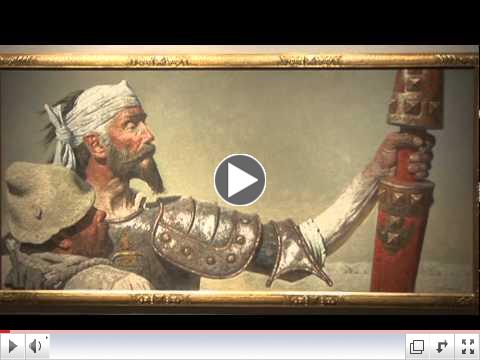 | | Geli Korzhev Installation at The Museum of Russian Art (TMORA) |
|
|
Guardians of Russian Art Museums
Cantor Arts Center, Stanford University July 25, 2012-January 6, 2013
In the United States, many museum guards are simply employed to protect the artwork and are clearly identified by some sort of uniform.
In Russia, the traditions of a gallery guard are a bit different. Often times the guards are not paid and are free to dress as they wish. The women choose to work in the galleries and guard the collections simply because they enjoy being surrounded by Russia's great art. The women are able to request to watch over certain rooms, rotating based on where they are needed most.
Photographer Andy Freeberg found a great interest in these women and created a project featuring these women, entitled Guardians of Russian Art Museums.
The 16 "Guardian" photographs came about when Freeberg traveled to Russia in 2008 intending to document the country's evolution since his last visit in the 1980s. But once there, Freeberg focused his lens on the retirement-aged women guarding Russia's national treasures in the art museums. Freeberg discovered that despite sitting for hours and earning little pay and even volunteering, the women loved their jobs; they were deeply proud of Russia's culture and felt honored to protect and share its treasures. He was struck by how the guards unconsciously resembled and complemented the objects in their care. The photographs emphasize how the women become part of the visitor's overall museum experience. When viewing the paintings and sculptures, the presence of these women becomes an inherent part of viewing the artwork itself.
"They are the guardians of the country's masterpieces, but also of much more. This series of photographs reflects the singular role that these women play in both the Russian art world and society as a whole." -from the introduction by Clifford J. Levy, Moscow bureau chief of the New York Times
It's interesting to imagine what each woman's personality must be like based on which artwork she chooses.
 | | Kugach's Before the Dance, State Tretyakov Gallery |
 | | Veronese's Adoration of the Shepherds, Hermitage Museum |
"After a while, part of the fun became finding the [portraits] where the women and the artwork resemble each other," he said. Freeberg acknowledged that the lyrical-looking guard of Veronese's "Adoration of the Shepherds," at the State Hermitage Museum looks very much like the subject of Vermeer's "Girl with the Pearl Earring." She could also pass for an Italian shepherdess, perhaps, and in that way she is a kind of live extension of the painting.
 | | Matisse Still Life, Hermitage Museum |
Another whimsical protector can be found in front of the "Matisse Still Life" at the Hermitage. Her bold, swirly sweater and printed stockings seem to match Matisse and add an air of festivity not often associated with Russian museum life.
 | | Statues of Antonius Pius, Youth and Caryatid, Hermitage Museum |
 | | Rublev and Daniil's The Deesis Tier, State Tretyakov Gallery |
 | | Konchalovsky's Family Portrait, State Tretyakov Gallery |
 | | Michelangelo's Moses and the Dying Slave, Pushkin Museum |
 | | Repin's Portrait of Baroness von Hildenbandt, State Tretyakov Galley |
 | | Portrait of Y.M.Yevreinov, Artist, State Tretyakov Gallery |
Her identity remains anonymous, but her face is not. The mature woman who guards the portrait of Y.M. Yevreinov at the State Tretyakov Gallery in Moscow is emblematic, but her expression is singular. The viewer is riveted by her bare and gentle wistfulness, an expression borne of experience and memory that overshadows the painting she protects.
"It's a look a lot of the women have," said Andy Freeberg, the 54-year-old photographer whose portrait series, "The Guardians of Russian Art Museums," has become an Internet sensation. "If they don't know you, they are not going to smile," he added. "My sense is that smiling is something intimate." Over time, the women did clearly become comfortable with Freeberg, yet their expressions still bear a certain gravitas and hard-earned dignity.
The woman seated in front of Repin's "Portrait of Baroness von Hildenbandt," also at the State Tretyakov, could pass for an older version of the Baroness herself (or even Anna Akhmatova). She wears a peach and purple crocheted shawl draped over black pants, with what looks like a swipe of red lipstick and a croissant-style bun on the top of her head.
 | | 2nd Century Mummy Masks, Pushkin Museum |
 | | Petrov-Vodkin's Bathing of a Red Horse, State Tretyakov Gallery |
 | | Nesterov's Blessed St Sergius of Radonezh, Russian State Museum |
 | | Malevich's Self Portrait, Russian State Museum |
 | | "Running", Alexander Denieka, Russian State Museum |
Guardians: Photographs by Andy Freeberg, an Exhibition in Three Parts
July 25, 2012- January 6, 2013, Cantor Arts Center, Stanford University
|
|
Marc Chagall's Russian Roots
The Origins of the Master's Creative Language
Once banned as "bourgeois", the work of painter Marc Chagall is enjoying a revival in the ex-Soviet Union with a new exhibition delving into the influence folk art and his Russian Jewish roots had on his work.
Marc Chagall's fantastical canvases, with their floating fiddlers, two-faced cats and explosions of color-are instantly recognizable, and uniquely beloved. But where did these visions come from?
The State Tretyakov Gallery endeavors to answer this question with a new exhibition in honor of the artist's 125th birthday. It displays dozens of rare early graphics and paintings from his youth in Belarus, as well as mature collages, illustrations and ceramics from the 1960s and '70s, allowing viewers to trace the motifs that Chagall would continue developing until his death at age 97.
 | | "If I create from the heart, nearly everything works; if from the head, almost nothing." - Marc Chagall |
Chagall was born Moishe Shagal in 1887 near Vitebsk, Belarus. Under the Russian Empire, Vitebsk was part of the "Pale of Settlement," the area to which Catherine II confined the Jews of her empire in the 18th century. He grew up in a shtetl, or small Jewish settlement; his father hauled barrels for a herring merchant, and his mother sold groceries.
When the 1917 Russian Revolution abolished anti-Semitic laws, Chagall was appointed Fine Arts Commissioner in Vitebsk, but a conflict with his fellow painter and colleague Kazimir Malevich led to his resignation in 1920.
Chagall left Vitebsk and within two years immigrated to France.
Arriving in Paris, his mystical visions of shtetl life contrasted starkly with the city's then-dominant Cubism, leaving him excluded from artists' circles but attracting interest from poets such as Guillaume Apollinaire. After fleeing to the United States in 1941, he returned to France after the war, remaining there for the rest of his life.
 | | Nude Over Vitebsk |
Chagall's work was far from static. He became increasingly enamored with color, as reflected in vibrant paintings and collages from the 1960s and '70s. (The works, which were studies for murals at New York's Lincoln Center and Metropolitan Opera, are being shown for the first time in Russia.) He also incorporated images from other life experiences, from youthful Parisian nights to his late-in-life rural retreat in Provence.
But he would never abandon the themes of his childhood village, which was decimated during World War II. In one bold red collage from 1966, for example, there appears the familiar figure of a man playing a fiddle, looking straight from Chagall's sketches of turn-of-the-century Vitebsk.
"Regardless of when his works were created, in youth or in old age, he drew on the same sources," Chagall's granddaughter Meret Meyer said at the exhibition opening.
 | | Russian Village |
One of the main components of this latest Russian tribute to the artist is a display of his family collection of portraits, never-before exhibited in Russia. The series, entitled My Life,was painted in 1922 provides an illustrative background to his family life, including all its key members, as well as a substantial references to his hometown of Vitebsk.
Other notable works in the exhibition include Chagall's Bible illustrations, with their richly colored renditions of Old Testament characters, and black-and-white designs for Gogol's "Dead Souls." The latter inspired the book's first French translation in 1925. Other rare treats are the 69-piece wedding service Chagall created for his daughter Ida's marriage in 1951, which Chagall's granddaughter recalled eating borshch from, and two marble fountain sculptures from 1964.
 | | The Exodus |
"In this exhibition you can hear a certain musicality, which comes directly from the artist's soul."
A noted realistic, who drew both realistic and fantastical references from real life events and locations, notable Jewish references in his displayed works include repeated symbolism of menorahs and the Torah (Jewish bible). When posed the question as to whether his art was based on fantasy or reality, Chagall is recorded as having answered: "It is not true, that my art is fantastic. I'm a realist and I love normal life on earth!"
 | | Angel over Vitebsk, 1977 |
Exhibition curator Ekaterina Selezneva claims the showing, which runs until September 30, "must help people to understand the mystery of Chagall", whose Russian roots are often overlooked due to his home nation's former rejection of his work.
"Visitors often ask, why Chagall's animals are blue, yellow or pink, why the bride is flying over the rooftops and the man has two faces. They will now understand where Chagall drew (his images) from," said curator Ekaterina Selezneva.
 | | The Blue House |
"It's impossible to present a complete, exhaustive exhibition of Chagall all at once," she said.
Seleznyova said the focus on Chagall's roots stemmed from responses to the 2005 show.
"Of course there were many positive reviews and thanks, but there were also very many questions," she said.
"Some of them were simple - 'Why is there a green goat in the painting, or a person with a yellow face?' But there were also more complicated questions about his persistent motifs." Some of the answers can be found in rarely seen graphic works from the artist's youth in Vitebsk. Drawings, watercolors and gouache paintings from the early 1900s depict everyday scenes of shtetl life. People attend weddings, play street music, put out fires and gather for meals, highlighting the warmth and community that could flourish amidst the poverty of the shtetl. The most intimate works, on loan from Chagall's descendants, depict moments from the artist's family life, such as his grandmother sweeping or taking a nap.
 | | Rain |
"The exhibition gives the strong impression that we're seeing, in essence, his diary," Seleznyova said.
To help viewers explore Chagall's formative influences, there are real-life artifacts from Eastern European shtetls, on loan from St. Petersburg's Ethnographic Museum and the Museum of Jewish History in Moscow. Next to a painting of a family gathered around a baby carriage, for example, visitors see a real carriage from the same time. Other period objects on display include suitcases, Torahs, menorahs and hair clippers.
 | | "The Falling Angel", 1922 |
|
| | Getting under the skin of artist Marc Chagall |
Marc Chagall: The Origins of the Master's Creative Language
|
|
Thomas Kearns McCarthey Gallery
444 Main Street, P.O. Box 1695, Park City, UT 84060
Tel: 435.658.1691 Fax: 435.658.1730
website: www.McCartheyGallery.net11 AM to 6 PM Monday through Thursday
11 AM to 9 PM Friday & Saturday
11 AM to 5 PM Sunday
Open until 9 PM for Gallery Stroll (last Friday of every month)
Stephen Justesen Robin Valline Jannett Heckert Susan Wythe
Gallery Director Art Consultant Sales Consultant Sales Consultant
Add info@McCartheyGallery.net to your Address Book to ensure delivery to your inbox.

|
|
|
|
|
|
|
|
|
|
|
|
|



