THE ALL-IMPORTANT DOG WALK!
Author: Dawn Pizzoferrato, ABCDT, owner of Pizzoferrato Pet Care and Training Services.
Most dog owners know that their dogs need exercise. But most don't
know how important this need is to the relationship between dog and
owner and many dog owners don't know how much and even more importantly
what kind of exercise their dog needs.
There
are all sorts of fallacies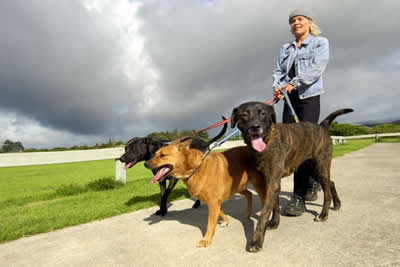 regarding exercise: Small dogs need less
exercise and large dogs need more. If you have a large yard where your
dog can run free, he will get enough exercise. If you play fetch with
your dog for a few minutes each day your dog is getting plenty of
exercise. Well, these are all false. There are many small breed dogs
(Terriers come to mind) that need much more exercise than large breed
dogs (Great Danes also come to mind). And in my opinion, a romp in the
back yard after you come home from work with a few minutes of fetch is
simply not enough exercise for most adult dogs. regarding exercise: Small dogs need less
exercise and large dogs need more. If you have a large yard where your
dog can run free, he will get enough exercise. If you play fetch with
your dog for a few minutes each day your dog is getting plenty of
exercise. Well, these are all false. There are many small breed dogs
(Terriers come to mind) that need much more exercise than large breed
dogs (Great Danes also come to mind). And in my opinion, a romp in the
back yard after you come home from work with a few minutes of fetch is
simply not enough exercise for most adult dogs.
Dogs need to walk. That's what they do. Yes, they are great runners
and absolutely love it, but walking (or a trot) is their natural pace
for getting around in the world. So as the "Pack Leader" it is our
responsibility to walk with our dogs. Did you notice I wrote, "walk with our
dogs"? That's because that is really how it should be. Your dog
shouldn't be pulling on you and you shouldn't have to be pulling on
your dog. It should be a calm, stress-free, relaxing yet focused time
for both of you. When a group (pack) of dogs walk together they are
bonding. They establishing and strengthening their roles in the pack.
So how do you make that happen? Well, first let's discuss WHEN to
walk your dog. It is my belief that dogs should be walked BEFORE being
fed. I don't think it matters whether it is in the morning or evening.
It just needs to be before they are fed. Why, Do you ask? I have two
reasons. One-it is the natural order of things for dogs. A dog wakes up
in the morning, goes for a walk "looking" for food, eats, then naps.
Walking is how a dog "works" for it's food. We all must work for our
food, and so should your dog. No free-rides allowed. Two-If you have a
dog prone to Bloat (the deadly problem when the stomach fills with air
and can possibly twist), it's important that your dog does not exercise
after eating.
 So you're ready to walk, now is the time to start acting like a leader. It is important that you
initiate the walk. If your dog is begging you to go walk and you do,
who is the leader? Your dog is. Just wait (taking away your attention)
until your dog is calm and make the walk a reward for it's calm
behavior. Now make your dog "sit" and be calm while you put on the
leash. If your dog can't sit still, put the leash down and walk away.
When your dog is calmer, have her "sit", then try again. This may take
awhile the first time, so give yourself plenty of time so you can be
patient. Pack Leaders do not lose their patience. So you're ready to walk, now is the time to start acting like a leader. It is important that you
initiate the walk. If your dog is begging you to go walk and you do,
who is the leader? Your dog is. Just wait (taking away your attention)
until your dog is calm and make the walk a reward for it's calm
behavior. Now make your dog "sit" and be calm while you put on the
leash. If your dog can't sit still, put the leash down and walk away.
When your dog is calmer, have her "sit", then try again. This may take
awhile the first time, so give yourself plenty of time so you can be
patient. Pack Leaders do not lose their patience.
This might be a good time to talk about equipment. If your dog is
capable of walking on a "loose" leash, all you need is a flat buckle
collar and a regular 6-foot nylon or leather leash. I am not a fan of
"Flexi leads", choke chains or prong collars. If your dog is a puller
or a lunger, a head collar or anti-pull halter (Halti, ControlEase,
Gentle Leader or Canny Collar) is usually an instant fix. They provide
a natural deterrent to pulling by making the head (or chest in the case
of the halter) pull BACK when the dog is pulling forward. It is
wonderful and preferable that your dog learns to walk on loose leash
with just a flat collar. But it is perfectly acceptable to use and
always use a head collar or anti-pull halter. It is important to know
that a regular halter will actually PROMOTE pulling in dog that tends
to pull. This is called "oppositional reflex" which causes them to pull
against anything that's pulling against them.
Donned with all the right equipment, you are now ready to proceed on
your walk. But first you have to get out the door. Your do g should sit
and WAIT for you to open the door. Allowing your dog to bolt out an
open door again tells your dog that he is the leader. So ask your dog
to "sit" then start to open the door. If your dog moves out of the
"sit," close the door, ask for a "sit" again then start to open the
door again. You need to keep doing this until you can open the door all
the way without your dog moving. Now go through the door AHEAD of your
dog. From now on you will exit or enter a door AHEAD of your dog. Okay,
now walk! g should sit
and WAIT for you to open the door. Allowing your dog to bolt out an
open door again tells your dog that he is the leader. So ask your dog
to "sit" then start to open the door. If your dog moves out of the
"sit," close the door, ask for a "sit" again then start to open the
door again. You need to keep doing this until you can open the door all
the way without your dog moving. Now go through the door AHEAD of your
dog. From now on you will exit or enter a door AHEAD of your dog. Okay,
now walk!
Are you walking beside your dog, "with your dog"? Or is your dog
walking ahead of you, sniffing the ground, stopping to pee on every
tree? If the former is true, just keep going; don't stop for at least
2-3 blocks. If you sense your dog needs to relieve itself, YOU decide
where and when. When your dog is done, start up again and walk. If you
have a working dog, get a backpack and have him carry a couple bottles
of water. When you have a breed that was bread to work, you MUST
fulfill that need in them. I have 3-4 different routes I take around my
neighborhood and I alternate between them. This way my dogs have a
slightly varied route everyday with different smells, sights and
sounds. This helps keep them engaged while walking. Their brains will
be working as much as their brawn.
If your dog pulls out ahead of you, stopping to sniff every tree, a
quick collar correction before your dog gets to end of the leash is
quite appropriate. But it must happen before there is any tension on
the leash, be quick and strong enough to get your dog to IMMEDIATELY
turn back to you and then you must immediately create slack in the
leash again. If your dog is wearing a head collar or anti-pull harness,
stop in place until your dog moves back towards you and takes the
tension off the leash before proceeding forward. If pulling continues,
stop, say "EH, EH" and change direction. Do this as often as necessary
to stop any pulling. Same thing goes for a dog lagging behind, don't
wait for him, keep going and encourage with voice for them to catch up.
Talk to your dog when he is doing a good job and keep your pace up.
Your dog is more likely to keep up with you and to be less interested
in extrinsic distractions if you are walking at a fun pace for your
dog. Keeping up this pace will help keep your dog focused. When you
have the perfect walk, you'll know it. You're relaxed, you're holding
the leash gently, and there is plenty of slack on the leash. You are
aware of your dog, but not focused on him. Your dog is aware of you,
but also not focused on you. You each check in once in while, but you
keep moving ahead. happen before there is any tension on
the leash, be quick and strong enough to get your dog to IMMEDIATELY
turn back to you and then you must immediately create slack in the
leash again. If your dog is wearing a head collar or anti-pull harness,
stop in place until your dog moves back towards you and takes the
tension off the leash before proceeding forward. If pulling continues,
stop, say "EH, EH" and change direction. Do this as often as necessary
to stop any pulling. Same thing goes for a dog lagging behind, don't
wait for him, keep going and encourage with voice for them to catch up.
Talk to your dog when he is doing a good job and keep your pace up.
Your dog is more likely to keep up with you and to be less interested
in extrinsic distractions if you are walking at a fun pace for your
dog. Keeping up this pace will help keep your dog focused. When you
have the perfect walk, you'll know it. You're relaxed, you're holding
the leash gently, and there is plenty of slack on the leash. You are
aware of your dog, but not focused on him. Your dog is aware of you,
but also not focused on you. You each check in once in while, but you
keep moving ahead.
Every walk, even for the smallest dog should last at least 20
minutes. If you have a larger or more energetic dog, they may need as
much as an hour, twice a day. Your dog should have a good pant going on
when you return home -- where you enter through the door ahead of your
dog.
Remember, your walk with your dog is your greatest opportunity to
establish your leadership and to bond with your dog. It's when you can
live in the NOW with your best friend, and free yourself from all the
junk you have to deal with the rest of your day. It's one of the
healthiest things you can do for yourself and your dog!
Article may not be reprinted without express written permission
|


 Dear AnnaBelle:
 AnnaBelle's Pet Station Introduces
 Doggie Do Good Beginner -- Clicker Style:


 Few things bring more
enjoyment to your dog than the reward of a treat. And it makes us feel
good, too. The very act of giving a treat helps to solidify the bond
that we share with our canine companions. Unfortunately, many of the
canine snacks available on the market today are non-nutritive "junk
foods" that could be harmful to your dog's health. It's important to
remember that even if you feed your dog a diet of healthy food, "junk
food" treats could have a significant negative impact on his or her
health. Thankfully, you don't have to abandon this great way to reward
your dog. There's no reason treats can't be nutritious and tasty. When
Life's Abundance formulates its baked cookies, it treats them as
important vehicles for nutrition and pleasure.
Few things bring more
enjoyment to your dog than the reward of a treat. And it makes us feel
good, too. The very act of giving a treat helps to solidify the bond
that we share with our canine companions. Unfortunately, many of the
canine snacks available on the market today are non-nutritive "junk
foods" that could be harmful to your dog's health. It's important to
remember that even if you feed your dog a diet of healthy food, "junk
food" treats could have a significant negative impact on his or her
health. Thankfully, you don't have to abandon this great way to reward
your dog. There's no reason treats can't be nutritious and tasty. When
Life's Abundance formulates its baked cookies, it treats them as
important vehicles for nutrition and pleasure.
