|
|
|
Follow us!
Keep updated on Plan Bay Area through our social media tools.
|
|

Welcome!
This is the second issue of our Plan Bay Area e-newsletter. This month we have an update on the next round of public workshops, a new video that helps demystify transportation and land-use planning models, a look at one of our new Climate Initiatives Program pilot projects, and an article about a new U.S. Census Bureau report on commuting in the United States. Helpful links are sprinkled throughout the text to give readers access to additional useful information. If you like this newsletter, please forward it to your friends and family and encourage them to subscribe. (See the Join Our Mailing List button to the left.)
Return to Top
|
|
|
Next Round of Public Workshops Scheduled in January
 | |
Contra Costa County Workshop, May 11, 2011
|
The Association of Bay Area Governments (ABAG) and the Metropolitan Transportation Commission (MTC) will hold the next round of Plan Bay Area public workshops in January 2012. By then we expect to have a set of clearly defined scenarios that illustrate different housing/jobs distribution and transportation infrastructure investments. The scenarios will be evaluated as to how well they help the region achieve the 15 percent per-capita greenhouse gas (GHG) emissions reduction targets and other Plan Bay Area Performance Targets.
Please note that registration is required to attend the workshops. Stay tuned for a future announcement with registration details.
Here is the workshop schedule:
- San Francisco County - Thursday, January 5, 6 p.m.
UCSF Mission Bay Conference Center, 1675 Owens Street, San Francisco
- Sonoma County - Monday, January 9, 6 p.m.
Finley Community Center, 2060 West College Avenue, Santa Rosa
- San Mateo County - Tuesday, January 10, 5:30 p.m.
The Hiller Aviation Museum*, 601 Skyway Road, San Carlos
(*Please note new location: revised December 8, 2011)
- Alameda County - Wednesday, January 11, 6 p.m.
City of Dublin Civic Center, 100 Civic Plaza, Dublin
- Marin County - Tuesday, January 17, 6 p.m.
Marin Center, 10 Avenue of the Flags, San Rafael
- Santa Clara County - Wednesday, January 18, 5:30 p.m.
Santa Clara County Government Center, 70 West Hedding, San Jose
- Napa County - Thursday, January 19, 6 p.m.
Napa Elks Lodge, 2840 Soscol Avenue, Napa
- Contra Costa County - Monday, January 23, 6 p.m.
Richmond Convention Center, 403 Civic Center Plaza, Richmond
- Solano County - Wednesday, January 25, 6 p.m.
Solano County Events Center, 601 Texas Street, Fairfield
We also have updated the Plan Bay Area Process Charts to reflect the revised workshop schedule. In the meantime, please stay involved in Plan Bay Area. One important way to participate is by attending the monthly meetings of our Regional Advisory Working Group (RAWG). The group meets on the first Tuesday of every month at 9:30 a.m. in the auditorium at the Joseph P. Bort MetroCenter, 101 Eighth Street, Oakland 94607.
Another great way to stay involved is by reading this newsletter, passing it on to your friends, subscribing to the OneBayArea Twitter feed and reading and "liking" the OneBayArea Facebook page.
Return to Top
|
New Video Helps Demystify Transportation and Land-Use Models
 | | Demystifying Land-Use and Transportation Modeling |
|
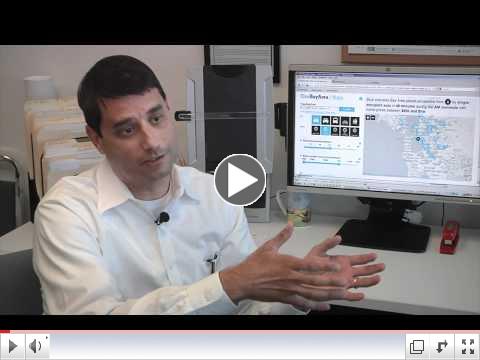
In our last issue we told you about the agencies' new Travel Time and Housing Prices Mapping Tool. This user-friendly web tool, based on MTC's and ABAG's modeling work, makes it easy for anyone to see their commuting and housing options depending on choice of travel mode and current home prices.
Please take a moment to view a new video that demonstrates the tool and explains the modeling process. It features ABAG land-use modeler Mike Reilly, MTC transportation modeler Dave Ory and MTC public information officer Leslie Lara. We encourage you to try the tool yourself, and we hope the video will help take some of the mystery out of the complicated modeling process.
Return to Top
|
Truckers Tweeting as Part of MTC's Climate Initiatives Pilot Program

Burt Reynolds would have been lost without his CB radio in the movie Smokey and the Bandit. That was back in the 1970s when "citizens band" radios were all the rage. In 2011 truckers and enthusiasts still use the CB airwaves, but new communication tools could revolutionize the way truckers transport goods, alleviating road congestion around ports and terminals, and reducing air pollution, including the greenhouse gases (GHGs) that cause climate change.
One such tool was unveiled in October as part of a pilot project involving a partnership between MTC, the Port of Oakland and West State Alliance. Using a cell phone's texting feature, MTC's 511 system is alerting the pilot group of truckers about real time traffic congestion at specific locations throughout the port, along with Bay Area-wide incident and congestion information. This could help immensely, since no system currently exists to inform truckers of traffic congestion in the port, causing long wait times and excess GHG emissions from idling. This information will enable the truckers to alter their travel times to avoid congestion, reducing wait times and air pollution. (Of course, we encourage responsible texting, and will instruct the truckers to check texts prior to leaving on a trip or while stopped!)
If all goes well, we hope to launch the program to all truckers who frequent the port.
Return to Top
|
SF Bay Area Commuters Rank Second in Nation in Public Transit Use, According to New Report by U.S. Census Bureau
 Nearly 15 percent of Bay Area commuters take public transit to work. That's according to a new study released by the U.S. Census Bureau's American Community Survey Reports, "Commuting in the United States: 2009." The only metropolitan region surpassing the Bay Area in transit ridership was the New York City area with about 30 percent. The Washington, DC area rounded out the top three with 14 percent of commuters riding transit to work. Nearly 15 percent of Bay Area commuters take public transit to work. That's according to a new study released by the U.S. Census Bureau's American Community Survey Reports, "Commuting in the United States: 2009." The only metropolitan region surpassing the Bay Area in transit ridership was the New York City area with about 30 percent. The Washington, DC area rounded out the top three with 14 percent of commuters riding transit to work.
The Bay Area did not make the top ten metro areas for commutes to work by bicycle or walking. The top biking/walking towns mostly had populations of less than 500,000 (compared to 7 million in the Bay Area!), and many were university towns with large numbers of college age students.
Some other highlights from the report:
- Surprise! The Bay Area did not make the top ten list of metro areas with the longest commutes. However, Bay Area workers' average commute time of 27.1 minutes was still longer than the national average of 25.1 minutes.
- Over three-quarters of the nation's workers drove to work alone.
- More than 81 percent of suburban workers drove to work alone, compared to about 72 percent of urban dwellers.
- About 16 percent of Hispanic workers carpooled, compared to nearly 10 percent for non-Hispanic workers.
- Public transit usage among African-Americans was the highest of any ethnic group; at 11.5 percent, it was more than three times the rate among non-Hispanic Caucasians.
|
Plan Bay Area is a joint effort led by the Association of Bay Area Governments (ABAG) and the Metropolitan Transportation Commission (MTC) in partnership with the Bay Area's other two regional government agencies, the Bay Area Air Quality Management District (BAAQMD), and the Bay Conservation and Development Commission (BCDC). For more information visit our website.
Return to Top
|
|
|
|
|
|
|