|
Uncovered! The truth about septic tank pumping
by David Casaletto
Ozarks Water Watch Executive Director
Much of my water quality career has been focused on stopping pollution from failing septic systems and other wastewater treatment plants. Besides replacing failing systems, a lot of emphasis has always been placed on educating homeowners on maintenance and care of their septic systems. (You city dwellers on sewer keep reading! You need to be prepared for when you decide to leave the city life and join us out here in the Ozarks hills!) One of the most common and easy things a homeowner needs to do and the one that we all hear about most is getting the septic tank pumped on a regular basis. There are even rebates available from some watershed groups to encourage this pumping.
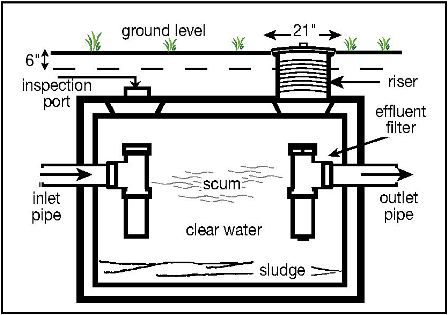 | | Diagram of typical septic tank with effluent filter and riser. |
While I agree 100% that the regular pumping of your septic tank is important, I think there is sometimes a lack of communication as to why it is needed. First let's get the misconceptions out of the way. Will pumping fix a failing system? No. Will it stop effluent from surfacing on the ground or backing up in the home? Only temporarily until the tank fills back up. Will pumping your tank prevent potential pollution to ground and surface waters? Yes, by protecting your lateral field.
 | | Use this chart to decide when to pump. |
So why do we pump a septic tank? The answer is that pumping is an insurance policy to prevent damage to the lateral or soil absorption field. Normally all the workings of a septic system, good and bad, happen below ground and away from our sight. I was made aware of a septic problem last week where a "reed bed" had been installed between the septic tank and the lateral to provide for additional treatment. This "reed bed" allowed us to view what happens when solids leave the septic tank.
A septic tank is a large container that usually holds 1000 gallons or more and is made out of concrete, plastic or fiberglass. When you flush your toilet, run your dishwasher or do laundry, the water drains down the pipes and out to the tank. The solids (sludge) settle to the bottom of the tank and the fats, oils and grease floats to the top as scum. The center of the tank is what is called the "clear zone". While it is not completely clear and definitely not fully treated, the effluent is mostly free from solids. About 20% of the treatment happens in the septic tank with 80% happening in the soil. (That is why if there is not enough soil or the wrong type of soil, an advanced treatment system with drip irrigation may be needed.) This partially treated effluent travels out of the tank into the lateral field where bacteria in the soil clean and treat the water.
Over time, the solids in the bottom of the tank build up. If the tank is not pumped, the solids can flow out of the tank into your lateral field. The solids will prevent the effluent from reaching the soil so surfacing will occur. At this point, the lateral field is ruined and can be very expensive to replace. To protect the lateral field, most new systems (but very few old ones) now have an effluent filter installed at the outlet of the septic tank. This filter will keep solids from flowing out of the tank. This filter requires periodic cleaning as, overtime, it will clog. The outcome of a clogged filter will most likely result in sewage backing up into your home.
 
Effluent filter (blue) must be cleaned periodically.
The reed bed I referred to earlier is a concrete tank, without a lid, placed between the septic tank and the lateral field. There are pipes with holes in them running through the bottom of the tank. The tank is filled with crushed rock then covered with soil and planted with reeds. The effluent passes through this tank on its way to the lateral field allowing the bacteria that live on the rocks in the bed to treat the effluent before it enters the lateral field. Sort of a man made "wetlands".
 | | Reed bed rock was clogged with sludge (solids). |
In this case, the septic tank was not pumped in time and solids traveled into the reed bed. The bed acted like a very large effluent filter and over the course of years finally plugged up and the effluent surfaced. The fix was to remove the rock and solids, clean out the pipes and install new clean rock. This homeowner was lucky as the reed bed, acting as a filter, prevented solids from entering his lateral field so a complete lateral field replacement was not needed. While a reed bed is just one of many options a homeowner has when installing an onsite system, I am not promoting it over any other. In this case it just allowed us to "see" what normally happens underground if the pumping of a septic tank is ignored. If anyone has questions on your septic system or wastewater treatment in general, feel free to contact me and I will help you find the answers.
In closing, if you are interested in the latest news articles on water quality and the environment and current events and activities, please go to the Ozark Water Watch FACEBOOK page and "LIKE" us. Plus please pass this newsletter along to your friends and colleagues and encourage them to subscribe!
Finally, my youngest daughter is a graphic designer and lives in Portland, Oregon. She just returned from a combination business trip and vacation to Hawaii. I think I may need to go over there soon and check out the water quality!

| 


