|
Newsletter Title Newsletter Subtitle
April 2011 |
|
|
|
|
|
|
Message From The President | |

Word on the street is good.Things are buzzing, phones are ringing, my vendors are placing larger orders than last year, and we are seeing much more activity in 2011. Unemployment with a slight dip downward, all good ju-ju (vibe). We are back to work full time now, with a full crew. New this year is that we are moving to total staff uniforms, consisting of cargo pants and a collared shirt, instead of just a logo'd shirts. Everyone is really ready for Spring. Enough of the snow. Even though it's getting warmer, keep in mind that even though the garden centers are bursting with your favorite annuals, its still too soon to plant them. The earth hasn't warmed up yet, and yes, we could still see the white flakes for an unwelcome encore(how many times did you go to an Easter egg hunt with snow on the ground?) So, mind the weather, and when it's closer to Mother's Day and maybe even a little later, you are safer to do your summer installations. Springing forward.....
Shelly Hewson |
|
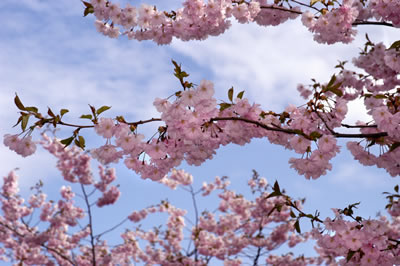
Dogwood Tree |  The Dogwood Tree, also known as Cornus Florida is one of my favorites and has the reputation for being one of the most attractive in North America. Its an excellent choice for all four seasons. Showy flowers blossom in the spring, (in pink or white) with its leaves turning red-purple in the fall. Glossy red fruits attract songbirds. The checkered bark contrasts nicely against the snow. A native tree found growing in the woods; it likes fertile, well-drained soil. Their primary demands are soils high in organic matter and protection from drought. Best results occur when dogwoods are planted in association with larger trees that provide moderate shade. They can grow to twenty five feet tall with a twenty five foot canopy at full maturity. The Dogwood Tree, also known as Cornus Florida is one of my favorites and has the reputation for being one of the most attractive in North America. Its an excellent choice for all four seasons. Showy flowers blossom in the spring, (in pink or white) with its leaves turning red-purple in the fall. Glossy red fruits attract songbirds. The checkered bark contrasts nicely against the snow. A native tree found growing in the woods; it likes fertile, well-drained soil. Their primary demands are soils high in organic matter and protection from drought. Best results occur when dogwoods are planted in association with larger trees that provide moderate shade. They can grow to twenty five feet tall with a twenty five foot canopy at full maturity. |
|
|
|
|
Facts About Daffodils |
 Daffodils, also called Narcissus, were named after a Greek youth who was in love with himself. These pretty yellow flowers are said to have been first sighted about 200-300 years ago in the Mediterranean region. They now grow naturally all over Europe, Asia and North Africa. The ancient Romans cultivated them extensively and then they became the forgotten flower until 1600. Circa 1629, a few Englishmen rescued the daffodil out of the weeds and gave it a place in the garden. The British believed that the sap from theses flowers had special healing powers. Daffodils look best when planted in large clumps or in groupings of the same color. They tend to thrive in cooler climates, which will result in longer lasting blooms. Best time to plant bulbs are in the fall, during September or October. Its important to remember that all kinds of daffodils require a period of dormancy, requiring some chill time prior to the growing season. Daffodils are dormant during the summer months and start growing in the winter. The plants require cold weather to start growing. The best time to transplant bulbs are in the spring, after they have bloomed (this way you can locate them). They need to be yellow and dry. The bulb must be kept in tact. Once removed, store in a cool, dry place until they can be planted in the fall. Best spot to plant bulbs are in a sunny location. Prunning your daffodils should only be done when the leaves have wilted back and not before. The bulbs get their energy from the leaves, and next years bloom will be affected if you prune the leaves before they die naturally. Once this happens, you can cut the leaves and stem to the ground. Dead heading the flowers also helps to save energy for next season's bloom. |
| Snow Mold |

Snow Mold is a fungal disease that appears in the early spring as the snow melts. There are two types of snow mold, grey and pink. Pink mold infects the crown of the plant and can cause more injury than gray mold which only infects the leaf tissue. Snow mold damage looks like circular patches (3"-12") of dead and matted grass. It is not uncommon to find both gray and pink snow mold together. Pink snow mold is distinguished by the pink color of the web-like mycelium growing on the grass surface. While the grass is wet, the mycelium starts out white and resembles cobwebs. As it matures, it turns its pink or salmon color. The mycelium quickly disappears as the grass dries. Gray snow mold is similar to pink snow mold except that its mycelium remains whitish-gray. Gray snow mold is also well-known by the company of tiny black mycelia masses on the grass blades and leaf covers of infected plants. Snow mold is caused when there is an extended period of snow cover on ground that is not fully frozen. It can also be brought on by a badly timed fertilizer application which causes a flush of growth too late in the fall. Snow mold can also occur under leaves that have not been cleaned up or amongst long grass that should have been mowed once more before winter set in. To minimize the risk of snow mold occurring on the lawn it is important to "put the lawn to bed" properly. Avoid excessive nitrogen fertilizers in the fall, then mow the lawn until it stops growing, clean up leaves in the fall and manage thatch to avoid buildups of more than 2". Although it can look really nasty in the early spring, most snow mold damage will recover in time. Once the area has dried, the infection will cease and the turf will grow out and renew itself. To speed up the process, the infected area can be lightly raked to encourage drying. Some overseeding may be necessary and if the damage is extremely severe, topdressing can be applied and areas can be repaired like a bare patch. Repair a bare patch on a lawn and quickly have it blend in with this 20 minute easy, step by step process.
Here's How:
1. Rake and remove any debris or dead grass from the area.
2. Break up the soil with a hard toothed lawn rake or a garden cultivator.
3. Add about 2 inches of compost or loam and incorporate it into the existing soil with the rake.
4. Turn the rake upside down, use the top edge to even out the surface, spread some of the mix to the adjacent areas.
5. Sprinkle seeds evenly across the area, thick enough to cover the surface, but not so thick that the seeds pile up on top of each other. Use the appropriate seed for your region and micro-climate (sun or shade). Perennial ryegrass should be a part of the blend for its ability to quickly germinate.
6. Add a starter fertilizer, preferably one containing a selective, pre-emergent weed control like Tupersan. This will get the grass seed to grow but not any weed seeds. This step is optional for organic lawns or for budget concerns. However, if synthetic starter fertilizer is not used, be sure to use good compost and/or organic fertilizer.
7. Lightly rake in the seed and fertilizer to a depth of about 1/2 an inch. Be careful not to rake away the seed and fertilizer from its desired location.
8. Use a roller or just step down repeatedly on the patch to ensure soil to seed contact and lightly water the area. Keep the seedlings moist throughout the day until they're an inch or so high. After a couple of mowing's, the patch should blend right in with the rest of your lawn.
Tips:
1. A garden cultivator is excellent for loosening the soil.
2. Use straw mulch to cover the patch. It provides shade and prevents the seedlings from drying out.
3. Try to time repairs with appropriate weather for germination and growth. (just before it rains) Avoid drought or stress conditions. |
| Drainage Tips in the Landscape | |
Drainage Tips in the Landscape
Accounting for water flow should be a major consideration when designing your landscape. You need to have a clear understanding of how your property will be graded to direct storm water runoff. Keep in mind that water damage to homes far exceeds termite and fire damage. Most homeowner policies do not cover against water damage in a non-flood zone area.
Preventative Measures Checklist:
· Check to secure your downspouts (from the gutters) for any loose connections including their connection to the underground piping.
· Do not over water plant material near the foundation, patios or fence walls.
· During a rain storm, identify any standing water in the turf or next to your foundation
· Check irrigation system for leaks
· When adding enhancements such as a pool or installing a berm, insure the grade changes and directs surface water away from the house.
· Pipe Air Conditioning condensation lines away from the foundation
· Positive grade should slope away from the house
· Test sewer and water lines for leaks in the system. Today it can be done by inserting a traveling camera into the pipe to determine breaks, sagging or leakage.
· Make sure there is no stagnant water in low lying spots, where water does not drain for a period of time. This then becomes a breeding ground for mosquito's which carry West Nile Virus.
Methods of Correction
· Aerate the lawn
· Install a French drain on the property
· Swall the property to divert water to run off to the direction you prefer
· Re-grade around the foundation and/or raise the soil level if settling occurred.
· Tie your gutters and leaders into an underground run off system. |
|
|
We'd Love to Hear from
Keep your feedback coming.
Whether you'd like to discuss your property, inquire about additional services,
need a price quote, or have a burning gardening question
call, email, snail mail, or stop by in person! We'd love to catch up.
908-222-3616
|
|
Shelly Hewson
President, Hewson Landscape Inc.
|
|
|
|
|