News and Notes
Hewson Landscape Inc.
April 2010 |
|
|
|
|
|
| Message from the President |  The industry is starting to percolate. Things are heating up and getting busy. Myself and in speaking to my colleagues, work is getting scheduled and starting to accumulate. New construction is active again. I'm still working on sites where a lot of winter storm damage occurred. So many mature trees were hit from the last heavy snow-a lot of splitting,cracking, and breaking of major branches, creating a safety need to eliminate before people or houses are effected. I'm also getting an influx of projects that have been kept on hold for several years now, and people are now ready to get it done. It's great to see this much activity. Hopefully, we can keep this mojo flowing. Here's to a Happy Spring!
|
| Perennial Bloomers of the Month |  Grape Hyacinth (Muscari armeniacum)
This flower blooms a purple blue color and literally looks like a bunch of tiny grapes. It's fragrance will tickle your nose and blooms for about 4 weeks. It is happy growing in sun to part shade and likes rich, moist, well drained soil. It is dormant in the summer, but the foliage comes up again in the fall. It looks nice as a front border plant growing about 6-7 inches in height.These bulbs will have to be planted in Fall to reap the rewards in the Spring.
~~~~~~~~~~~~~~~~~~~~~~~~~~~~~~~~~~~~~~~~~~~~~~~
 Bleeding Heart (Dicentra spectabilis) Bleeding Heart (Dicentra spectabilis)
This plant has pink colored, heart shaped flowers attached to an arching stem. It blooms for about 10 weeks and can grow up to 30 inches high and 3 feet across. It does well in some sun to shade, and likes rich, moist, well drained soil. It should be cut back when dormant and also planted behind another plant that will cover up its dormancy in the hot summer months. |
|
|
|
Definition of a Spring Clean-Up
|
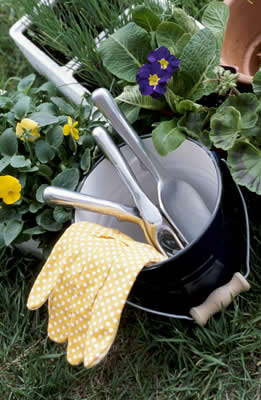 Removal of winter accumulated debris including leaves, twigs, branches, and trash from your turf and planting beds. Power blowing decks, fenced areas, turf and beds. Removal of winter accumulated debris including leaves, twigs, branches, and trash from your turf and planting beds. Power blowing decks, fenced areas, turf and beds.
I have had several clients inquire on the cost of performing spring and fall cleanups. The cost seems to be more expensive than regular mowing and here are the reasons why:
· Labor Intensive- 4-6 men are dispatched on a cleanup crew as opposed to 2 during the regular maintenance season. They are equipped with back pack blowers, rakes and leaf vacuums to remove all the accumulated debris. This proves to be a time consuming job, especially when everything is wet after the winter. Remember, this has not been maintained from December to April, so 5 months is a long time of dormancy and accumulation.
· Debris Disposal- No garbage is left on site, whether it's organic or trash, so the cost to remove and dispose of it is another factor. Some exceptions do apply when organic matter, such as leaves, are left on site and can be blown into the woods, to decay naturally.
Additional services to prepare for the new season include:
· Application of spring fertilizer
· Bed Edging, Mulch installation, and an application of weed control for the beds
· Aeration/overseeding
· Irrigation start up, repairs, and an evaluation of the system
· Spot seeding and top dressing damaged turf areas (this could be a result from pests and snow mold)
· Prune shrubs from winter damage
|
| Adding Color to Your Landscape |  Color is the most rewarding, yet challenging, element to work with in the landscape. Color can be utilized in the garden for the following effects:
· To bring life and excitement to the landscape
· Accent important areas that you want noticed (for example the front door or pool area)
· Blend the exterior environment with structural colors to tie the overall design
· Attract animals and insects, such as birds and butterflies
· Create a mood
· Balance bed and landscape design
· Provide variety and interest through the seasons
Color Design Principles
· Unity
· Focal points
· Balance
· Rhythm
Unity implies than an agreement exists among the elements in a design and belongs together. Unity can be achieved by choosing plants with similar characteristics as a foundation for your plan.
Focal points are the opposite of unity; these are points of emphasis that is different than the rest of the plants. Focal points can be architectural, such as a sculpture or fountain, or a plant with an unusual color or form, such as a red Japanese maple. Caution should be used with too many focal points than can detract from each other.
Balance is an equal distribution of visual weight. In formal design, we replicate on one side of a feature with what is exactly on the other side to achieve balance.
Rhythm is a movement across recurrent motifs. This movement of the eye can be achieved in the garden by the repetition of a certain color at regular intervals. An example would be a line of daylillies placed at regular intervals in a perennial border.
Plant Colors
In addition to flower color, plants may have colorful bark patterns, fruit, leaves or fall color. Examples of trees with colorful or textured bark include river birch, and American beech. Hollies are wonderful winter accents with bright red, yellow, orange, or black fruits. There are many cultivars of trees, shrubs, and herbaceous perennials that can give you a variety through our four seasons.
|
| New Plant Introductions for 2010 |
Landscape professionals have expressed the need for plants that present a longer lifespan, and can endure harsher conditions. They need perennials that are able to overwinter, and annuals that bloom bigger and are more colorful than before to be worth the extra cost. The landscape industry has been answered by lots of new vegetation. People now have the ability to have plant life and color almost all year long, even in those chilly winter months. New Picks Laser Cyclamen are just the thing for adding dramatic color to any landscape in fall, winter, and early spring. They stay lively with color in temperatures as low as 30 degrees. They are available in 18 colors so there is something for everyone to enjoy. They look excellent in any landscape and last through the winter. They grow well in partial or full shade; they reach an average height and width of 10 to 12 inches. Cyclamens have elating foliage, after the flowers die back, and a delightful fragrance. Pulmonaria "Silver Bouquet" is mildew resistant, has short bloom stalks, vivid colors, and thick foliage. It is also tolerant to high temperature and humidity. This  particular plant displays brilliant silver foliage even when the flowers are no longer present. They do well in average soil and can be planted in part sun or shade. They will grow 20 inches wide and 7 inches tall on average and usually consist of several shades of large pink flowers.  Heuchera "Electra" is a perfect perennial with blood-red veins that electrify bright golden leaves. The red in the vein stays true while the leaf will change color throughout the change in temperature. The leaves are yellow shades in the spring and chartreuse in summer and fall. This plant is heat and humidity tolerant and is best placed in full shade in moist but well drained soil that is low in peat. On average it is 11 inches wide and 7 inches tall. |
| Weed of the Month |
 Dandelion is a winter perennial. The dandelion has a thick fleshy tap root which often branches. New plants come from the root, or root segments. The flowers are yellow and have individual stems. The yellow flower will turn to a white globular puff ball, disseminating seeds by wind. Dandelions spread both by seed and stems from the root. Integrated Pest Management Control Recommendation: Dandelions can be physically removed, but it is very important to remove the tap root, in its entirety, as new plants can sprout from root sections. Use the appropriate digging tool which is designed to penetrate deep with minimum damage to surrounding turf grass plants. Herbicide Use: Since dandelions are winter perennials which germinate in the fall, postemergent herbicide applications will be most effective. Use a selective postemergent application timed after germination when plants are young and actively growing. |
| Arbor Day |
 In 1854 J. Sterling Morton moved from Detroit to Nebraska with his wife. Morton was a journalist and became the editor for Nebraska's newspaper. He used this as an opportunity to spread his enthusiasm and knowledge for trees.
The people of Nebraska soon came to find that trees were needed as wind breaks, to keep soil in place, for fuel and building purposes, and for shade from the hot sun. Morton began to advocate individuals for planting trees in his articles, and editorials. He encouraged civic organizations and groups to join him. Due to all this effort he became the Secretary of the Nebraska territory. This allowed him more opportunity to stress the importance of trees.
April 10, 1872 was the first Arbor Day and an estimated 1 million trees were planted in Nebraska. By 1882 schools Nationwide were celebrating Arbor Day and going out and planting trees. In 1885 Arbor Day was declared a legal holiday in Nebraska and April 22, Morton's birthday, was the permanent date for the holiday. Today we honor Arbor Day on the last Friday in April. This year it is Friday, April 30. |
| Earth Day |
 Senator Gaylord Nelson is known as the founder of Earth Day. His passion for having this day of recognition began in 1962 when he realized that our environment and its well being was such a non-issue in the politics of our country.
Nelson went to Washington to meet with Attorney General Robert Kennedy to discuses having President Kennedy shed some light on the issue of our planet. In September of 1963 President Kennedy began his five-day, eleven-state, conservation tour. The tour did not succeed in bringing environmental issues to the national political agenda.
For 6 years Nelson spoke all over the country on environmental issues. In the Summer of 1969, after having hardly any success, Nelson was at a college campus and witnessed an anti-Vietnam war demonstration. This gave Nelson the idea to organize a huge grassroots protest over what was happening to the environment. The ball started rolling. In Seattle, in September of 1969 Nelson announced that in the spring of 1970 there would be a nationwide grassroots demonstration on behalf of the environment and invited everyone to participate. The story was carried from coast to coast and the response was electric. On November 30, 1969 the New York Times held an article by Gladwin Hill discussing the astonishing explosion of environmental events taking place across the country. At this point the grassroots activities had ballooned past the capacity of the US senate office and its staff. It then came to Nelson's attention that it was going to be impossible to organize some 20 million demonstrators and the thousands of schools and communities that were ready to participate in the first Earth Day. Yet somehow on April 22, 1970 it all came together and some 20 plus million people made a commitment that day to do something good for the planet.
Today Earth Day has spread across oceans and continents around the world. People all over the planet are aware of the damage that we are causing to the world that we live in and more and more people are stepping up to take a stand and fight for our planets survival. |
| April is National Lawn Care Month: |
 Did you know... Did you know...· Well-cared-for lawns can significantly increase your property value. · A healthy lawn is of utmost importance to our environment. (A 50-foot by 50-foot lawn produces enough oxygen for a family of four.) · Lawns cool the atmosphere. (Eight healthy front lawns have enough cooling effect of 70 tons of air conditioning, which is enough for 16 average homes.) · Grass converts carbon dioxide to oxygen, a process that helps clear the air. · Dense, healthy grass slows water runoff, removing contaminates and trapping soil. Fresh,filtered water returns to the underground water supply. |
 |
| 10% Weed Control Coupon | |
Commercial/Industrial Clients
Save 10% on your first non selective weed control service, with a minimum sign up of 2 applications.
We guarantee our work. If your weeds don't die back after 10 days from our first application, we'll follow up with a second visit at NO COST to you.
Offer Expires: May 30, 2010
P.s.-Remember last year with all that rain? The weeds grew out of control!
|
|
|
We'd Love to Hear from You!
Whether you'd like to discuss your property, inquire about additional services, need a price quote, or have a burning gardening question- call, email, snail mail, or stop by in person! 908-222-3616Hewson Landscape Inc.601 North Ave., Plainfield, NJ 07060info@hewson-landscape.com Click Here to Visit our Websiteor |
|
|
|
|