News and Notes
Hewson Landscape Inc.
May 2010
|
|
|
|
|
|
Message from the President
|

Our building has just been audited for a PSE&G Small Business Direct Install Energy Efficiency Program. The program will remove the existing lights, dispose of them and replace with new energy efficient lights, without reducing the light output. Cost to the business is 20% of the project, with 0% financing, offered for a two year period. We will be saving almost 50% of our current usage of KWH, which is an equivalent of planting 2 acres of trees annually or removing 1.4 cars from our roads annually. Just one way to reduce the carbon imprint of our existence.
|
| Purple Sensation Ornamental Onion (Allium aflatunense "Purple Sensation" |
 The Allium 'Purple Sensation' is a fall planted ornamental bulb. When the flower blooms in late spring and early summer it blooms for about 3 weeks. The plant has tightly packed pink-purple florets which sit at the top of a tall, thick, bare stem. The plant can grow to be 26-34 inches tall. The blooms are fragrant. When planting them, the bulbs should be spaced 4-5 inches apart and about 5 inches deep. For a striking, eye catching focal point it is best to plant 10 or so in the same area. The plant does well in most soils, and likes the soil to be well drained. It also likes full to partial sun. This plant will add nice color to your garden, and some height. |
|
|
|
How to Prune Lavender
|  Lavender does not like being cut all the way to the ground.If they are, it usually leads to their demise. It is also not good to prune plants back in the cool months of fall and winter. The best time to prune is in the spring and in some cases after their first bloom.
If lavender is pruned in the fall or winter it stimulates the plant to grow, which wastes energy the plant would need in the spring to produce new growth. Instead the plant begins to produce new growth in the cooler months and when the frost comes it kills the plant. The best time to prune lavender is when you see a little green start to appear. Then you can begin to remove the dead tips of branches and old flowers. After the plants flowers fade it is time to dead head the plant and shape it. When pruning lavender it may be easier to grab a bunch of dead flowers and cut them all off at once as opposed to trying to remove each one individually. |
| Container Gardening |  There are several things to
consider before you begin your container garden: · Will the plant be indoors or outdoors? · Does the plant need sun or shade? · What else is going in the pot?
· Can you water the plant as needed? (does the
hose reach)
· Will the containers be in the way? · What kind of containers do you need for
different types of plants? Containers
allow you to enjoy plants in areas where a traditional garden is awkward or
impossible. It also enables you to experiment with plants and to optimize or to
control environmental conditions. You can also control the soil type and how it
drains in a container when you can't always control it in your yard.
Controlling all these things allows you to plant what you want and to also
plant things that maybe you typically were not able to plant before. Having plants in containers provides mobility. If you plant a
plant in a pot and put it in the sun in the morning you can move it into the
shade so that the afternoon heat does not beat down on it all day. Plants in
containers can be arranged to your liking as well. Being able to easily move
the containers allows you to have more control over pest management because the
infected plant can be removed from the other plants and treated before the
problem spreads. Large containers can be moved with a garden dolly. When choosing a container you can use what is typical, or you
can become a little more creative. · Garden poles have become very popular and are
great for growing large amounts of vegetables or flowers in a small area. (For
example, upside down tomato plants) · Hanging baskets are good for spotlighting plants
that you might not notice on the ground. They also change your eye's focus from
the ground to a different height level. · Window boxes compliment the front of the house
or office building. · Raised beds are nice along homes or apartment
buildings, which allows roof runoff to water your plants. Make sure to be aware
of the shade tolerance of the plant if putting it next to the house and not out
in the yard. · Terra cotta pots are good for plants that roots
need to breath. They also hold warmth, which may require additional watering in
the hot summer months. · Stone
containers will add a natural effect to your home or garden. They may break
easily, and some are extremely heavy to move. Make sure that when you use stone, the location is more on the permanent side. You need to take into
consideration freezing and thawing. These along with terra cotta pots may need
to be moved indoors during the winter. They will definitely crack during winter month. I have experience in this department. Quite an expensive mistake. · Plastic pots are the most common, especially
when you buy plants in the store. They are easy to move, and to clean. They can simulate terra cotta, but plastic can be a bit suffocating to the plant. · You can go out and be creative and use any other
kind of container you may find. An old wheel barrow might be nice, or a shoe or
basket, or an old fashioned bath tub or row boat. |
Annuals
|  Annual flowers are plants that go through their entire life cycle-from germination to seed production-in one year. Lasting only one season gives them a versatile place in the garden. They can be used to add color, texture, and volume to any garden. Annual flowers are plants that go through their entire life cycle-from germination to seed production-in one year. Lasting only one season gives them a versatile place in the garden. They can be used to add color, texture, and volume to any garden.
· Plant annuals among perennials or shrubs where you need to fill space between plants.
· Use annuals to add as accents as a burst of color.
· Plant annuals over fading spring bulbs, as they will add color for the summer and then die back and the perennial will have its space again the following spring.
· Grow annuals in a garden for summer cutting, or drying and arranging in the wintertime.
When choosing your annuals think about color, form, and texture. Also be mindful of the plant location. Also keep in mind the spacing of each plant and how much space it will occupy when full grown. Make sure the soil is healthy and ready to be planted in. Adding organic material and mulch helps. If planting in pots use new mix each year.
When transplanting from a container to a pot or your garden plant the plant at the same depth as the container and firmly press down on the soil around the plant making in secure. Applying light fertilizer will give the roots a boost and help them take root faster, thus giving the plant an edge. Mulching flower beds helps retain water and reduce the growth of weeds. Deadheading if required, will help the plants produce more blossoms. |
| Lyme Disease on the Rise |

If
you work or spend time in wooded or grassy areas, you should be aware of the
dangers of Lyme disease. In 2008, nearly 28,921 cases of Lyme disease were
reported to the Centers for Disease Control and Prevention (CDC). Lyme disease
is an infection caused by a bacterium, Borrelia
burgdorferi, which is transmitted through bites from infected eastern
black-legged ticks. Lyme disease is not spread from person to person, only
through the tick. Cases of Lyme disease are most common in large areas of the
northeast. The debilitating effects of Lyme disease can include severe
headaches, arthritis, cardiac abnormalities and central nervous system
involvement leading to neurological disorders. If detected early, Lyme disease
can usually be treated very successfully.
Most
ticks favor a moist, shaded environment, especially areas with leaf litter and
low lying vegetation in wooded, brushy or overgrown grassy habitat. The
majority of Lyme disease cases result from the bites of infected nymphs which
feed in spring and early summer. Deer ticks feed on blood under the skin. They
are slow feeders and will feed for three to five days. If the deer tick is
infected, it must be attached for 24-48 hours before it transmits Lyme disease.
According
to the Centers for Disease Control and Prevention, the first sign of infection
is usually a circular, spreading rash known as erythema migrans (EM). A
distinctive feature of the rash is that it gradually expands over a period of
several days, reaching up to 12 inches across. The center of the rash may clear
as it enlarges, leaving a bull's-eye appearance.
Early Symptoms:
· Swelling of the lymph nodes near the tick bite
· Headache
· Joint pain
· Chills, fever and fatigue
Later Symptoms:
· Two or more areas of rash not at the site of the
bite
· Severe headache
· Enlarged lymph nodes
· Joint/neck stiffness
· Facial paralysis
· Tingling and numbness in the extremities
· Irregular heart rhythm
· Fever
· Arthritis, especially in the arms and legs
· Memory lapses (rare in children and teens)
Prevention:
· Scan clothes and any exposed skin frequently for
ticks
· Use insect repellent containing DEET on exposed
skin other than face
· Wear long pants, long-sleeved shirts, socks and
a hat.
· Tuck pant-legs into socks
· Wear light colored clothing to make it easier to
spot ticks
· Wash clothing in hot water and dry in dryer for
at least one hour to ensure ticks are dead
· Check yourself carefully for embedded ticks when
showering and dressing. Common places for ticks are armpits, scalp, and groin.
Removal:
· Using a pair of fine-pointed tweezers, grasp the
tick by the head or mouthparts right where they enter the skin. DO NOT grasp
the tick by the body.
· Pull firmly and steadily directly outward. DO
NOT twist the tick, or apply any petroleum jelly, a hot match, or any other
irritant. They will not help get the tick out.
· Clean the bite with disinfectant.
· Watch the site of the bite for the appearance of
a large rash beginning 3 to 30 days after the bite.
Remember that if caught early
enough Lyme disease is usually very treatable. Make sure to check yourself
regularly and try to be safe when working and playing outdoors.
|
Ground Ivy (Glechoma hederacea)
|
Ground ivy is a creeping winter perennial. The leaves are round to kidney shaped with round toothed edges. The leaves are opposite on long petiole attached to square stems that root at the nodes. It is usually found in moist shaded areas, but also tolerates sun very well. Ground ivy will form dense mats which can take over areas of turf grass. The flowers of ground ivy are blue to lavender and grow in clusters. They usually flower in the spring. Ground ivy spreads by stolons and sometimes by seed. Ground ivy is a highly aggressive plant species which will quickly invade turf areas from adjacent properties or ornamental planting  areas. The stem runners can be several feet long, and the failure to remove all plants along the entire length will result in re-infestation. All planted ornamental beds must be cleaned out as well. Maintenance of dense strands of turf grass with good insect and disease control and a sound fertility program will help prevent major infestations. Ground ivy in turf areas which must be maintained to high specification will require the application of a postemergent broadleaf herbicide, generally in sequential applications every three to four weeks. This is a very hard weed to control. If you see it, immediately remove it before it gets invasive. |
Mother's Day
|
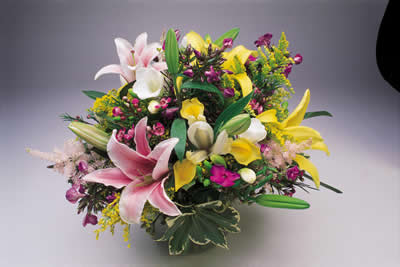 The earliest tributes to mothers date back to the annual
spring festival the Greeks dedicated to Rhea, the mother of many deities, and
to the offerings ancient Romans made to their Great Mother of Gods, Cybele.
Christians celebrated this festival on the fourth Sunday in Lent in honor of
Mary, mother of Christ. In England this holiday was expanded to include all
mothers and was called Mothering Sunday. The earliest tributes to mothers date back to the annual
spring festival the Greeks dedicated to Rhea, the mother of many deities, and
to the offerings ancient Romans made to their Great Mother of Gods, Cybele.
Christians celebrated this festival on the fourth Sunday in Lent in honor of
Mary, mother of Christ. In England this holiday was expanded to include all
mothers and was called Mothering Sunday.
In the United States, Mother's Day started nearly 150 years ago, when Anna
Jarvis, an Appalachian homemaker, organized a day to raise awareness of poor
health conditions in her community, a cause she believed would be best
advocated by mothers. She called it "Mother's Work Day."
In 1905 when Anna Jarvis died, her daughter, also named Anna, began a campaign
to memorialize the life work of her mother. Legend has it that young Anna
remembered a Sunday school lesson that her mother gave in which she said,
"I hope and pray that someone, sometime, will found a memorial mother's
day. There are many days for men, but none for mothers."
Anna began to lobby prominent businessmen like John
Wannamaker, and politicians including Presidents Taft and Roosevelt to support
her campaign to create a special day to honor mothers. At one of the first
services organized to celebrate Anna's mother in 1908, at her church in West
Virginia, Anna handed out her mother's favorite flower, the white carnation.
Five years later, the House of Representatives adopted a resolution calling for
officials of the federal government to wear white carnations on Mother's Day.
In 1914 Anna's hard work paid off when Woodrow Wilson signed a bill recognizing
Mother's Day as a national holiday.
Despite Jarvis's misgivings, Mother's Day has flourished in the United States.
In fact, the second Sunday of May has become the most popular day of the year
to dine out, and telephone lines record their highest traffic, as sons and
daughters everywhere take advantage of this day to honor and to express
appreciation of their mothers.
Happy Mother's Day Mom!
|
|
|
We'd Love to Hear from You!
Whether you'd like to discuss your property, inquire about additional services, need a price quote, or have a burning gardening question- call, email, snail mail, or stop by in person!
908-222-3616
Hewson Landscape Inc.
601 North Ave., Plainfield, NJ 07060
or |
|
|
|
|