Farm Update + Crop Planning Ramblings from Paige
This could be one of my most succinct newsletters to date. That could be because none of us had to be weekend farm-chore-person since irrigation duties and greenhouse watering are chores of the past. Or it could be because we're so darn busy with this week's beautiful and bountiful harvest. In either case, it's a sign of the times. A sign that we're no longer wishing little seeds to germinate or for plants to get rooted strongly. We're now spending our time pulling greens and roots from the fields and cleaning up and cover cropping land to be ready for next year.

I do feel like this -- my sixth -- year here at Serenbe Farms is one of timeliness. It seems like we're finally getting things done when they need to be done and keeping the ball in motion. Much of our fall and winter structure is based on frost dates and notes from past years. In fact, fall planting is one of the last pieces of the schedule to fall into place. For some reason, in the past we've always planted things too early (the soil is too hot, lack of rain) or too late (the soil is too cool, too much rain, early frost). After tweaking the past few years' plans, we've got a basic idea of our earliest dates for planting and our latest dates for planting to acquire harvests for our fall CSA shares. And finally this year, we've got an abundance of crops that in the past we didn't have until too late...such as carrots, broccoli, cabbage, cauliflower, and beets.
The trick to getting all of these things to grow so they can be ready before our CSA program ends is simple...water, water, water. When we seeded the teeny carrots back in July, they (the seeds) thought we were crazy (and so did the cauliflower, broccoli, and cabbage plants that we set out in the hottest part of the year.) But with lots of water at the right time, we were able to keep the plants unstressed and growing strong so that we're now able to harvest when the season seems right for such crops.
Crop scheduling is something I've always enjoyed. Seeing something from seed to harvest is always a pleasure of us farmers, but putting it all into sequence so that we can have 10-12 items for you each week is a daunting matter.
As you likely know, each crop and each variety of a crop takes different amount of time to mature. For instance, we've got quick carrots that take about 50 days and winter storage carrots that can take up to 80 days in the field. 30 days may not seem like much, but a whole month of time taking up bed space is quite a lot of maintenance, water, and work. But there are advantages to the early things and the later maturing things...the winter carrots taste sweeter and grow larger. The radishes that take longer store better and have more unique qualities. The cauliflower that takes only 50 days from transplant to head grows quite small in comparison to the our later varieties that grow to be huge in 20 more days.
Because there is so much diversity in what we plant, it means we can have successive harvests. Just because we planted one bed of cauliflower on August 15th doesn't mean that we'll harvest it all during one day or one week. We walk through the same 200' bed at least a couple dozen times looking for the heads that are perfectly ready...considering each crop produces only one head it takes quite a bit of attention. Growing these different varieties is one way that we can have the same crop for the shares for a couple of weeks.
Similarly, we also plant crops at different times so we can have continual harvests of that crop--known as succession planting. Each time that you've received radishes or turnips in your share, they've come from a different planted area. These crops are so quick that we plant them every 2-3 weeks in a different spot. This means that about every 3 weeks we can put turnips into the CSA share.
To begin a crop plan for this farm, I spent about a week and a half immersed in an Excel spreadsheet where I considered varieties, types of crops, frost dates, temperature highs and lows, precipitation averages, day length, days to maturity, pests, and diseases. It seemed like a big never-ending puzzle. From that time cooped up in the office emerged a 4 page excel crop plan that I've reinvented several times. Typically in a given year we can tell that we're improving because we have less crop failures. In the past we've had to till in countless beds of seeds that didn't germinate or crops that became infested with the season's worst bug or broccoli that flowered too soon because of the heat. Each year we take notes, reflect, and try to make sure that it doesn't happen again.
In farming, we figure that it's not a mistake if it happens only once...it's all a learning experience.
Crop Highlight of the Week:
Sunchokes aka Jerusalem Artichokes
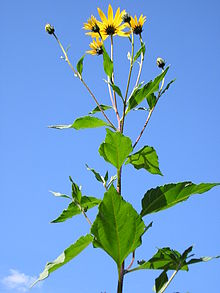 |
| The flower of the sunchoke is very similar to a sunflower |
These interesting ginger look-alikes are one of our favorite crops of this season. Don't be mistaken, they taste nothing like ginger but more of a nutty potato...one that has a texture of a water chestnut and can be eaten raw.
The sunchoke is not an artichoke although it's related to both the artichoke and the sunflower (both in the daisy family).
These crops were cultivated by North American natives...from the Midwest to the Northeast. Since it's been quite the worldly veggie -- favored in gourmet cuisines and even voted 'best soup vegetable' by 2002 Nice festival for the heritage of French cuisine.
These are high in carbs, but not starch, instead inulin which is a good source for natural fructose. This inulin isn't broken down by our digestive system...which is why we call them 'musical roots' (if you know what I mean).
Health benefits--Even so, these like all of our other veggies are very good for you -- high in potassium, iron, fiber, niacin, thiamine, phosphorus, and copper.
Eating them--They are super in storage (will keep for months in the fridge) and can be prepare any way possible. Here are a few ideas:
sunchoke bisque, marinated sunchokes, sunchoke slaw, roasted sunchokes, hash brown sunchokes (my favorite), pickled sunchokes, sunchoke mash, sauteed sunchokes.
Growing them--These things grow like weeds, very pretty weeds. If you'd like to grow them in your garden or in your flower beds, simply take one small root (larger than a quarter in girth) and plant it about an inch deep either now or in the springtime. Give it some space and make sure that you don't have anything that can be shaded out nearby. They grow to be 10-14' high and begin flowering in August. The frost makes the roots sweeter, so dig after you receive your first frost. Be careful to dig all the roots because they can be invasive. We typically have to take care to weed them out of where we've planted them previously.
Learn more here:
Okay, so much for being succinct :)
Take care and enjoy your veggies!
Bon Appetit,
Paige


