Serenbe Farms

  CSA Newsletter and Recipes (year)6-(week)12 


July 12th, 2011

Farm Update from Justin


It hasn't been long since I talked to you guys last but man have we been busy.  In the last week we have pulled almost all of the potatoes out of the ground, pulled the plastic onto our hoop-house, planted some stuff for the fall, weeded most of the farm, and trellised peppers and tomatoes.  Tired but fulfilling this is the peak of our year.  And by that I mean we cover cropped all of the spring areas, are busy harvesting all of the summer stuff, and planting the fall crops.   

Cultural Practices


   So lots of times people want to know how we seed crops and what we do to grow them.  I hope to shed some light on some of our basic cultural practices and educate you guys about how we plant and take care of our crops.

   The most common question is how do we seed crops.  There are many different ways in which we do this from transplanting to direct seeding.  We never buy in any plants only seed and we start all of our crops from seed ourselves.  This helps to ensure that we don't bring in any diseases on plants.  The only potential is on seed and we've never had an issue with it.  

   So transplanting for us involves the following steps.  Let's take swiss chard as an example.  We buy the swiss chard seed early in January.  We plant it in the greenhouse in early February.  We plant it in greenhouse flats where it lives for a few weeks until it goes outside.  This method is how we plant swiss chard, collards, broccoli, tomatoes, eggplant, peppers, flowers, and early season squash.  Below is a picture of what swiss chard looks like a few weeks after germination.  

 This next picture is what lettuce looks like after it's transplanted.


  The other way we get crops seeded is by direct seeding.  This involves placing the seed into the ground and germinating it in the field.  This has advantages over transplanting because the root system is never disturbed, it's typically stronger because it's been outside from the beginning, and it's the only way some crops can work. 

   We direct seed beans, carrots, radishes, turnips, arugula, mustard greens, and peas.  Most all root crops are direct seeded.  In the heat of the summer we have to direct seed everything because the heat in the greenhouse is too hot to allow anything to live.  

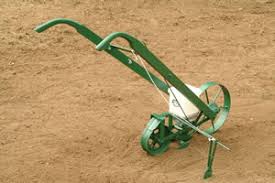
   One of my major jobs on the farm is direct seeding.  Most all of our seeding  happens through one of our two seeders (or by hand for more expensive or larger crops that require larger spacing...ie peanuts, melons, squash).  The two seeders we have are the Earthway and Planet Jr.   Both of these seeders create small furrows, have adjustable depths and seeding rates, cover the seed, then compact the seed for good seed to soil contact.  The advantage of the Earthway is that it is really cheap and effective on the home-garden level and has a short learning curve. For us its great for crops where the seed is cheap and we seed different varieties because it only takes a second to change the seed hopper to the different seed.   The Planet Jr. is much more expensive but can give much better results.  At about seven hundred dollars it's quite an investment.  It is more difficult to learn, has a much more finicky seed hopper, and requires some use to figure out which seed plate to use to seed your crop.  The advantage of the Planet Jr. that I like so much is that it uses much less seed and it's super heavy.  Well pushing something heavy through our soils isn't easy but since it's heavy it doesn't jump around and create uneven germination like the Earthway.  


 Earthway 

Planet Jr. 

    We always plant more seeds than we want so that we can thin out the bad ones and keep the strong ones.  One of the hard parts of direct seeding is keeping the seed moist in the field to germinate in the hot weather.  Another major issue we have is soil crusting.  This happens because of our heavy clay soils.  We typically can stop the crusting by using our floating row fabric which helps to keep the soil moist and keep it from crusting. 

   I hope this sheds some light on what one of our seeding days is like and what it takes to even get a crop to germinate.  


Garlic 


   The small bulb with a big story.  From winter to spring this vegetable probably receives the most of our attention over an extended period of time.  It all starts with prepping beds and ordering seed in the winter time.  Usually we plant our garlic on October 15th each year.  To prep the ground we use soil test to determine what we need to add in to the soil to feed the garlic to be the best, biggest, and nicest it can be.  It involves adding nitrogen to increase dry matter weight and promote leafy growth in the summer, adding 
phosphorus which helps in nutrient movement and cell structure, adding potassium which increases bulb size and helps with nutrient movement, and lastly adding any micro-nutrients which are missing.  [We strive to add micro-nutrients back into the soil ensuring that our food is of the utmost quality and delivered to you packed with micro-nutrients you probably don't get from any other food source.  We use sea water trace mineral liquid fertilizers and other things like azomite.] 


   After the ground is prepped we plant the garlic cloves one a time six inches apart from each other.  It is important to plant the clove with the top pointing up and in the proper orientation so that it doesn't spend all of its energy trying to emerge.  Once it does emerge which is typically a few weeks later it will grow several inches to a foot before the colder winter weather sets in.  At this point it goes 'semi-dormant' until the spring time. 


   In the spring time we begin fertilizing with nitrogen again to promote the leafy growth to help with photosynthesis.  This involves foliar feeding with fish emulsion.  Foliar feeding is when you mix water and an organic source of fertility and spray onto the plant leaves.  We ensure that we keep the garlic field free of competition [aka weeds] and that it is well watered.  


   Once the garlic is a few months from maturity we begin adding lots of seaweed solution through our feritgation[watering through the drip tape] system. The seaweed has a host of cytokins, auxillins, potassium, and trace minerals.  This promotes rapid bulb growth and adds to the garlic flavor.  


   Next it's time to harvest the garlic.  We use the 60% rule that is when about 60% of the green leafs turn brown and die back we begin to harvest.  After we harvest we tie the garlic up in bundles of ten to hang and dry.  It takes about two weeks to dry.  Drying promotes the changeover from sugars to starch and makes the garlic last longer.  After its dried it is given to you guys almost weekly in your share.  


   A note on storage of garlic.  It can be stored at room temperature on your kitchen counter.  Don't feel overwhelmed when you receive it every week.  It will last way into the winter time.  And you can even break it down into cloves and plant it in your garden!


Thanks,


Justin


This week's share
(this list is subject to change): 

Tomatoes!! (cherries + slicers)

Cucumbers (this is the 'reap the benefit/loss' part of the CSA) -- make pickles or share with a neighbor?

Bell Peppers

Garlic

Onion(s)

Edamame (see print out @ CSA distribution for more info)

Melon and/or blueberries

Herbs
 
+possible other item(s) TBD tomorrow

Become a fan of 

Serenbe Farms on Facebook

Where you can:
-see our recent photos
-learn about events
-share recipes 
Links
www.serenbefarms.com

www.georgiaorganics.org
www.slowfoodatlanta.org
RECIPES are found here: www.serenbefarms.wordpress.com


Submit any favorites for the blog to info@serenbefarms.com.