Farm News From Paige
Finally the leaves are changing and we're beginning to think more and more about what tasks we'll be able to catch up on during the late fall and winter. Usually I use the days and weeks to keep track of time and to make sure things are on schedule, but this year nature and the weather have outdone the use of the calendar. Now, when it's dry, we work 10-12 hour days, when it's wet, we work a little less.
Last week was a fantastic fall planting push. I've mentioned that we're a little behind on the planting. When we seeded our early beets (that you enjoyed last week) and carrots (that you'll enjoy the next couple weeks), we assumed that there would be an opportunity to plant and seed every two weeks after ensuring a continual harvest of both of these crowd pleasers. The weather had a different intention and kept us (and our tractor) out of the fields for about a month and a half. Finally the soil had dried out just enough for us to prepare about a quarter acre of bed space that we filled with lettuce, leek, green onion, and fennel transplants that were patiently waiting for their turn to hit the soil. We also direct seeded spinach, tons of carrots, beets, Asian greens, turnips, lettuce mix, radishes, and more! These crops should be ready by the time the last couple weeks of CSA roll around. Thanks to Natalie, Justin, and Stephanie that worked super hard during these long planting days!
I've got planting on the brain. In this newsletter I'll share a couple of tidbits about planting and then briefly share with you our list of goals for the fall and winter.
Planting and direct seeding--the easiest part of farming. These are the two things that we do on the farm that seem to take the least amount of time in the scheme of things. The actually planting or seeding probably only takes about 1/15th of the time that it takes to maintain and harvest the crops. So, to say that we seeded a quarter acre of fall crops in just one afternoon really doesn't equate to too much work. Sure, we have to bend over and seal up all of the transplants roots into our soil. And we have to calibrate our seeder to make sure that our seeding rate is just right. These things do take a little time, but a good planting has a good rythym and efficiency.
Direct seeding. Our sprinkling of seeds into our soil in our fields is referred to as direct seeding. We direct seed certain crops: things that grow close together (arugula, spinach), things where the seed is relatively cheap (chard, beans), and things that don't like being transplanted (root veggies, cucumbers, melons). Some things we plant at specific intervals by hand (watermelon we plant 2 seeds every foot) and some things we use our push seeders (carrots, beets, spinach, etc.).
We have two types of push seeders, one (Earthway brand) is

lightweight, inexpensive and works well with bigger seeds and the other (Planet Jr. brand) is a heavy duty machine that was developed pre-industrial farming days. The workhorse Planet
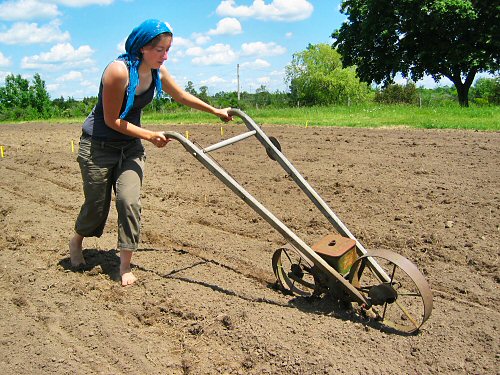
Jr. seeder has 38 different seed hole sizes so it can be calibrated for any seeding job. We typically test the rate of seeds that these machines will drop by running them over a board lined with 2 yardsticks. We can judge the rate by counting the number of seeds that have dropped in a given area and adjust as need be. We don't like spending extra time thinning out seedlings or having to go back to plant more, so the seeding rate is very important.
These seeding machines save us lots of time. They dig a furrow, drop the seeds, cover the seeds, and apply pressure to ensure good soil to seed contact...all in one pass.
 Transplanting.
 One of the more expensive pieces of infrastructure on the farm is the greenhouse. This guy is incredibly functional. It's in full sun, has roll up sides, has fans for air circulation, and a propane heater for warmth. The reason why we installed this uber-functional piece of metal and plastic is simply for the use of starting our transplants. There are certain crops that we seed in our potting soil (we mix ourselves) and then transplant out. The crops we transplant include those that would not have time to mature in the fields due to frosts (peppers, tomatoes), crops where we want to get a headstart on the season (melons, squash, basil), crops that have expensive seed (broccoli, kohlrabi), and crops where we desire a very specific spacing (green onions, head lettuce). Usually things take anywhere from 25 days to 3 months in the greenhouse. We plant them out when their roots have colonized the cell or container where they are growing.
Beds. We plant and seed everything into beds that are approximately 4 feet wide. We have different numbers of rows per bed depending on the crop. Carrots, for example, we seed in 5 rows per bed. Lettuces, 3 rows, squash, 1 row per bed. We also have different spacing 'in row' for each plant. Head lettuces get a foot per transplant, carrots get about 3/4 of an inch between plants, and squash get about a 18" per plant. Things we direct seed need to be thinned down to our desired spacing, but we know we've done a good job with the seeder when minimal seeds are wasted. Thinning is a hard task to teach as we all naturally dislike pulling plants that we've worked hard to get established.
And, as I ramble on, I'll share with you a few things that we plan to do in the next few weeks and months.
Shorter term:
plant lots of strawberries (We missed out on the planting window last year...hopefully we'll have tons of strawberries for the shares next year!)
plant lots of onions and garlic for next year (We have already gotten started! My favorite farm task!)
seed sunchokes for next year
continue planting for the winter (carrots, beets, greens, spinach, lettuces, etc.)
Longer term:
erect a hoop house (unheated greenhouse) for tomatoes in the early summer and lettuces over the winter
inoculate more shiitake logs for mushroom production
begin an oyster mushroom project (these grow indoors in a climate controlled environment)
build permanent shelves in our market shed (and some other facelifts to the shed)
build an insulated box for air conditioned storage of tomatoes, potatoes, garlic, etc.
build a wood fired pizza oven (out of mud!)---we'll probably open this project up to any helpers
If you have any extra time this winter and would like to help out on the farm we'd love to have you. It'll just be Justin and I this winter...extra hands always make these large tasks easier...and construction is fun!!
I hope you enjoy your shares this week. Things to get excited for in the near future will be sunchokes, luffa sponges (actually a gourd), more lettuce, pea tips, more peanuts, carrots, horseradish, and more!
Stay dry!
Paige


