|
Ecocities Emerging
To support humanity's transition into the Ecozoic Era
| Ecocity Builders
August 2012
| |
|
Greetings,
Celebrated U.S. environmental analyst Lester Brown's "Plan B" is a good idea, as is Al Gore's "Global Marshall Plan" (although the latter not useful for world application because it's too historically connected to the US and Second World War history). Plan B's basic idea is powerful. But it doesn't tell anyone what it's all about. You already have to know it's a program to help... Rescue the World."
So why not rechristen and tune it up, with all due credits to all contributing along the way:
World Rescue - 5 Imperatives
1. Population - (plan on reducing it peacefully)
2. Agriculture/Diet Nexus - (generally toward organic, natural energy systems, permaculture, biochar etc.)
3. The Built Environment - (ecocities, ecotowns, ecovillages)
4. Generosity - (invest in the above three, tax and spend on the common good, no stealing, no war)
5. Education - (strongly emphasizing the above four)
The above 5 are long-term enterprises starting gradually and gaining traction, resolutely shifting direction of the course of civilization and I think outlines the absolute essentials that have to be dealt with, as difficult as they are. The built environment is Ecocity Builders' specialty -- the structure that orders it all, and proportionalized properly, sets up ecological networks of cross influence, and implies chains of cause and effect going in the right direction.
My longtime friend Albert Bates (influential figure in the intentional community and ecovillage movements, director of the Institute for Appropriate Technology since 1984) recently sent the following quote: "In times of danger, bitter truths serve us better than sweet lies." -- Diane Dumanoski
Along those lines, here is one of my own: "Leave the low hanging fruit for the children."
Richard Register Founder and President Ecocity Builders


Keeper of the International Ecocity Conference Series
Ecocity Builders is a non-profit organization dedicated to reshaping cities, towns and villages for long-term health of human and natural systems. Ecocity Builders 339 15th Street, Suite 208 Oakland CA 94612 USA www.ecocitybuilders.org www.ecocitystandards.org  Thank you to our major supporters: British Columbia Institute of Technology - School of Construction and the Environment; Helen and William Mazer Foundation; Columbia Foundation; HealthBridge Canada
|
|
Barcelona, Spain launches "City Protocol" - global smart city initiative
Following on from conversations with cities, companies, institutions and organizations to further develop the smart city concept from an urban ecosystem framework, Barcelona has established City Protocol; the public/private basis to become a global reference model of sustainable urban development.  | | Opening panel discussion in Barcelona |
Ecocity Builders' Executive Director Kirstin Miller attended the recent launch meeting of City Protocol in Barcelona and will serve on the Steering Committee representing Ecocity Builders. The first meeting of the Steering Committee will take place in San Francisco in October 2012.
With funding and support from IT company Cisco, Barcelona will also create the BIT-Habitat Foundation (Barcelona Institute of Technology for the Habitat) in order to test-run new urban services based on the City Protocol.
The Foundation will encourage innovation in new services and boost competitiveness and the investigation of economic sectors considered strategic for the city and its area of influence, with special attention on those related to smart cities, sustainable growth, and urban regeneration. The Foundation will foster the association or establishment of agreements with public organizations such as Ecocity Builders, Metropolis and UN Habitat, as well as private firms such as Cisco, with whom it has already signed a participation agreement.
The City Protocol is based on the development of a system that makes it possible to measure and evaluate urban efficiency and quality with indicators that cover structural, functional, social, and sustainability-related aspects.
 | | Discussions on the patio in Barcelona |
Ecocity Builders will link the International Ecocity Framework and Standards (www.ecocitystandards.org) to the foundational basis for the City Protocol. The ecocity approach to sustainable development seeks to maximize the possibility that cities can become more resilient by sustainably meeting a majority of their needs from the natural capital of their own bioregions. Cities and citizens maximize resilience through a whole systems approach that responds to critical risk factors for climate change and natural disasters while concurrently working with a network of cities around the world taking action to restore planetary boundaries to safe and stable conditions. In the spirit of the Internet Protocol which creates today's internet experience, City Protocol is about connecting together the best of the networks and strategies in order to create a new way of thinking, communicating, building, maintaining and living it cities that are increasingly healthy, vibrant, livable and sustainable. For more information: http://www.cityprotocol.org/  | Group photo of the City Protocol
launch meeting in Barcelona |
|
Occupy World Street - The Song
by Ross Jackson
http://www.occupyworldstreet.org/
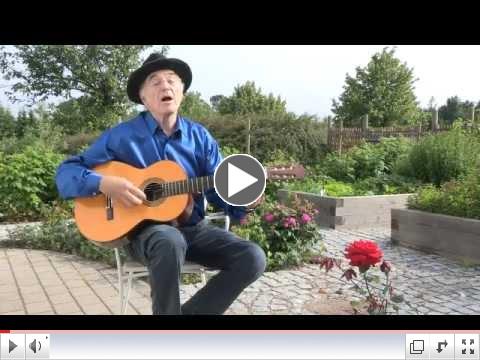 | | Occupy World Street - The Song |
Ross Jackson together with his Danish wife Hildur, is the founder/chairman of Gaia Trust, a Danish charitable association whose main projects to date have been supporting the ecovillage movement, and in particular GEN, the Global Ecovillage Network, as well as supporting education for a sustainable future, and in particular, Gaia Education. |
|
"The only certain thing about this coming century is it's immense uncertainty. The great temptation of our time will be the impulse to flee from this uncertainty. Given the black-and-white propensity of Western minds, it will take conscious effort to resist taking refuge either in despair - in the conviction that 'it's too late' - or in the alternative, to bask in groundless, sunny optimism that 'we'll figure out something, because science always does.'
I have heard a great deal said about the importance of hope as the human prospect has grown darker, but hope will sustain us only if it is clear-eyed. In reflecting about cultural traps that have made past societies incapable of meeting the challenge of changing circumstances, the anthropologist Paul Bohannan asks, 'Have they at least figured out some of the things they should not do? Or are they running on blind hope? That kind of hope kills.' I don't think we have figured it out. I fear blind hope as much as despair."
"In times of danger, bitter truths serve us better than sweet lies."
- Diane Dumanoski - The End of the Long Summer : Why We Must Remake Civilization to Live on a Volatile Earth
|


Founded in 1992, Ecocity Builders is a nonprofit organization dedicated to reshaping cities for the long-term health of human and natural systems.
www.ecocitybuilders.org
|

The International Ecocity Framework and Standards (IEFS) initiative seeks to provide a vision for an ecologically-restorative human civilization as well as a practical methodology for assessing and guiding progress towards the goal.Website http://www.ecocitystandards.org
To date in English, Chinese, German, French, Korean and Portuguese |
|
Car Free Journey
By Steve Atlas

Providence, Rhode Island
Sometimes, we get so caught up in visiting large cities and famous vacation spots that we overlook smaller cities that are delightful, less crowded, and frequently less expensive.
For example, most people know about Boston, MA; but how many of you have ever taken the time to visit Providence, Rhode Island? It's easy to get to Providence. Many areas are within a short walk of downtown or easily accessible by public transportation. Today, our Car Free Journey spotlights Providence, Rhode Island.
"Providence is a very easy city to navigate on foot, by bike, or on bus," says Lani Stark, a local resident who walks or pedals across the city daily. "I moved here nearly three years ago and, after quickly realizing I wasn't using my car, went car-free."
"My very favorite walk (or ride) is from Benefit Street, over the river, and down Westminster Street - particularly during warm evenings or weekend afternoons, when the area is lively and full of things to see and do."
(As a special service to you, we will include some of Lani's suggestions throughout this column. Her comments will be in Italics or (parentheses).
READ ON
 | | Providence, Rhode Island |
|
|
|
Liberating Streets: Of bubbles, hobby horses and tumbling towers (a photo diary)
by Sven Eberlein
Sunday Streets returned to my neighborhood in San Francisco's Mission District. Sunday Streets is an event organized by the City of San Francisco, MTA, and Livable City that creates a large, temporary, public space by closing off stretches of a neighborhood's streets to automobile traffic, and opening them to pedestrians, bicyclists, and activities. Or to be more specific, a huge street party for old and young to come out and be human for a day. 
I've posted about Sunday Streets quite a few times and I keep telling myself that I don't need to do it again, but what makes this event so special is that it's never quite the same. Each time I go, even for just a couple of hours, there are new sights and sounds.
The people who've been there before keep reinventing themselves, and all the first-timers add so many new layers of fun and creativity that it's hard to keep up. I really can't say it enough, but when the streets are for the people and the people get out of their cars, really cool, creative, and unexpected stuff happens, just like that.

READ ON |
14 Keys To Building People
Friendly Communities
I'll be speaking later this week to a new (to me) audience on the subject of sustainable communities, and I've been thinking about what I would like to say. In particular, I've been honored by an invitation to appear at the California Center for Sustainable Energy in San Diego, where my companions on the program will be Howard Blackson of the excellent town planning and marketing firm Placemakers - whose work I cite all the time - and Matthew Porrecca of BNIM Architecture, a sustainability practice best known for leading the green restoration of Greensburg Kansas, destroyed by a tornado in 2007.
I wrestled with preparation for this one, because ours is a fast-evolving field, and the right and true message for today is not the same as it was ten or even two years ago. I didn't feel comfortable with just a re-run of old material. But, as I write this, I am settling on a plan.
I want to share some of the ways I have been coming to think about community sustainability, or what I like to call good "people habitat." And I hope that during the full session there will be a good exchange of ideas among Howard, Matthew, the audience, and myself. I reserve the right to change everything between now and Thursday morning, but I'm pretty sure my remarks will include the following:
 | | Washington, D.C., courtesy of dewithas/Flickr |
1. It's not really about energy. Or any other single environmental issue. When it comes to community, people must come first. If our strategies don't work for people, they won't work for the planet. If our plans don't nourish the human spirit, they aren't worth pursuing.
2. A corollary is that we must think holistically. We're part of an ecosystem where everything affects everything else. When we plan energy or water, we're also planning health, education, and 20 other things, whether we intend it or not. It's best to have the whole shebang in mind from the start.

3. Holistic thinking changes the result. The classic example is that an issue-oriented focus on green building without regard to the context can lead to a very un-green outcome. Holistic thinking recognizes that a low-tech building in the right place can be greener than the award-winning, high-tech building in the wrong place.
4. We don't need to do it all at once, not that we could. Feel good about progress that moves the baseline. Reducing driving by five percent nationally would save 162 million pounds of carbon emissions, more or less, every year. Increasing the average density of new land development by even 20 percent would save 440,000 acres of forests, farmland and habitat, an amount equal to the size of Kings Canyon National Park, every year. Maintain that for five years and we'll save an amount of land equivalent in size to Yellowstone.
5. Half the built environment that will be on the ground in 25-30 years has not yet been built. That presents a tremendous opportunity for progress, and we need to get it right.
6. The last half of the 20th century established some pretty lousy patterns on just about all environmental indicators. Land consumption, driving and related emissions, waste generation and water consumption all outpaced population growth. We now have one of the world's lowest rates of transit usage and also one of the world's lowest rates of purposeful walking. Very few kids walk or bicycle to school anymore, and in some places it's even illegal.
7. This is at least a contributing factor to a national crisis of obesity, whose rates have doubled in only 15 years. Diabetes, a killer disease, has risen in direct proportion to average weight gain.
8. Doing better means focusing on sustainability at two scales: regions (particularly metropolitan regions) and neighborhoods. Jurisdictional boundaries are irrelevantto the environment and the economy.
9. When considering development within a region, nothing matters more than picking the right locations. For the environment, revitalization (through adaptive reuse where possible, followed by redevelopment) is almost always best, followed by infill. Relatively central locations are twice as important to reducing driving rates and associated emissions as any other factor, because of shorter driving distances as much as mode shifts. Revitalization also makes use of existing infrastructure and helps reduce fragmentation of the landscape.
10. For sustainability at the neighborhood scale, LEED for Neighborhood Development provides an excellent beginning frame, providing guideposts for the locations, designs, and environmental management systems that most improve environmental performance.
11. Walkable density is important, but it needn't be high density. Research demonstrates that there are continuing but diminishing environmental gains above 20-35 homes per acre. Above that level, other factors may be more important in finding an optimum intensity of development.
12. We must provide a diversity of housing types and prices in order to serve all members of a community.

13. LEED-ND's guidance is particularly instructive for such issues as walkability, transit service, and neighborhood-scale energy and water usage. But there is room for improvement in the way the system credits existing neighborhoods, historic preservation, affordability, parks and green space, health, and community engagement.
14. There are some very encouraging signs that we are on a better path for sound development than we were 20 years ago. Central cities are growing again and even outpacing suburban growth in the most recent reports; driving rates, driver's licensing, and car registrations are all down as more people choose walkable neighborhoods; transit usage is up; green homes are commanding a resale premium; anddemographics favor urbanism. Policymakers and businesspeople whose choices are consistent with these trends will be the ones whose communities and enterprises are most successful in the coming years.
Of course, my favorite part of any presentation is shining a spotlight on particular initiatives and developments that I think are leading the way to greater sustainability. I'm not going to name them in this article, though; for that, you'll have to come to the workshop.
This post originally appeared on the NRDC's Switchboard blog.

Kaid Benfield is the director of the Sustainable Communities and Smart Growth program at the Natural Resources Defense Council, co-founder of the LEED for Neighborhood Development rating system, and co-founder of Smart Growth America. He writes (almost) daily about community, development, and the environment. For more posts, see his blog's home page. |
|
|
Principal Features of an Ecocity

|
|
PRINCIPAL SPONSOR OF THE INTERNATIONAL ECOCITY FRAMEWORK AND STANDARDS

|
|
|
|
|



