|
|
|
|
"Yes, I see the Church as the body of Christ. But, oh! How we have blemished and scarred that body through social neglect and through fear of being nonconformists."
"There was a time when the church was very powerful. It was during that period when the early Christians rejoiced when they were deemed worthy to suffer for what they believed. In those days the church was not merely a thermometer that recorded the ideas and principles of popular opinion; it was a thermostat that transformed the mores of society. Whenever the early Christians entered a town the power structure got disturbed and immediately sought to convict them for being "disturbers of the peace" and "outside agitators." But they went on with the conviction that they were "a colony of heaven," and had to obey God rather than man. They were small in number but big in commitment" -Dr. Martin Luther King, Jr.
|
Duvalier, Aristide and the Crisis in Haiti
 by Bill Fletcher BlackCommentator.com Is it me or are events in Haiti taking a bizarre turn? The arrival of Jean Claude "Baby Doc" Duvalier defied the expectations of probably every observer of Haitian politics and history. This notorious monster who, along with his father "Papa Doc" Duvalier, presided over the rape of Haiti and the murder of thousands, returned to Haiti allegedly to help the people in their time of need. There are many things about this turn of events that make it Twilight Zone-ish but one thing in particular struck me. How is it possible that an undisputed despot who was overthrown by the Haitian people has been permitted to return to Haiti from exile whereas the democratically elected president of Haiti, overthrown in a coup that had the blessing of the USA - but not the blessing of the Haitian people - has been refused reentry? The answer to this question rests in the USA and France, rather than Haiti. The answer, also, presents a challenge, if not embarrassment, for the Obama administration. The evidence revealed this week demonstrates that Duvalier did not just appear unannounced in Haiti. He had the permission of France. This is of critical importance, given the collaboration between France and the USA in 2003/2004 in the overthrow Aristide. French antipathy to Aristide reached a crescendo when, in 2003, Aristide demanded that France repay Haiti for the millions extorted by France between the late 1820s and 1947. US antipathy towards Aristide went back to when he was first elected in 1990 under a progressive populist platform. Read More
|
"Sad Day for Haitian Democracy" as U.S. Threatens to Cut Off Aid to Haiti in Order to Reverse its Election Results, CEPR Co-Director Says
For Immediate Release: January 25, 2011
Contact: Dan Beeton, 202-239-1460
Washington, D.C.- Increasing U.S. pressure on the Haitian government for it to overturn the results of the November 28 presidential election marks another "sad day for Haitian democracy" and such a move "will do nothing to fix an inherently flawed election," the Co-Director of the
Center for Economic and Policy Research(CEPR) said today. The international community, led by the U.S., France, and Canada, has been intensifying the pressure on the Haitian government to to allow presidential candidate Michel Martelly to proceed to the second round of elections instead of Jude Celestin. In the past several days the U.S. government revoked the visas of several Haitian officials close to President Préval, threatened to deem Haiti's government illegitimate if the second round of elections was not announced by February 7, and implied that aid to the desperately poor country could be cut if the government did not accept the results that it wanted.
"This is a sad day for Haitian democracy. As in the coups of 1991 and 2004, the United States and its allies are trying to reverse the results of an election and decide who can be president of Haiti," CEPR Co-Director
Mark Weisbrot said. "It will do nothing to fix an inherently flawed election that excluded several parties, and had the lowest voter participation for a presidential election in the Western Hemisphere in over 60 years."
CEPR released two reports on Haiti's election this month, including what appears to be the only independent recount of the 11,181 vote tally sheets from the first round of elections. CEPR also released a statistical
analysis of the report [PDF] from the Organization of American States (OAS) "Experts" Mission. The OAS Mission Report provided the pretext for international pressure on the Haitian government to overturn the initial count from the November 28 elections, which had placed Celestin slightly ahead of Martelly.
CEPR's analysis of the OAS report found it to be " methodologically and statistically flawed ," and reaching what "appears to be a political, and not a professional, decision" that favored Martelly. CEPR's own count of the tally sheets concluded that "Based on the numbers of irregularities, it is impossible to determine who should advance to a second round. If there is a second round, it will be based on arbitrary assumptions and/or exclusions."
"This also reflects badly on the major media, which has mostly gone along with this travesty," Weisbrot added. "The OAS report on the Haitian election was a politically orchestrated farce, but most of the press have simply accepted it without even asking the most obvious questions."
Read More
|
Congresswoman Waters opposes plot to control Haiti

Urges prosecution of Duvalier for human rights violations
and new elections that respect the will of the Haitian People
Washington D.C.
Congresswoman Maxine Waters (D-CA) issued the following statement today, upon learning that Haiti's former dictator, Jean-Claude "Baby Doc" Duvalier, returned to Haiti after 25 years of exile in France: The plot to control Haiti has gone from the absurd to the ridiculous. The return of Jean-Claude "Baby Doc" Duvalier to Haiti in the midst of a flawed election is truly shocking. The Duvalier dictatorship was absolutely brutal, and there is extensive documentation of the human rights violations suffered by the Haitian people during his reign. I was pleased to hear that the authorities had taken him into custody, and I urge that he be tried for his crimes. Nevertheless, Duvalier's return raises serious questions about who in Haiti facilitated his return and what his supporters expect to gain by bringing him back. Duvalier's return comes in the midst of a desperate attempt by President Rene Préval to maintain control of Haiti by ensuring the election of Jude Celestin, his chosen successor. President Préval did this by appointing a Provisional Electoral Council (CEP) that was biased in his favor, which refused to allow candidates from over a dozen political parties to participate in the elections. Among those excluded was Lavalas, Haiti's largest political party and the party most popular among Haiti's poor. The result was a deeply flawed election that generated widespread and sometimes violent protests among the Haitian people. Read More
|
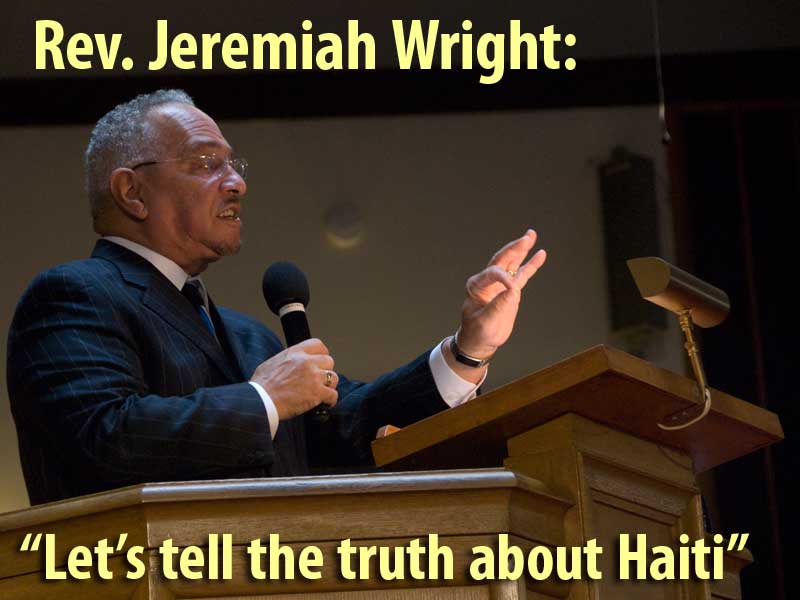 by Randall White Haiti Action.net - Oakland, CA, USA - "... If you want to help Haiti, let's start, let's start, let's start by telling the truth. Okay? The truth is that on April 7, 2003, President Aristide, a democratically elected president on the side of the poor, called together a Restitution Commission which determined that France owed Haiti twenty-one billion dollars. And within weeks, France and The United States told Aristide it was time for him to go. Step aside, step down, resign or be killed. "The Haitians had their duly elected, democratically elected president kidnapped by United States Marines ..." On Sunday September 19th at Allen Temple Baptist Church in Oakland it soon became obvious that when Rev. Dr. Jeremiah Wright said he had "retired," a couple of years ago, it meant he retired from his daily pastoral obligations at Trinity United Church of Christ (TUCC) in Chicago - where the Rev. Otis Moss III is now the Senior Pastor - and did not include his prophetic obligation to deliver timely messages to the People of God. Since his "retirement" in 2008 he has been in constant demand - just as in the years before Bill Moyers "admitted" that he was aware of the most prolific minister in his own, largely white, denomination - as a revival week preacher for many African-American congregations across the USA.
Read More |
The Uses of Haiti
 In this publication, Dr. Paul Farmer explores the 200 year history of Haiti-U.S. relationship. The book demonstrates the ruthlessness of United States policy toward Haiti from its independence in 1804 to today. In this publication, Dr. Paul Farmer explores the 200 year history of Haiti-U.S. relationship. The book demonstrates the ruthlessness of United States policy toward Haiti from its independence in 1804 to today.
"The Uses of Haiti tells the truth about uncomfortable matters-uncomfortable, that is, for the structures of power and the doctrinal framework that protects them from scrutiny. It tells the truth about what has been happening in Haiti, and the US role in its bitter fate."
-Noam Chomsky, from the Introduction
In this third edition of the classic The Uses of Haiti, Paul Farmer looks at what has happened to the health of the poor in Haiti since the coup.
Winner of a McArthur Genius Award, Paul Farmer is a physician and anthropologist who has worked for 25 years in Haiti, where he serves as medical director of a hospital serving the rural poor. He is the subject of the Tracy Kidder biography, Mountains Beyond Mountains.
Where:
TransAfrica Forum
1629 K Street, NW, Suite 1100, Washington, DC 20006
|
-
-
-
-
Source: UrbanFaith.com
A year after the disaster in his country, Haiti native Alex Altidor marvels at how God protected his wife and used the deadly quake to bring his family back together.
It took an earthquake for me to get to know Alex Altidor. Even though we are co-workers at Urban Ministries, Inc. (UMI), he works in the finance department while I reside in editorial --two worlds apart. I always saw Alex in the hallways -- very soft-spoken, bright smile, and youthful spirit -- but after the catastrophic earthquake in Haiti on January 12, 2010, I learned Alex's story and made a ..
-
|
|

|
Living in TWO WORLDS and Responding to God's Call
by Julie Fleurinor
Senior, Garrett Evangelical Theological Seminary
My spiritual journey began while I was an undergraduate student and met a new church pastor, Rev. Candace M Lewis who invited me to attend a bible study. During this time, I began to wrestle with whether the church had a place for a person like me, an African Haitian American woman. New Life Community UMC, a new church start in the Florida Conference, taught me live into the reality of Jeremiah 29:11
11For surely I know the plans I have for you, says the Lord, plans for your welfare and not for harm, to give you a future with hope. My twelve-year-active-membership in this congregation, tuned my ears to hear GOD's call to ministry.
I believed that if I was going to share God's love with others, I needed a better understanding of God's Word and myself. My journey continued as I entered Garrett Evangelical Theological Seminary. Since being at Garrett, I have entered the process for ordination to further response to God's call to servant leadership in the UMC. The call has been challenging to say the least! I struggled with what and how I should act and sound as a United Methodist Pastor-in-training.
Growing up in Miami, Florida there were real dangers in not being able to walk, talk and act like an American. The tremendous pressure to conform and fit in was unbelievable. I remember heart-breaking incident of a young boy killing himself after a group of his friends discovered that he was Haitian. Though there is not that much pressure to conform today, attitudes towards immigrants continues to be discriminatory and dismissive.
Read More
|
|
Resisting the Religious Elite's Collaboration with Empire, Part I: Jerusalem under the Persians
by Wes Howard-Brook on October 15, 2010 "All who will not obey the law of your God and the law of the king, let judgment be strictly executed on them, whether for death or for banishment or for confiscation of their goods or for imprisonment." (Ezra 7.26)
The 5thcentury BCE priest-scribe Ezra faced a huge challenge. The Persian Empire had crushed the Babylonians and now was the remaining superpower. Yet the Persians continued to face resistance from Egypt, to the south of the former site of Jerusalem. Like the United States' early 20th century interest in having a naval base in Hawaii, the Persians sought a convenient military outpost to shelter troops and materiel in the event of a campaign against Egypt. A rebuilt Jerusalem would serve the empire's interests. As empires have done throughout the ages, the Persians co-opted the indigenous religious elite to support the imperial program. Ezra was the Persians' man. They sent him back to Judah with royal silver and gold and imperial authority to rebuild the city in accordance with the Persian plan (Ezra 7.11-26). Read More
|
|
Resisting the Religious Elite's Collaboration with Empire, Part II: Cracking Open the Imperial Canon
by Wes Howard-Brook January 4, 2011 The fourth century Roman emperor, Constantine, has become "popular" again. Recent years have witnessed a flood of new biographies and analyses of the person and influence of the man who made "Christianity" licit within the Roman Empire and thus changed history. The late Anabaptist writer, John Howard Yoder, famously blamed Constantine's merging of church and state for the subsequent centuries of "Christian warfare" and other imperial actions done in the name of the God of Jesus. Conservative Presbyterian minister and scholar, Peter Leithart, has taken on Yoder and others in his defense of Constantine as a true believer who did more good for the church than harm. Engaging Constantine today is a necessary task in a world where the mainline church's captivity to the imperial state is all too plain to see. One element of Constantine's reign which has been less considered is his role in ordering the formation of an imperial canon of sacred books as the foundation for Catholic Christianity: that is, the Bible as we know it. Read More
|
|
Haiti: A Slave Revolution 200 years after 1804
TIMELINE
1492 Christopher Columbus lands near today's city of Cap Haïtien and claims the island of Hispaniola for Spain. The western third of the island is now Haiti and the rest of the island is the Dominican Republic.
1625 First French settlements on Tortuga Island, off the northwest coast, are established.
mid-1600s French settlements and plantations are established in coastal areas on the western third of the island.
1697 Under the terms of the Treaty of Ryswick, Spain cedes the western third of Hispaniola to France.
1700s The French colony of Saint Domingue is the most lucrative colony in the world, at this time, more lucrative than the 13 Colonies. Its slave-produced tropical crops -- sugar, rum, cotton, tobacco, and indigo -- generated great wealth. Near the end of the 18th century, 500,000 to 700,000 people, mainly of western African origin, were enslaved by the French.
1791 The Haitian Revolution begins when a group of slaves gather at Bois-Caïman in the northern part of the colony.
1803 The Haitian blue and red flag is adopted at the Congress of Arcahaie. The Battle of Vertières is the last victory of the Haitians over the French.
1804 Jean-Jacques Dessalines declared Haiti independent on January 1, after crushing the French army sent to re-enslave Haiti. Over half the people in Haiti die before the struggle has run its course.
1806 Jean-Jacques Dessalines is assassinated at Pont-Rouge.
1815-1816 Simón Bolívar gets asylum in Haiti twice and also receives military assistance to liberate South America from Spain.
1822 Haiti invades the Spanish colony of Santo Domingo (today's Dominican Republic), and ends slavery there.
1838 France fully and unconditionally recognizes Haiti's independence. It had given Haiti "conditional" recognition in 1825 after Haiti promised to pay 150 million gold francs as "compensation" for its "losses."
1844 The Haitian occupation of Santo Domingo ends.
1862 The United States recognizes Haiti.
1889 Frederick Douglass is appointed as U.S. Minister and Consul General to Haiti.
1915 United States Marines invade Haiti and occupy it. A largely peasant guerrilla army, known as the cacos, resists the occupiers under the leadership of Charlemagne Péralte, who is betrayed and assassinated by Marines in 1919.
|
|
About Us

... You will raise up the age-old foundations; And you will be called the repairer of the breach, The restorer of the streets in which to dwell. (Isaiah. 58:12)
Kinetics mission is to disseminate information and develop new ideas that work to strengthen social movements within the African-American community; providing them with the tools and skills to pursue justice and better address the needs of those whom they serve.
| |
|
|
|
Join Us

Kinetics Faith & Justice Network mission is to provide the faith community with the tools to advocate and mobilize on local, national, and international issues, to build capacity to solve our own problems, and to use dialogue as a catalyst for social change. Members include clergy, scholars, lawyers, social justice advocates, and nonprofit and business professionals.
| |
|



