|
|
|
|
"Churches must move from a position where people serve the structure of the church to a position where its structure serves people's needs."
C. Gene Wilkes, "Jesus on Leadership"
|
Dear Senators and Delegates:
As leaders of our faith communities, we call on the Maryland General Assembly to raise the state minimum wage and thereby foster economic recovery for our families, our communities and our state.
An adequate minimum wage is a bedrock moral value. Our diverse faiths all affirm the dignity of the worker and the moral imperative of fair and just wages. A job should keep you out of poverty, not keep you in poverty. Yet in our own state of Maryland the minimum wage is $7.25 an hour, providing only $15,000 a year for a full-time worker, which is not enough to live on.
It is immoral that people work full time, but have to choose between paying the rent and paying for child care. It is immoral to have wages so low that waitresses, cashiers and child care workers depend on food banks and food stamps to help feed their families. It is immoral to have wages so low that housekeepers, health care aides and security guards go to work every day from homeless shelters.
It is immoral that the minimum wage keeps people in poverty instead of out of poverty.
Raising the minimum wage is not only vital for our working families, it is vital for our economy, as workers take their pay increase and spend it on needed goods and services at their corner markets, pharmacies and other local businesses.
In 1968, just days before his murder, the Rev. Dr. Martin Luther King Jr. told sanitation workers in Memphis, "It is criminal to have people working on a full-time basis and a full-time job getting part-time income." King said, "We are tired of working our hands off and laboring every day and not even making a wage adequate with daily basic necessities of life."
The real value of the minimum wage is less now, more than 40 years later, than it was when Dr. King spoke those prophetic words. The minimum wage would be about $10 today if it had kept pace with the cost of living.
The Golden Rule teaches us, "Do unto others as you would have them do unto you." We, faith leaders across the state, urge the Maryland General Assembly to raise the minimum wage to $10 by 2013 and adjust it starting in 2014 to keep up with the cost of living. In raising the minimum wage, we lift our working families and our state.
Sincerely,
Faith leaders -Click here to endorse this letter
If you are not a faith leader (e.g., Reverend, Rabbi, Imam, Director of faith-based program, Religious Social Action Committee Chair, etc.) then please use the General Public sign on instead. Thank you.
|
|
"When you look at the amounts of funds that pass through our churches, and the fact that we spend $10,000 a year feeding hungry people and passing out 250 turkeys, it is disgraceful when compared to the millions of dollars that pass through our churches."
- exerpt from SOCIAL WITNESS, 'PROPHETIC' DISCERNMENT, AND POST-CIVIL RIGHTS ERA CHURCHES. This report was prepared by Dr. R. Drew Smith.
|
|
Faith Advocates for Jobs

The Faith Advocates for Jobs
campaign, in order to combat the
severe unemployment crisis that is
devastating so many of America's working
people and families, and to help rebuild the
foundations of our nation's economy, will:
1. Organize at least 1,000 congregation-based unemployed worker support committees in 2011. 2. Advocate for public policy initiatives to address the crisis. 3. Develop educational programs in support of job creation and retention and a restored economy More Information Congregational Commitment Pledge to Join the Faith Advocates for Jobs Campaign |
|
THE STATE OF WORKING MARYLAND 2010
Executive Summary
The state of working families in Maryland has deteriorated, and the prospects for the future are shaky, unless state and national governments take strong action to promote a broadly-shared recovery.
The current economic downturn is notable not just for the severity of economic contraction but also for the length of decline. In the nine previous recessions on record, by seven quarters (21 months) after the official start of the recession, the economy had actually grown by an average of 4% compared to its pre-recession peak.
This has not yet occurred since the 2007-2009 recession; making it the worst known recession in the nation's history. As of the third quarter of 2010, inflation-adjusted GDP remained 0.6% below its pre-recession peak.
Since 2000, median household income in Maryland increased only 6% in inflation adjusted terms, from $65,325 to $69,272 (in 2009 dollars). The average annual increase was only 6/10 of 1% over the decade. Moreover, the median household income in Maryland actually declined in 2009 compared with both 2007 and 2008.
Over the last decade, the rate of poverty in Maryland has risen from 7.4% in 2000 to 9.1% in 2009. Maryland's unemployment rate stands at 7.4% - the higher level since 1983. By numerous indicators detailed in this report, working families in Maryland are hurting, even as Maryland has retained its ranking as the wealthiest state in the nation.
Business profits and stock prices have recovered, but employment and median incomes have not. The national and state economies are on a path to a "jobless recovery." The danger Maryland faces is that most of the gains of the economic recovery will flow to the
wealthiest Marylanders. New jobs will be few, and those that emerge will have lower wages and fewer benefits than before the recession.
Public policy has a crucial role to play in addressing this danger. National and state governments must promote the development of jobs that can support families. They must support initiatives in training and education to prepare workers for 21st century job
demands. They must vigorously implement the Patient Protection and Affordable Care Act. They must reinforce investments in transportation, child care and housing affordability that make it possible for people to work. They must make public benefits
accessible and efficient, by implementing "no wrong door" processes for obtaining benefits and by outlawing discrimination on the basis of source of income. They must support the ability of working people to organize and bargain collectively for improved wages and benefits.
The economy remains fragile and is performing well below its potential. Major deficit reduction should not be on the table until the recovery is firmly on track, that is, until unemployment has dropped and is on a downward trajectory. The public structures that
support a strong economy must be financed by revenue measures that are adequate to the state's needs and that reflect individuals' and businesses' ability to pay.
Maryland's strong economy won't just happen by itself -- it will be guided by our public policies. Maryland and the nation need to make the wise choices now that will lay the foundations for broadly shared prosperity, not a jobless recovery that mainly benefits
those who are already doing well.
See the full report by Maryland Budget and Tax Policy Institute and Progressive Maryland Education Fund [PDF - 28 pages]. 12/28/2010
|
When there is massive unemployment in the black community, it is called a social problem. But when there is massive unemployment in the white community, it is called a Depression. We look around every day and we see thousands and millions of people making inadequate wages. Not only do they work in our hospitals, they work in our hotels, they work in our laundries, they work in domestic service, they find themselves underemployed. You see, no labor is really menial unless you're not getting adequate wages. People are always talking about menial labor. But if you're getting a good (wage) as I know that through some unions they've brought it up . . . that isn't menial labor. What makes it menial is the income, the wages."
-Martin Luther King, Jr.
|
|
COMMUNITY ECONOMIC DEVELOPMENT AND THE IMPERATIVES OF MINISTRY
The following is an exerpt from SOCIAL WITNESS, 'PROPHETIC' DISCERNMENT, AND POST-CIVIL RIGHTS ERA CHURCHES. This report was prepared by Dr. R. Drew Smith Spring 2001 Roundtable participants discussed the extent to which economic development and political economy have emerged as primary emphases among black churches. It was pointed out by several participants that some of the church communions represented around the table had been at the forefront of promoting economic development as the "new black politics." Underlying the emphasis on economic matters was a commitment to community building. And while a number of participants were pleased that new opportunities for public and private sector partnerships around community development were emerging, there was still a conviction among some participants that there is "a role for self-initiative, self-responsibility, and self-funding of these projects." A number of participants shared examples from their own ministries of approaches to economic development, and what is important to note about many of these examples is the emphasis on human development rather than just on physical infrastructure development. One participant stated: As our congregation was preparing to initiate a massive building project, God spoke to my heart and said, 'if you build and invest fifteen million dollars here, in fifty years you will have a memorial. But if you invest in the people, in fifty years you will have a legacy.' We found out that it is not important to have fifteen million dollars tied up in a building, if you only have fifteen thousand dollars left at the end of the year to provide programs and services. Instead of building and being extravagant, it took seven or eight years, but now we have a two million-dollar endowment for a Christian school. And we do not have any millionaire members in our congregation. With two million dollars, banks and the city government listen when we talk. We also have seventy-five percent of our members actively involved in outreach. Read More |
|
.
|

Kinetics Faith & Justice Network mission is to provide the faith community with the tools to advocate and mobilize on local, national, and international issues, to build capacity to solve our own problems, and to use dialogue as a catalyst for social change. Members include clergy, scholars, lawyers, social justice advocates, and nonprofit and business professionals.
www.Kineticnet.org | |
|
|

|
|
Resisting the Religious Elite's Collaboration with Empire
"All who will not obey the law of your God and the law of the king, let judgment be strictly executed on them, whether for death or for banishment or for confiscation of their goods or for imprisonment." (Ezra 7.26)
The 5 th century BCE priest-scribe Ezra faced a huge challenge. The Persian Empire had crushed the Babylonians and now was the remaining superpower. Yet the Persians continued to face resistance from Egypt, to the south of the former site of Jerusalem. Like the United States' early 20 th century interest in having a naval base in Hawaii, the Persians sought a convenient military outpost to shelter troops and materiel in the event of a campaign against Egypt. A rebuilt Jerusalem would serve the empire's interests.
As empires have done throughout the ages, the Persians co-opted the indigenous religious elite to support the imperial program. Ezra was the Persians' man. They sent him back to Judah with royal silver and gold and imperial authority to rebuild the city in accordance with the Persian plan (Ezra 7.11-26).
Ezra was willing to support the Persian scheme, but he was no fool. He well knew that the prophet Jeremiah had claimed that Jerusalem's destruction by the Babylonians was YHWH's punishment for the elite's reliance on imperial politics rather than on YHWH alone. How was relying now on Persian financing and support for the rebuilding of Jerusalem and its temple any different from what Jeremiah had condemned before the Exile?
Read More |
|
MLK: Nonconformist
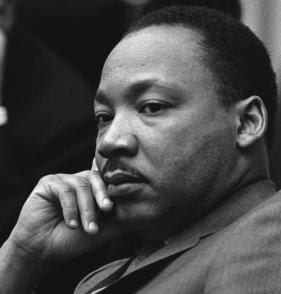
"History will have to record that the greatest tragedy of this period of social transition was not the strident clamor of the bad people, but the appalling silence of the good people"
"Our lives begin to end the day we become silent about things that matter."
"I submit to you that if a man hasn't discovered something that he will die for, he isn't fit to live."
"In the end, we will remember not the words of our enemies, but the silence of our friends."
"Ten thousand fools proclaim themselves into obscurity, while one wise man forgets himself into immortality."
"When you are right you cannot be too radical; when you are wrong, you cannot be too conservative."
"The hope of a secure and livable world lies with disciplined nonconformists who are dedicated to justice, peace and brotherhood."
"The ultimate measure of a man is not where he stands in moments of comfort and convenience, but where he stands at times of challenge and controversy."
"Yes, I see the Church as the body of Christ. But, oh! How we have blemished and scarred that body through social neglect and through fear of being nonconformists."
"There was a time when the church was very powerful. It was during that period when the early Christians rejoiced when they were deemed worthy to suffer for what they believed. In those days the church was not merely a thermometer that recorded the ideas and principles of popular opinion; it was a thermostat that transformed the mores of society. Whenever the early Christians entered a town the power structure got disturbed and immediately sought to convict them for being "disturbers of the peace" and "outside agitators." But they went on with the conviction that they were "a colony of heaven," and had to obey God rather than man. They were small in number but big in commitment"
|
|
About Us

... You will raise up the age-old foundations; And you will be called the repairer of the breach, The restorer of the streets in which to dwell. (Isaiah. 58:12)
Kinetics mission is to develop new ideas that work to strengthen social movements within the African-American community; bridging the gap between church and community and providing them with the tools and skills to pursue justice and better address the needs of those whom they serve.
|
|
Featured Article
What action, if any, do you want your members to take? Add a "Find out more" link to additional information that you may have hosted on your website.
|
|
|
|
|
Just Church Quiz
Just Bible
When reading or using the Bible in your church, how often are biblical passages referring to
poverty, injustice or wealth used?
a) On a regular basis
b) Several times a year
c) Once or twice a year
d) Hardly ever
Just Jesus
How often do sermons or talks focus on economic justice through Jesus' ministry, and our
relationship with Jesus in such a context?
a) On a regular basis
b) Several times a year
c) Once or twice a year
d) Hardly ever
Just Worship
How often do issues of poverty, personal lifestyle and economic justice feature within sermons, or
talks within worship?
a) On a regular basis
b) Several times a year
c) Once or twice a year
d) Hardly ever
Just Congregation
"We are aware of issues within our congregation that cause people to be excluded or marginalized."
a) Strongly agree
b) Probably
c) Not sure
d) Disagree
Just Community
"We are actively trying to address poverty-related issues in our community."
a) Strongly agree
b) Probably
c) Not sure
d) Disagree
Just Spirituality
"Our church attempts to integrate prayer, spirituality and action with issues of poverty and justice."
a) Strongly agree
b) Probably
c) Not sure
d) Disagree
Just Children
How often are children in the church (in Sunday school, youth groups, etc.) exposed to faith based justice regarding poverty issues?
a) On a regular basis
b) Several times a year
c) Once or twice a year
d) Hardly ever
Just Living
"Being a Christian affects how I live my daily life in tangible ways."
a) Strongly agree
b) Probably
c) Not sure
d) Disagree
Just Money
"In its preaching and teaching, my church helps me to think about my relationship with money and how I manage it, as a natural part of Christian discipleship."
a) Strongly agree
b) Probably
c) Not sure
d) Disagree
Just Transformation
"As a church we take action to support the poor within our society, and we understand we have a responsibility to do so."
a) Strongly agree
b) Probably
c) Not sure
d) Disagree
Just Action
"In our church we have clear structures in place to allow us to plan and participate in specific actions to empower vulnerable people within our own neighborhoods and communities."
a) Strongly agree
b) Probably
c) Not sure
d) Disagree
When you have finished, score your answers as follows: A = 4 points; B = 3 points; C = 2 points; D = 1 point.
Add up the totals.
| | http://www.justchurch.info/ |
|
|
|


