"Washing one's hands of the conflict between the powerful and the powerless means to side with the powerful, not to be neutral."--Paulo Freire
Greetings,
I would like to solicit your help with a few projects. I was asked by Chaplain Christopher Wallace of the Baltimore City Correctional Center to facilitate a discussion between rival gang members inside of Baltimore City Correctional Center. He informed me that a gentleman by the name of "Big C" had pulled rival gang leaders together and that they wanted to call a TRUCE.
When I was first introduced to "Big C", I was sold. I knew this was a brother who was committed to real change and who had the respect of everyone in the system. Over the next few months we begin to host monthly meetings and develop a curriculum. Special thanks go to Dr. Tyrone Powers, Dr. Andrey Bundley, Prof. Leslie Parker-Blyther and Bridget Alston-Smith.
Big C is now home and we have begun phase three of our program, connecting the movement from the inside to the streets. He was incarcerated for the last 15 years and has been a CRIP for the last 26 years. I am convinced that removing guns, holding prayer visuals and rallies with little to no follow through will not end the violence on the streets. To create and sustain a movement you must empower the individuals who understand the streets and who have a calling and obligation to repair them. Gangs in Baltimore did not start over night and unfortunately they will not end over night. All true revolution begins in the mind. As a man thinketh in his heart so is he. So if we want to change the behavior of an individual we must deal with their thought life, we must deal with the pain, the misplaced hate, the lack of self knowledge and spiritual awareness. This is the work that we are committed to and we need your support.
First, there is no library inside of the prison and the men have requested that we assist them if we could. Chaplain Wallace has given us the green light to do a book drive. Delegate Jill P. Carter has pledged 50 books and Rev. Heber Brown has offered Pleasant Hope Baptist as a site for the book drop off. If you are interested in donating books for the library at Baltimore City Correctional Center or if your church/organization would like to participate in our book drive please contact me.
Big C has also created a TRUCE t-shirt that we would like to have printed. We already have an order for 50 shirts. Your support in helping us print 500 shirts would go a long way. The selling of the shirts will help us raise much needed funds to support our program. We also would like to give some away. The cost to print 500 shirts is roughly $2,200. If your church, group or organization would like to partner with us please contact me.
Finally I am on the advisory board for the National Faith & Justice Network and we will be hosting Conspire, a conference for faith-rooted leaders. I would like to take several young people with me and am looking for individuals who like to sponsor five young people. For more information on Conspire log onto www.NFJN.org or email me at info@kinetincnet.org
Lastly, I want to thank everyone who called, emailed or wrote letters to your elected officials regarding the Juvenile Lead Bill. I also want to give a special thank you to Delegate Jill P. Carter who we met with over the summer and winter and asked to introduce this bill.
Help us be a restorer of streets and the community!
In love & service,
Jamye Wooten
Kinetics
info@kineticnet.org
www.Kineticnet.org
443.415.7974
... You will raise up the age-old foundations; And you will be called the repairer of the breach, The restorer of the streets in which to dwell. (Isaiah. 58:12)

|
|
I'm a criminal and so are you
Editor's note: America's 300 million-plus people are declaring their identity in the 2010 Census this year. This piece is part of a special series on CNN.com in which people describe how they see their own identity. Michelle Alexander is the author of The New Jim Crow: Mass Incarceration in the Age of Colorblindness (The New Press, 2010)She is the former director of the Racial Justice Project of the ACLU of Northern California and of the Civil Rights Clinic at Stanford Law School. She holds a joint appointment with the Kirwan Institute for the Study of Race and Ethnicity and the Moritz College of Law at The Ohio State University.
(CNN) -- Who am I? How do I identify?
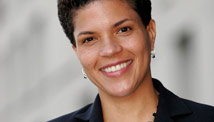 Lately, I've been telling people that I'm a criminal. This shocks most people, since I don't "look like" one. I'm a fairly clean-cut, light-skinned black woman with fancy degrees from Vanderbilt University and Stanford Law School. I'm a law professor and I once clerked for a U.S. Supreme Court Justice -- not the sort of thing you'd expect a criminal to do. Lately, I've been telling people that I'm a criminal. This shocks most people, since I don't "look like" one. I'm a fairly clean-cut, light-skinned black woman with fancy degrees from Vanderbilt University and Stanford Law School. I'm a law professor and I once clerked for a U.S. Supreme Court Justice -- not the sort of thing you'd expect a criminal to do.
What'd you get convicted of? people ask. Nothing, I say. Well, then why do you say you're a criminal? Because I am a criminal, I say, just like you.
This is where the conversation gets interesting. Most of my acquaintances don't think of themselves as criminals. No matter what their color, age or gender, most of the people in my neighborhood and in my workplace seem to think criminals exist somewhere else -- in ghettos, mainly.
|
Manhood Training The Warrior Method
featuring Dr. Raymond Winbush

With special guest Bro. Ray Cook
Baltimore City Correctional Center Tuesday, June 15, 2010 6:30 p.m.-9:00 p.m. |
|
T.R.U.C.E. presents...
Maryland Legislative Recap
Anti-Gang Legislation and its Impact
  
Delegate Jill P. Carter Elder Ted Sutton Dr. Tyrone Powers
Baltimore City Correctional Center
Wednesday, May 12, 2010
6:30pm-9:00pm |
Examining the Impact of Race and Ethnicity on the Sentencing of Juveniles in the Adult Court
Kareem L. Jordan and Tina L. Freiburger
Abstract
Several studies have examined the effects of race and ethnicity on the sentences of adult offenders in the criminal court. The findings of these studies often show that race and ethnicity influence defendants' sentencing outcomes. Few studies, however,
have examined how race and ethnicity influence juvenile defendants sentenced in the adult criminal justice system. The purpose of this study, therefore, is to determine how race and ethnicity affect the sentences of juveniles, utilizing a national dataset of youth convicted of a felony in adult court. The findings suggest that race and ethnicity do impact the sentencing outcomes of convicted youthful offenders. In addition, the results suggest that the combination of race and other factors (i.e., interactions) has an effect on sentencing. Implications for subsequent research also are discussed.
|
|
FROM SLAVERY TO MASS
INCARCERATION
Rethinking the 'race question' in the US
Not one but several 'peculiar institutions' have successively operated to define, confine, and control African- Americans in the history of the United States. The first is chattel slavery as the pivot of the plantation economy and inceptive matrix of racial division from the colonial era to the Civil War.
The second is the Jim Crow system of legally enforced discrimination and segregation from cradle to grave that anchored the predominantly agrarian society of the South from the close of Reconstruction to the Civil Rights revolution which toppled it a full century after abolition.
America's third special device for containing the descendants of slaves in the Northern industrial metropolis is the ghetto, corresponding to the conjoint urbanization and proletarianization of African-Americans from the Great Migration of 1914-30 to the 1960s, when it was rendered partially obsolete by the concurrent transformation of economy and state and by the mounting protest of blacks against continued caste exclusion, climaxing with the explosive urban riots chronicled in the Kerner Commission Report.1
The fourth, I contend here, is the novel institutional complex formed by the remnants of the dark ghetto and the carceral apparatus with which it has become joined by a linked relationship of structural symbiosis and functional surrogacy. This suggests that slavery and mass imprisonmentare genealogically linked and that one cannot understand the latter-its timing, composition, and smooth onset as well as the quiet ignorance or acceptance of its deleterious effects on those it affects-without returning to the former as historic starting point and functional analogue.
Viewed against the backdrop of the full historical trajectory of racial domination in the United States (summed up in Table 1), the glaring and growing 'disproportionality' in incarceration that has afflicted African-Americans over the past three decades can be understood as the result of the 'extra-penological' functions that the prison system has come to shoulder in the wake of the crisis of the ghetto and of the continuing stigma that afflicts the descendants of slaves by virtue of their membership in a group constitutively deprived of ethnic honour (Max Weber's Massehre).
|
|
Jim Crow alive and well in U.S. prison system
The over-incarceration of young black men is no accident, new book reveals
April 08, 2010|By Dan Rodricks
Baltimore Sun
Here's something you won't hear much about in the coming Maryland gubernatorial election: The United States has the world's highest incarceration rate and a de facto racial caste system that discriminates against hundreds of thousands of black men in the way Jim Crow laws once did. You won't hear anything close to that from Martin O'Malley, the Democrat and present governor, nor from Robert L. Ehrlich Jr., the Republican and wannabe-governor-again who, compared to Mr. O'Malley, is a downright progressive on corrections.
You likely won't hear about it from any of the Marylanders running for the U.S. House or Senate this year. And the first black man elected president will probably refrain from such rhetoric, too.
In fact, few politicians want to talk about criminal justice unless pressed to do so. They certainly do not speak about the consequences of the system's design: massive numbers of men, and an inordinate number of black men, in prison, on parole or on probation for drug-related offenses, unable to find employment because of their criminal records, and generally unable to get on track, support their families and reintegrate as contributing citizens.
|
|
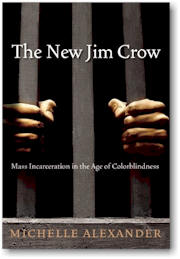
The New Jim Crow: Mass Incarceration in the Age of Colorblindness
As the United States celebrates the nation's "triumph over race" with the election of Barack Obama, the majority of young black men in major American cities are locked behind bars or have been labeled felons for life. Although Jim Crow laws have been wiped off the books, an astounding percentage of the African American community remains trapped in a subordinate status-much like their grandparents before them.
In this incisive critique, former litigator-turned-legal-scholar Michelle Alexander provocatively argues that we have not ended racial caste in America: we have simply redesigned it. Alexander shows that, by targeting black men and decimating communities of color, the U.S. criminal justice system functions as a contemporary system of racial control, even as it formally adheres to the principle of color blindness. The New Jim Crow challenges the civil rights community-and all of us-to place mass incarceration at the forefront of a new movement for racial justice in America.
A longtime civil rights advocate and litigator, Michelle Alexander was a 2005 Soros Justice Fellow. She holds a joint appointment at the Moritz College of Law and the Kirwan Institute for the Study of Race and Ethnicity in Columbus, Ohio, where she lives. The New Jim Crow is her first book.
|
|
About Us

... You will raise up the age-old foundations; And you will be called the repairer of the breach, The restorer of the streets in which to dwell. (Isaiah. 58:12)
Kinetics mission is to disseminate information and develop new ideas that work to strengthen social movements within the African-American community; providing them with the tools and skills to pursue justice and better address the needs of those whom they serve.

|
|