|
|
|
|
Militarizing Haiti: The Shock Doctrine at Work?
With Haiti's government "all but invisible" and its repressive police forces "devastated," popular organizations were starting to fill the void. But the Western powers rushing in want to rebuild Haiti on a foundation of sweatshops, agro-exports and tourism.
So wrote Arun Gupta in the latest issue of the Indypendent, on the way neoliberal "reforms" are being pushed Haiti's way. Gupta joins guest host Esther Armah in the studio, along with Reverend Osagyefo Sekou, who just returned from Haiti, to talk about the rebuilding effort underway and how people in the U.S. can help make sure Haiti is rebuilt for the Haitian people.
|
|
The U.S. in Haiti: Neoliberalism at the Barrel of a Gun
By Arun Gupta
indypendent.org
Illustrations by Lisa Lin
 Official denials aside, the United States has embarked on a new military occupation of Haiti thinly cloaked as disaster relief. While both the Pentagon and the United Nations claimed more troops were needed to provide "security and stability" to bring in aid, violence was never an issue, according to nearly all independent observers in the field. Official denials aside, the United States has embarked on a new military occupation of Haiti thinly cloaked as disaster relief. While both the Pentagon and the United Nations claimed more troops were needed to provide "security and stability" to bring in aid, violence was never an issue, according to nearly all independent observers in the field.
The military response appears to be more opportunistic. With Haiti's government "all but invisible" and its repressive police forces "devastated," popular organizations were starting to fill the void. But the Western powers rushing in want to rebuild Haiti on a foundation of sweatshops, agro-exports and tourism. This is opposed by the popular organizations, which draw from Haiti's overwhelmingly poor majority. Thus, if a neoliberal plan is going to be imposed it will be done at gunpoint.
The rapid mobilization of thousands of U.S. troops crowded out much of the aid being sent to the Port-au-Prince airport following the Jan. 12 earthquake. Doctors Without Borders said five of its cargo flights were turned away, while flights from the World Food Program were delayed up to two days. By the end of January, three quarters of Haitians still lacked clean water, the government had received only 2 percent of the tents it had requested and hospitals in the capital reported they were running "dangerously low" on basic medical supplies like antibiotics and painkillers. Nearly a month into the crisis, the Washington Post reported, "Every day, tens of thousands of Haitians face a grueling quest to find food, any food. A nutritious diet is out of the question."
|
1) In 1989, the Red Cross raised $50 MILLION for the victims of the San Francisco earthquake. But it's estimated that only $10 MILLION of it was turned over to the actual victims.
2) After September 11th, the Red Cross raised $543 MILLION for the family members of people who died in the attacks. But they held back more than HALF of that money, which eventually led to the dismissal of their president.
3) In 2004, the Red Cross raised $3.21 BILLION to aid the victims of the Indian Ocean tsunami. But they're still holding onto $500 MILLION of it.
4) And in 2005, the Red Cross raised $1.1 BILLION to aid the victims of Hurricane Katrina. But they kept $200 MILLION of it to, quote, "prepare for future disasters."
(The Red Cross is a great organization, and the money they raise will eventually be used to help someone in crisis . . . at least we hope. But they're not nearly as forthcoming as you would hope or expect, considering it's YOUR donations that keep them in business.)
(And it's worth mentioning that the Red Cross got $100 MILLION in bailout funds, and that PRESIDENT OBAMA capped the salaries of Red Cross execs at $500,000 a year. Because they'd been earning almost $1 MILLION a year.)
http://www.sfbayview.com/
December 12th Movement
Friday Haiti Relief Coalition456 Nostrand Avenue Brooklyn, NY 11216 Ph (718) 398-1766 Fax (718) 623-1855 D12M@aol.com
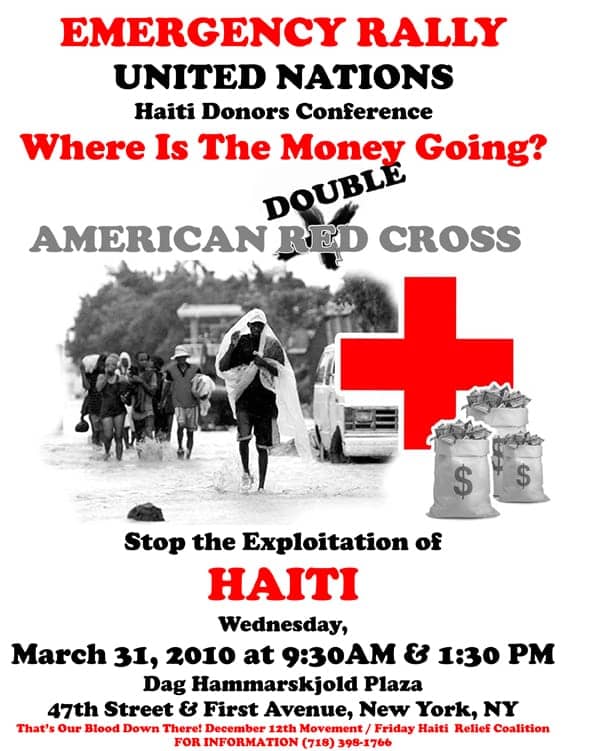
As the Haitian people brace themselves for the hurricane and rainy season with no shelter and no supplies for millions, nations like the United States, France, Canada, and others are attending the United Nations Donors Conference on Wednesday, March 31, 2010. At the conference, these wealthy nations will "donate" funds to the over 3000 non governmental organizations, primarily headquartered in their own countries. They are in effect paying themselves.
The American Red Cross has already admitted to financing their own debt with donations given for Haiti Relief. The Friday Haiti Relief Coalition are demanding an independent accounting and held a protest demonstration at the American Red Cross Headquarters last week. According to the Red Cross official report of the first two months, they collected over $354 million and have accounted for only $106 million.
The Friday Haiti Relief Coalition will hold protests on Wednesday during the Haiti Donors Conference at Dag Hammarskjold Plaza, 47th Street and First Avenue, NYC at 9:30 AM and 1:30 PM. Spokesperson Amadi Ajamu said "People donated their hard earned money to the Haitian people in their time of crisis. Haitians must determine for themselves how they want to rebuild their nation." |
|
Haiti: A Slave Revolution 200 years after 1804
TIMELINE
1492 Christopher Columbus lands near today's city of Cap Haïtien and claims the island of Hispaniola for Spain. The western third of the island is now Haiti and the rest of the island is the Dominican Republic.
1625 First French settlements on Tortuga Island, off the northwest coast, are established.
mid-1600s French settlements and plantations are established in coastal areas on the western third of the island.
1697 Under the terms of the Treaty of Ryswick, Spain cedes the western third of Hispaniola to France.
1700s The French colony of Saint Domingue is the most lucrative colony in the world, at this time, more lucrative than the 13 Colonies. Its slave-produced tropical crops -- sugar, rum, cotton, tobacco, and indigo -- generated great wealth. Near the end of the 18th century, 500,000 to 700,000 people, mainly of western African origin, were enslaved by the French.
1791 The Haitian Revolution begins when a group of slaves gather at Bois-Caïman in the northern part of the colony.
1803 The Haitian blue and red flag is adopted at the Congress of Arcahaie. The Battle of Vertières is the last victory of the Haitians over the French.
1804 Jean-Jacques Dessalines declared Haiti independent on January 1, after crushing the French army sent to re-enslave Haiti. Over half the people in Haiti die before the struggle has run its course.
1806 Jean-Jacques Dessalines is assassinated at Pont-Rouge.
1815-1816 Simón Bolívar gets asylum in Haiti twice and also receives military assistance to liberate South America from Spain.
1822 Haiti invades the Spanish colony of Santo Domingo (today's Dominican Republic), and ends slavery there.
1838 France fully and unconditionally recognizes Haiti's independence. It had given Haiti "conditional" recognition in 1825 after Haiti promised to pay 150 million gold francs as "compensation" for its "losses."
1844 The Haitian occupation of Santo Domingo ends.
1862 The United States recognizes Haiti.
1889 Frederick Douglass is appointed as U.S. Minister and Consul General to Haiti.
1915 United States Marines invade Haiti and occupy it. A largely peasant guerrilla army, known as the cacos, resists the occupiers under the leadership of Charlemagne Péralte, who is betrayed and assassinated by Marines in 1919.
|
|
Haiti and Human Rights
Consider the following situation that Haiti is in:
- Haiti is the third hungriest country in the world after Somalia and Afghanistan
- The richest 1% of the population controls nearly half of all of Haiti's wealth
- The poorest country in the western hemisphere
- The world's fourth poorest country in the world
- Ranks 146 out of 173 on the United Nations Human Development Index
- Has a life expectancy of 52 years for women and 48 for men
- Adult literacy is about 50%
- Unemployment is 70%
- 85% of Haitians live on less than $1 U.S. per day.
- Haiti ranks 38 out of 195 for under five mortality rate.
The above statistics hide the fact that Haiti has had problems for decades. Furthermore, since its very beginnings as a modern state some 200 years ago, Haiti has constantly been affected by outside influences and interests, negatively impacting its own destiny.
In addition, coverage of issues in Haiti has often been accompanied by amazing media distortion leading to effects such as minimal or no coverage of problems and massive human rights violations during dictatorial regimes, while demonizing the one democratically elected leader.
Accusations and criticisms of cheap labor, resource exploitation and democracy stifling have been directed at outsiders such as the United States for various reasons, including:
- Support for dictators in recent decades;
- Hostility towards the (former) democratically elected president;
- Various interests of big U.S. companies.
| |
Haiti and America's Historic Debt
By Robert Parry
January 13, 2010
Announcing emergency help for Haiti after a devastating 7.0-magnitude earthquake, President Barack Obama noted America's historic ties to the impoverished Caribbean nation, but few Americans understand how important Haiti's contribution to U.S. history was.
In modern times, when Haiti does intrude on U.S. consciousness, it's usually because of some natural disaster or a violent political upheaval, and the U.S. response is often paternalistic, if not tinged with a racist disdain for the country's predominantly black population and its seemingly endless failure to escape cycles of crushing poverty. Read More |
Travesty in Haiti: A true account of Christian missions, orphanages, fraud, food aid and drug trafficking
TRAVESTY is an anthropologist's personal story of working with foreign aid agencies and discovering that fraud, greed, corruption, apathy, and political agendas permeate the industry. It is a story of failed agricultural, health and credit projects; violent struggles for control over foreign aid; corrupt orphanage owners, pastors, and missionaries; the nepotistic manipulation of research funds; economically counterproductive food aid distribution programs that undermine the Haitian agricultural economy; disastrous social engineering by foreign governments, international financial and development organizations--such as the World Bank and USAID-- and the multinational corporate charities that have sprung up in their service, CARE International, Catholic Relief Services, World Vision, and the dozens of other massive charities that have programs spread across the globe, moving in response not only to disasters and need, but political agendas and economic opportunity. TRAVESTY also chronicles the lives of Haitians and describes how political disillusionment sometimes ignites explosive mob rage among peasants frustrated with the foreign aid organizations, governments and international agencies that fund them. TRAVESTY recounts how some Haitians use whatever means possible try to better their living standards, most recently drug trafficking, and in doing so explains why at the service of international narcotraffickers and Haitian money laundering elites, Haiti has become a failed State. TRAVESTY reads like a novel. It takes the reader from the bowels of foreign aid in the field; to the posh and orderly urban headquarters of charities such as CARE International; to the cold, distant heights of Capitol Hill policy planners. The journey is marked by true accounts involving violence, corruption, appalling greed, sexual exploitation, disastrous social engineering, and the inside world of drug traffickers. But TRAVESTY it is not a novel. It is founded on 15 years of academic and field experience, research, and hard data. It entertains the reader with vivid first hand accounts while treating seriously the problems inherent not only in international aid, but the sabotaging effects of the drug war on economic development in remote and impoverished areas of the hemisphere. |
|
About Us

... You will raise up the age-old foundations; And you will be called the repairer of the breach, The restorer of the streets in which to dwell. (Isaiah. 58:12)
Kinetics mission is to disseminate information and develop new ideas that work to strengthen social movements within the African-American community; providing them with the tools and skills to pursue justice and better address the needs of those whom they serve.
| |
|
|
|
Join Us

Kinetics Faith & Justice Network mission is to provide the faith community with the tools to advocate and mobilize on local, national, and international issues, to build capacity to solve our own problems, and to use dialogue as a catalyst for social change. Members include clergy, scholars, lawyers, social justice advocates, and nonprofit and business professionals.
| |
|