|
|
|
|
Greetings!
"When I give food to the poor, they call me a saint. When I ask why the poor have no food, they call me a communist."
These are the words of the late Dom Hélder Câmara,
a champion of Brazil's poor and a pioneer of Latin America's liberation theology movement. Many Christian churches are involved in some sort of charity that reaches out to the poor, but few seem to challenge the systems that create poverty. Let's quickly do the global math.
- There are 6 billion people on God's green earth
- 2 billion claim Christianity as their religion of choice
- At least 80% of humanity lives on less than $10 a day.Source 1
- Almost half the world - over three billion people - live on less than $2.50 a day.
- More than 80 percent of the world's population lives in countries where income differentials are widening.Source 2
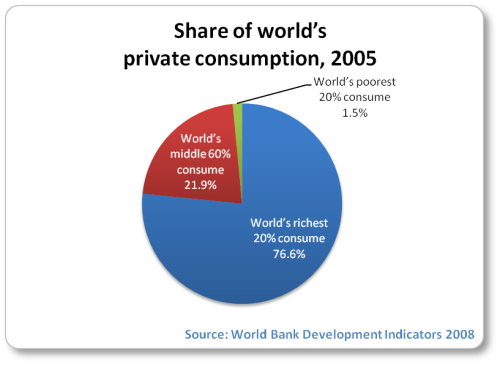
- The poorest 40 percent of the world's population accounts for 5 percent of global income. The richest 20 percent accounts for three-quarters of world income.Source 3
- 640 million live without adequate shelter, 400 million have no access to safe water, 270 million have no access to health services. 10.6 million died in 2003 before they reached the age of 5 (or roughly 29,000 children per day).
"we have about 50% of the world's wealth, but only 6.3% of its population....In this situation, we cannot fail to be the object of envy and resentment. Our real task in the coming period is to devise a pattern of relationships which will permit us to maintain this position of disparity....To do so, we will have to dispense with all sentimentality and day-dreaming; and our attention will have to be concentrated everywhere on our immediate national objectives....We should cease to talk about vague and... unreal objectives such as human rights, the raising of the living standards, and democratization. The day is not far off when we are going to have to deal in straight power concepts. The less we are then hampered by idealistic slogans, the better.
... We should recognize that our influence in the Far Eastern area in the coming period is going to be primarily military and economic. We should make a careful study to see what parts of the Pacific and Far Eastern world are absolutely vital to our security, and we should concentrate our policy on seeing to it that those areas remain in hands which we can control or rely on."
With the sort of disparities and unjust policies that exists around the world we will be Feeding the Children until Jesus returns. Dr. King once said "any religion that professes to be concerned about the souls of men and not concerned about the city government that damns the soul, the economic conditions that corrupt the soul, the slum conditions, the social evils that cripple the soul, is a dry, dead, do-nothing religion in need of new blood." The church is in need of new blood. We must move from a charitable church to a justice seeking church. There is a global economic system that has been built off of the poor. One must ask the questions why are so many resource-rich nations so poor and what roles have Christian organizations played in the underdevelopment of the poor?
In love & service,
Jamye Wooten
Kinetics
Kineticnet.org
"Yes, I see the Church as the body of Christ. But, oh! How we have blemished and scarred that body through social neglect and through fear of being nonconformists."
"There was a time when the church was very powerful. It was during that period when the early Christians rejoiced when they were deemed worthy to suffer for what they believed. In those days the church was not merely a thermometer that recorded the ideas and principles of popular opinion; it was a thermostat that transformed the mores of society. Whenever the early Christians entered a town the power structure got disturbed and immediately sought to convict them for being "disturbers of the peace" and "outside agitators." But they went on with the conviction that they were "a colony of heaven," and had to obey God rather than man. They were small in number but big in commitment"
-Dr. Martin Luthe King, Jr.
|
|
Making Matters Worse in Haiti
By Tony Campolo, Founder of the Evangelical Association for the Promotion of Education
HuffingtonPost.com
 At last count there were 9,943 faith-based organizations with ministries in Haiti. For years, with good intentions and with great dedication, they have tried to give economic assistance and spiritual help to the Haitian people. This does not take into account the thousands of church groups that have taken "mission teams" to Haiti to build schools and churches in Haitian villages across that little country. Yet Haiti has continued in a downward spiral into greater and greater poverty and social disorganization, not in spite of all these "good works," but in great part because of them. So much of what has been done in Haiti has disempowered Haitians and diminished their dignity by doing for them what they could have done for themselves. At last count there were 9,943 faith-based organizations with ministries in Haiti. For years, with good intentions and with great dedication, they have tried to give economic assistance and spiritual help to the Haitian people. This does not take into account the thousands of church groups that have taken "mission teams" to Haiti to build schools and churches in Haitian villages across that little country. Yet Haiti has continued in a downward spiral into greater and greater poverty and social disorganization, not in spite of all these "good works," but in great part because of them. So much of what has been done in Haiti has disempowered Haitians and diminished their dignity by doing for them what they could have done for themselves.
Does it ever occur to those leaders who take bright, enthusiastic American young people to Haiti to build hundreds and hundreds of church buildings and schools that Haitians are capable of building them? Do they even consider how many jobs they take away from Haitians because of their well-intentioned construction enterprises? Does it occur to them that when Haitians see an American youth group put up a cinder block school building in just ten days that this could contribute to a sense of inferiority as these Americans do in ten days what seems to Haitians like a miracle?
|
|
Christian Imperialism in Haiti? Missionaries, Theo-tourism, and the Invasion of the Global South
by Michelle Gonzalez Maldonado, Ph.D.
religiondispatches.org
 In the past three weeks we have been overwhelmed with images of religious groups descending upon the island of Haiti, uniting religious solidarity and aid, most often in the name of Jesus Christ. From Pat Robertson's Operation Blessing distributing food and water in Port-Au-Prince to Christian Scientists working side by side with US doctors in the many makeshift hospitals that now dot the capital, to the dramatic arrest of ten Southern Baptist Missionaries accused of kidnapping, these images beg the question of the connection between aid and evangelization. And, perhaps more harshly, these incidents force us to wonder if the "good" these groups bring is outweighed by the manner in which their ignorance is a destructive force in the global South. In the past three weeks we have been overwhelmed with images of religious groups descending upon the island of Haiti, uniting religious solidarity and aid, most often in the name of Jesus Christ. From Pat Robertson's Operation Blessing distributing food and water in Port-Au-Prince to Christian Scientists working side by side with US doctors in the many makeshift hospitals that now dot the capital, to the dramatic arrest of ten Southern Baptist Missionaries accused of kidnapping, these images beg the question of the connection between aid and evangelization. And, perhaps more harshly, these incidents force us to wonder if the "good" these groups bring is outweighed by the manner in which their ignorance is a destructive force in the global South.
The current North American missionary wave-often in the guise of aid-is not new to the Caribbean and Latin America. The twentieth century is marked particularly by the increased presence of Protestant denominations in traditionally Roman Catholic countries. Haiti is no exception. These North American missionary groups, both Roman Catholic and Protestant, bring US cultural Christian values, along with their food, medicine, textbooks, and able hands ready to build schools, clinics, and homes for the poor. Ultimately they impose a worldview upon populations, remaining blissfully unaware of the cultural, historical, and religious intricacies of the countries they visit.
|
|
"Feed the Children" Scam?
 CBS News investigative correspondent Sharyl Attkisson reports most donors have no idea about the nasty family feud that's tearing apart the billion-dollar a year charity. CBS News investigative correspondent Sharyl Attkisson reports most donors have no idea about the nasty family feud that's tearing apart the billion-dollar a year charity.
On one side: founder Larry Jones. On the other: his daughter Larri Sue, and the charity's Board of Directors. It came to a head more than a year ago when each side accused the other of the worst sort of financial improprieties.
In a lawsuit, Larry Jones accuses the Board of serious financial neglect, claims his daughter misused charity funds including living in a $1.2 million dollar Los Angeles home on the charity's dime, and that she engaged in illegal schemes to cover up unpaid taxes.
|
|
From Mission Trips to Friendship Trips
|
|
Statement on Haiti from Adoptees of Color
adopteesofcolor.org/
This statement reflects the position of an international community of adoptees of color who wish to pose a critical intervention in the discourse and actions affecting the child victims of the recent earthquake in Haiti. We are domestic and international adoptees with many years of research and both personal and professional experience in adoption studies and activism. We are a community of scholars, activists, professors, artists, lawyers, social workers and health care workers who speak with the knowledge that North Americans and Europeans are lining up to adopt the "orphaned children" of the Haitian earthquake, and who feel compelled to voice our opinion about what it means to be "saved" or "rescued" through adoption.
We understand that in a time of crisis there is a tendency to want to act quickly to support those considered the most vulnerable and directly affected, including children. However, we urge caution in determining how best to help. We have arrived at a time when the licenses of adoption agencies in various countries are being reviewed for the widespread practice of misrepresenting the social histories of children. There is evidence of the production of documents stating that a child is "available for adoption" based on a legal "paper" and not literal orphaning as seen in recent cases of intercountry adoption of children from Malawi, Guatemala, South Korea and China. We bear testimony to the ways in which the intercountry adoption industry has profited from and reinforced neo-liberal structural adjustment policies, aid dependency, population control policies, unsustainable development, corruption, and child trafficking.
|
Travesty in Haiti: A true account of Christian missions, orphanages, fraud, food aid and drug trafficking
TRAVESTY is an anthropologist's personal story of working with foreign aid agencies and discovering that fraud, greed, corruption, apathy, and political agendas permeate the industry. It is a story of failed agricultural, health and credit projects; violent struggles for control over foreign aid; corrupt orphanage owners, pastors, and missionaries; the nepotistic manipulation of research funds; economically counterproductive food aid distribution programs that undermine the Haitian agricultural economy; disastrous social engineering by foreign governments, international financial and development organizations--such as the World Bank and USAID-- and the multinational corporate charities that have sprung up in their service, CARE International, Catholic Relief Services, World Vision, and the dozens of other massive charities that have programs spread across the globe, moving in response not only to disasters and need, but political agendas and economic opportunity. TRAVESTY also chronicles the lives of Haitians and describes how political disillusionment sometimes ignites explosive mob rage among peasants frustrated with the foreign aid organizations, governments and international agencies that fund them. TRAVESTY recounts how some Haitians use whatever means possible try to better their living standards, most recently drug trafficking, and in doing so explains why at the service of international narcotraffickers and Haitian money laundering elites, Haiti has become a failed State. TRAVESTY reads like a novel. It takes the reader from the bowels of foreign aid in the field; to the posh and orderly urban headquarters of charities such as CARE International; to the cold, distant heights of Capitol Hill policy planners. The journey is marked by true accounts involving violence, corruption, appalling greed, sexual exploitation, disastrous social engineering, and the inside world of drug traffickers. But TRAVESTY it is not a novel. It is founded on 15 years of academic and field experience, research, and hard data. It entertains the reader with vivid first hand accounts while treating seriously the problems inherent not only in international aid, but the sabotaging effects of the drug war on economic development in remote and impoverished areas of the hemisphere. | |
|
When Christian Mission Goes Way Wrong (part 2)
By Pastor Heber Brown, III FaithinActionOnline.com
 I have an uneasy feeling when it comes to Christian Missionaries. I know that sounds strange coming from a pastor. But anyone who reviews the history of missionaries from the Western, American context will find a deluge of disheartening examples connecting Christian Mission with subjugation, oppression, and the dehumanizing of Indigenous Communities. While all Christian Mission cannot be characterized as such; all too often from antiquity to more modern times, it has had a cozy relationship (if not a partnership) with colonialism, imperialism, slavery, and White Supremacy. I have an uneasy feeling when it comes to Christian Missionaries. I know that sounds strange coming from a pastor. But anyone who reviews the history of missionaries from the Western, American context will find a deluge of disheartening examples connecting Christian Mission with subjugation, oppression, and the dehumanizing of Indigenous Communities. While all Christian Mission cannot be characterized as such; all too often from antiquity to more modern times, it has had a cozy relationship (if not a partnership) with colonialism, imperialism, slavery, and White Supremacy.
|
Haiti and America's Historic Debt
By Robert Parry
January 13, 2010
Announcing emergency help for Haiti after a devastating 7.0-magnitude earthquake, President Barack Obama noted America's historic ties to the impoverished Caribbean nation, but few Americans understand how important Haiti's contribution to U.S. history was.
In modern times, when Haiti does intrude on U.S. consciousness, it's usually because of some natural disaster or a violent political upheaval, and the U.S. response is often paternalistic, if not tinged with a racist disdain for the country's predominantly black population and its seemingly endless failure to escape cycles of crushing poverty. Read More |
HAITI: THE JEWEL OF THE ANTILLES
Haiti, once called The Jewel of the Antilles, was the richest colony in the entire world. Economists estimate that in the 1750s Haiti provided as much as 50% of the Gross National Product of France. The French imported sugar, coffee, cocoa, tobacco, cotton, the dye indigo and other exotic products. In France they were refined, packaged and sold all over Europe. Incredible fortunes were made from this tiny colony on the island of Hispaniola.
How could Haiti have once been the source of such wealth and today be the poorest country in the Western Hemisphere? How could this land that was once so productive today be semi-barren? How did "The Jewel of the Antilles" become the Caribbean's hell-hole?
|
|
Haiti: A Slave Revolution 200 years after 1804
TIMELINE
1492 Christopher Columbus lands near today's city of Cap Haïtien and claims the island of Hispaniola for Spain. The western third of the island is now Haiti and the rest of the island is the Dominican Republic.
1625 First French settlements on Tortuga Island, off the northwest coast, are established.
mid-1600s French settlements and plantations are established in coastal areas on the western third of the island.
1697 Under the terms of the Treaty of Ryswick, Spain cedes the western third of Hispaniola to France.
1700s The French colony of Saint Domingue is the most lucrative colony in the world, at this time, more lucrative than the 13 Colonies. Its slave-produced tropical crops -- sugar, rum, cotton, tobacco, and indigo -- generated great wealth. Near the end of the 18th century, 500,000 to 700,000 people, mainly of western African origin, were enslaved by the French.
1803 The Haitian blue and red flag is adopted at the Congress of Arcahaie. The Battle of Vertières is the last victory of the Haitians over the French.
1804 Jean-Jacques Dessalines declared Haiti independent on January 1, after crushing the French army sent to re-enslave Haiti. Over half the people in Haiti die before the struggle has run its course.
1806 Jean-Jacques Dessalines is assassinated at Pont-Rouge.
1815-1816 Simón Bolívar gets asylum in Haiti twice and also receives military assistance to liberate South America from Spain.
1822 Haiti invades the Spanish colony of Santo Domingo (today's Dominican Republic), and ends slavery there.
1838 France fully and unconditionally recognizes Haiti's independence. It had given Haiti "conditional" recognition in 1825 after Haiti promised to pay 150 million gold francs as "compensation" for its "losses."
1844 The Haitian occupation of Santo Domingo ends.
1862 The United States recognizes Haiti.
1889 Frederick Douglass is appointed as U.S. Minister and Consul General to Haiti.
1915 United States Marines invade Haiti and occupy it. A largely peasant guerrilla army, known as the cacos, resists the occupiers under the leadership of Charlemagne Péralte, who is betrayed and assassinated by Marines in 1919.
|
|
Haiti and Human Rights
Consider the following situation that Haiti is in:
- Haiti is the third hungriest country in the world after Somalia and Afghanistan
- The richest 1% of the population controls nearly half of all of Haiti's wealth
- The poorest country in the western hemisphere
- The world's fourth poorest country in the world
- Ranks 146 out of 173 on the United Nations Human Development Index
- Has a life expectancy of 52 years for women and 48 for men
- Adult literacy is about 50%
- Unemployment is 70%
- 85% of Haitians live on less than $1 U.S. per day.
- Haiti ranks 38 out of 195 for under five mortality rate.
The above statistics hide the fact that Haiti has had problems for decades. Furthermore, since its very beginnings as a modern state some 200 years ago, Haiti has constantly been affected by outside influences and interests, negatively impacting its own destiny.
In addition, coverage of issues in Haiti has often been accompanied by amazing media distortion leading to effects such as minimal or no coverage of problems and massive human rights violations during dictatorial regimes, while demonizing the one democratically elected leader.
Accusations and criticisms of cheap labor, resource exploitation and democracy stifling have been directed at outsiders such as the United States for various reasons, including:
- Support for dictators in recent decades;
- Hostility towards the (former) democratically elected president;
- Various interests of big U.S. companies.
|
|
About Us

... You will raise up the age-old foundations; And you will be called the repairer of the breach, The restorer of the streets in which to dwell. (Isaiah. 58:12)
Kinetics mission is to disseminate information and develop new ideas that work to strengthen social movements within the African-American community; providing them with the tools and skills to pursue justice and better address the needs of those whom they serve.
Jamye Wooten
Founding Executive Director
| |
|
|
|

If you are in the Baltimore area and would like more information contact us at: info@kineticnet.org . |
|
| |
|
Join Us

Kinetics Faith & Justice Network mission is to provide the faith community with the tools to advocate and mobilize on local, national, and international issues, to build capacity to solve our own problems, and to use dialogue as a catalyst for social change. Members include clergy, scholars, lawyers, social justice advocates, and nonprofit and business professionals.
| |
|