|
|
|
|
Almost half the world - over three billion people - live on less than $2.50 a day.
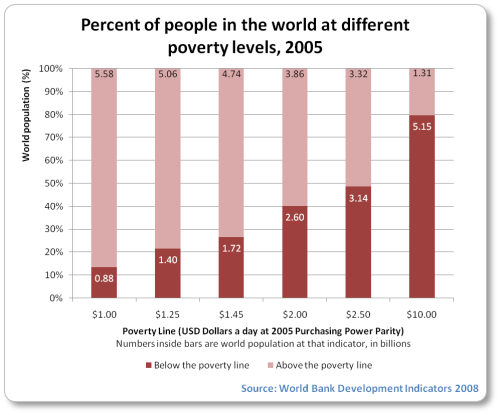
- At least 80% of humanity lives on less than $10 a day
- Almost half the world - over 3 billion people - live on less than $2.50 a day.
- The GDP (Gross Domestic Product) of the 41 Heavily Indebted Poor Countries (567 million people) is less than the wealth of the world's 7 richest people combined.
- Nearly a billion people entered the 21st century unable to read a book or sign their names.
- Less than one per cent of what the world spent every year on weapons was needed to put every child into school by the year 2000 and yet it didn't happen.
- 1 billion children live in poverty (1 in 2 children in the world).
- 640 million live without adequate shelter, 400 million have no access to safe water, 270 million have no access to health services. 10.6 million died in 2003 before they reached the age of 5 (or roughly 29,000 children per day).
Consider the global priorities in spending in 1998
Global Priority $U.S. Billions
Cosmetics in the United States $8
Ice cream in Europe $11
Perfumes in Europe and the United States $12
Pet foods in Europe and the United States $17
Business entertainment in Japan $35
Cigarettes in Europe $50
Alcoholic drinks in Europe $105
Narcotics drugs in the world $400
Military spending in the world $780
And compare that to what was estimated as additional costs to achieve universal access to basic social services in all developing countries:
Global Priority $U.S. Billions
Basic education for all $6
Water and sanitation for all $9
Reproductive health for all women $12
Basic health and nutrition $13
|
Everyday Justice: The Global Impact Of Our Daily Choices

by Heber Brown, III
Blog: www.FaithinActionOnline.com
 One of the books I'm reading right now is entitled Everyday Justice: The Global Impact of our Daily Choices by Julie Clawson. I'm just a couple chapters in so far, but I already appreciate how Julie brings home the issue of justice and reveals how we vote every day to either support justice or injustice by way of our consumption habits. One of the books I'm reading right now is entitled Everyday Justice: The Global Impact of our Daily Choices by Julie Clawson. I'm just a couple chapters in so far, but I already appreciate how Julie brings home the issue of justice and reveals how we vote every day to either support justice or injustice by way of our consumption habits.
I'm a bit of a policy wonk so I tend to engage at times in wonk-speak and unknowingly at the time communicate "over the heads" of some that I'm attempting to mobilize on an issue. Thus, only those who pour over legislation, watch C-Span, check in on British Parliament debates for fun, or browse the Library of Congress know what I'm talking about.
It's NOT been my experience that those who seem to "miss it" don't have the intellectual capacity to understand what I'm saying or the moral sensibilities to support. It more so points to my failure to communicate in such a way that is passionate - yes, but also clear and digestible. I'm always good on the passion side of that equation, but on the being clear part and showing how people's daily lives are impacted by whatever issue I'm talking about, I tend to have a low batting average. I struggle with this and am trying to do better. In the past, I would get my kicks off of "being prophetic" (whatever that means) so it didn't matter the reaction of those listening. I was just going after the shock value. I was big, bad, and Black enough to say whatever I wanted to say...in the name of Jesus of course. But thank God for growth! Now I realize not only how narcissistic that approach was, but how counterproductive it was as well. I get the sense that many people over the years in which I've been blessed to have audience eventually walked away from me with the question in mind: "Why should I care?"
|
|
From Christ's Church to iChurch
How consumerism undermines our faith and community.
by Skye Jethani, Leadership contributing editor
7/10/2006
A recent article in The New York Times reported the opening of the first Indian megatemple (the Hindu equivalent of the American megachurch). The enormous building is designed to attract and entertain the un-templed with a large-format movie screen, an indoor boat ride, and even a hall of animatronic characters. The temple's public relation's director proudly admits, "There is no doubt about it-we have taken the concept from Disneyland."
Similarly, Times writer Laurie Goodstein has reported on the struggle of American Muslim clerics to protect their faith from the influence of materialism and consumerism. Indications are that over time American Hindu and Muslim leaders will follow Christians in succumbing to the siren song of consumerism.
Christian critiques of consumerism usually focus on the dangers of idolatry-the temptation to make material goods the center of life rather than God. This, however, misses the real threat consumerism poses. My concern is not materialism, strictly speaking, or even the consumption of goods-as contingent beings, we must consume resources to survive. The problem is not consuming to live, but rather living to consume.
|
|
THE RELIGION OF CONSUMERISM
The OOZE
Every day advertisements implore us to get more from life. Fulfillment is within our grasp - and we deserve it. Why wait when we can have everything now?
We can buy the house of our dreams with no money down. We can pull a fine bottle of French wine from our miniature wine cellar and savor the flavors while we sit on our suede sectional and watch our fifty-inch flat screen. Before going to sleep on our third new mattress in five years, we can go online to make our interest-only mortgage payment and order the kids some cheap Christmas gifts made in China - and something for ourselves, too, so we can get free shipping.
We have been told that this is the perfect life. We have a sense that when we get to this point, we will be satisfied. Yet if we spend our lives pursuing this dream, we discover that it cannot deliver on its grand promises of ease and satisfaction. There will always be a finer wine, a better television, a faster computer . . . and so the race goes on until the day we find ourselves surrounded by the latest and greatest of everything, yet feeling more alone and unhappy than ever before.
| |
|
Tom Beaudoin's Consuming Faith presents key questions about attempting to put our spirituality into practice by integrating who we are with what we buy Where do these products come from? Who made them and in what conditions do they work? How does what I buy affect others? What does my faith have to do with what I buy? When is enough, enough? Today, it is more important than ever to pay attention to our economic spirituality.
|
|
About Us

... You will raise up the age-old foundations; And you will be called the repairer of the breach, The restorer of the streets in which to dwell. (Isaiah. 58:12)
Kinetics mission is to disseminate information and develop new ideas that work to strengthen social movements within the African-American community; providing them with the tools and skills to pursue justice and better address the needs of those whom they serve.
Programs
TubmanCityPress
Faith in Life Speaker Series
| |
|
|
|
Join Us

Kinetics Faith & Justice Network mission is to provide the faith community with the tools to advocate and mobilize on local, national, and international issues, to build capacity to solve our own problems, and to use dialogue as a catalyst for social change. Members include clergy, scholars, lawyers, social justice advocates, and nonprofit and business professionals.
| |
|