|
|
|
My people are destroyed for lack of knowledge. Because you have rejected knowledge, I also will reject you from being My priest. Since you have forgotten the law of your God, I also will forget your children.
- Hosea 4:6 | |
Greetings!
With the deployment of law enforcement agents, commonly referred to as School Resource Officers, to public schools, our children's discipline has begun to move from the schoolhouse to the courthouse. There is a need to distinguish between discipline that should be handled by the school and criminal offenses that should be handled by law enforcement.
In Florida a five-year-old girl was arrested and removed from her elementary school by police for having a temper tantrum in class and a 12-year-old was arrested for passing gas. According to POLICING IN SCHOOLS, an ACLU research paper, childhood arrests increase the likelihood of interaction with the criminal justice system and reduce the opportunities for employment. So when the state of Maryland is planning to build a juvenile detention center that cost over $100 million, failing to fund programs for youth, firing teachers, and criminalizing the behavior of our children, the pipeline is plain to see. Who will occupy the new detention center other than our children? What will we do to combat this dangerous trend? As my big brother and juvenile justice advocate Cameron Miles once told me "if you are serious about ministry, there are ministry opportunities on every corner of Baltimore."
So are you a Minister or a MiniStar? Let's get to work church!
If you are interested in partnering on juvenile justice issues email me at info@kineticnet.org . We will be locking arms with juvenile justice advocates, faith-based/community leaders and anyone who is interested in saving our children.
In love and service,
Jamye Wooten
Kinetics
Kineticnet.org |
|
POLICING IN SCHOOLS:
DEVELOPING A GOVERNANCE DOCUMENT
FOR SCHOOL RESOURCE OFFICERS IN K-12 SCHOOLS
AN ACLU WHITE PAPER
BY CATHERINE Y. KIM AND I. INDIA GERONIMO
PUBLISHED AUGUST 2009
INTRODUCTION
K-12 public schools across the country have begun to deploy law enforcement agents on school grounds in growing numbers. Although there are no current national figures for the number of such officers, in 2004, 60 percent of high school teachers reported armed police officers stationed on school grounds,1 and in 2005, almost 70 percent of public school students ages 12 to 18 reported that police officers or security guards patrol their hallways.
Frequently referred to as "School Resource Officers" or SROs, these agents are often sworn police officers employed by the local police department and assigned to patrol public school hallways full-time. In larger jurisdictions such as Los Angeles and Houston, these officers may be employed directly by the school district.
Without addressing the question of whether police officers should be deployed to schools in the first instance, this White Paper posits that if they are deployed, they must be provided with the tools necessary to ensure a safe school environment while respecting the rights of students and the overall school climate.
|
Improper school-based arrests and referrals to law enforcement have a devastating impact on children. Studies show that being arrested has detrimental psychological effects on the child; nearly doubles the odds of dropping out of school, and, if coupled with a court appearance, nearly quadruples the odds of dropout; lowers standardized test scores; reduces future employment prospects; and increases the likelihood of future interaction with the criminal justice system.-POLICING IN SCHOOLS:
DEVELOPING A GOVERNANCE DOCUMENT FOR SCHOOL RESOURCE OFFICERS IN K-12 SCHOOLS |
New detention centers planned 
PSA-Dewberry / August 17, 2009
An artist's rendering by PSA-Dewberry of Fairfax, Va., shows the design for the proposed juvenile detention center.

PSA-Dewberry / August 17, 2009
The proposed five-story, 200,000-square-foot Baltimore Youth Detention Center will accommodate youths charged criminally as adults and will enable the state to increase services for youth offenders.
Baltimore Sun photo by Karl Merton Ferron / August 17, 2009
A view looking west on East Monument Street shows the site of the adjoining juvenile and women's detention centers in East Baltimore.
|
| The number of children arrested or referred to court for school discipline has grown in recent years. In South Carolina, the single most common offense resulting in a juvenile court referral during the 2007-08 year was "Disturbing Schools." - POLICING IN SCHOOLS: DEVELOPING A GOVERNANCE DOCUMENT FOR SCHOOL RESOURCE OFFICERS IN K-12 SCHOOLS |
Arresting Development: Addressing the School Discipline Crisis in Florida
Many Florida districts, like many districts in other states, have turned away from traditional education-based disciplinary methods-such as counseling, after-school detention, or extra homework assignments-and are looking to the legal system to handle even the most minor transgressions. Children are being criminalized, handcuffed, arrested, booked, and sent to court for minor misconduct in school. Known by many as the "schoolhouse-to-jailhouse track" or the "school-to-prison pipeline," this growing trend of relying upon law enforcement and the courts for typical, minor adolescent misbehavior is alarming. It has dire consequences for children and their families and puts aside any notion of forgiving and teaching children.
Statewide there were 26,990 school-related referrals to the Florida Department of Juvenile Justice (DJJ) during the 2004-05 school year. Over three-quarters of school-based referrals (76 percent) were for misdemeanor offenses such as disorderly conduct, trespassing, or assault and/or battery, which is usually nothing more than a schoolyard fight.
In addition to turning to police as disciplinarians, Florida schools increasingly utilize internal discipline methods that focus on isolation and removal of students instead of addressing the underlying causes of behavioral problems. In fact, the growth in the number of out-of-school suspensions has outpaced the growth of the student population by almost two-to-one. Out-of-school suspensions rose from 385,365 during the 1999-00 school year to 441,694 in 2004-05, a 14 percent increase, even though the student population increased by only 8.4 percent.
These punitive practices fall hardest on students of color, especially Black children. In the 2004-05 school year, Black students received 46 percent of out-of-school suspensions and police referrals, but comprised only 22.8 percent of the student population. Students with disabilities are also targeted by these practices.
|
Children of color and students with disabilities are disproportionately represented among these students. In Florida, Black youth, who represented only 22 percent of the overall juvenile population, accounted for 47 percent of all school-based delinquency referrals; youth with special needs accounted for 23 percent of all school-based referrals.- POLICING IN SCHOOLS:
DEVELOPING A GOVERNANCE DOCUMENT FOR SCHOOL RESOURCE OFFICERS IN K-12 SCHOOLS
|
Schoolhouse to Jailhouse
Make the Road New York's Youth Power Project
5 min., 21 sec.
We're not criminals. We're students."
Youth at Make the Road New York, a Brooklyn community organization, discuss the School to Prison Pipeline and its impact on their lives. The film also tells the story of Luis, a young man suspended from school and questioned by officers from the local precinct for having a cell phone in his bag.
|
|
ADVERTISEMENT
The Center for the Integration of Spirituality and Mental Health
and
The Black Mental Health Alliance
presents
The Annual Mental Wellness Service Initiative
|
�� Learn how to bolster participation in the Annual Mental Wellness
Promotion Service Initiative
�� Receive training on the implementation of the Annual Mental
Wellness Promotion Service
�� Hear testimonials from pastors who have participated in the
Initiative
|
| Download Flyer | | |
Locating the School-to-Prison Pipeline
The "school-to-prison pipeline" refers to the
policies and practices that push our nation's
schoolchildren, especially our most at-risk children, out of classrooms and into the
juvenile and criminal justice systems. This pipeline reflects the prioritization of incarceration over education. For a growing number of students, the path to incarceration includes the following "stops":
|
|
Mapping and Analyzing The Schoolhouse to Jailhouse Track Action Kit
This Action Kit is intended to help mobilized communities (parents, youth, advocates, and educators) understand and begin to address the schoolhouse to jailhouse track so that they may ultimately create caring learning environments that push students toward colleges and careers rather than prison. It includes information on:
- Collecting information and data about school discipline policies and practices;
- Analyzing and organizing the data; and
- Developing messages that resonate with your audience.
|
Open Letter to Delegate Keith Haynes
Heber Brown, III on August 20th, 2009
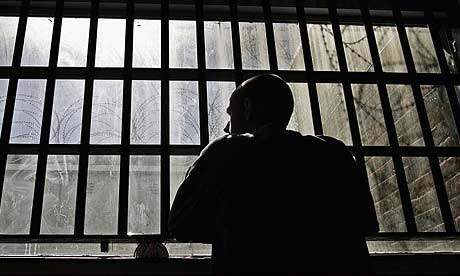 Photo Credit: static.guim.co.uk Good Morning Delegate Haynes,
I pray this email finds you and your family well. I'm writing because I just finished reading an article in today's Baltimore Sun by Julie Bykowicz entitled, "Maryland Detention Center Plans Move Forward" which details how the state is prepared to spend $100 million dollars to build two new prisons - one for youth and the other for women in East Baltimore.
To be honest, I am disturbed by this news because the perception is that money is readily available to build prisons or to support repressive enforcement measures in Maryland's African American communities; but it always seems that we beg for resources that would support our public schools and direct investment to our neighborhoods. In a state where the Governor is proposing cuts to the budget for the second year in a row; I am beyond befuddled that $100 million is found to build more prisons in Black neighborhoods anticipating an escalation in the incarceration of youth who will be charged as adults and women.
You are quoted in this article as calling this plan a "good investment." As one of the 6 African Americans on the House Appropriations Committee; I would like to believe that you would have a better grasp of what a "good investment" is in the big picture of the health of our community.
However, I'll give you the benefit of the doubt because I am well aware of how mainstream media sometimes misquotes and/or publishes statements out of context in order to support their pretext. Instead of relying on The Sun; I'd rather hear your position straight from you.
Can you please share your views related to this project and its impact on our community.
I look forward to hearing from you.
Rev. Heber Brown, III
|
Md. moving forward on detention center projects
Two planned $100 million facilities in E. Baltimore would hold youths, women
Downtown Baltimore's campus of ancient-looking prison buildings, several of which date to the 1800s, is slated for a major face-lift as the state moves forward with plans for two new detention centers that would cost more than $100 million each.
A state architectural board is scheduled to review today the design for a five-story, 180-bed detention center for teens facing adult criminal charges. Construction of the glassy, modern building along East Monument Street could begin next summer.
Meanwhile, design of an 800-bed detention center for women began about a month ago.
The buildings would keep adult male detainees separate from women and teens as required by federal law, addressing long-standing Justice Department complaints. Now, men, women and teens share hallway, classroom and booking space, creating conditions that Benjamin Brown, deputy commissioner of the state Department of Public Safety and Correctional Services' pretrial division, calls untenable.
"It definitely is a difficult place to manage today," Brown said.
The state agency has overseen Baltimore pretrial services, including the city jails, since the 1990s.
This week, the state settled a decades-old federal lawsuit over health and safety conditions at the Baltimore City Detention Center, parts of which are 150 years old, though prisoner rights advocates said plans for the new facilities were not a factor in that agreement.
The two projects are expected to cost the state more than $280 million. State lawmakers have approved money for design but not construction. They're expected to vote on the youth center construction during the next legislative session, which begins in January.
Although Maryland is strapped for cash amid a national economic downturn, lawmakers do not expect to postpone the projects, in part because the state's top bond rating enables it to borrow money cheaply.
Del. Keith E. Haynes, a Baltimore Democrat on the capital budget subcommittee, called the buildings "a good investment" because they would create jobs in construction and lead to the hiring of more state employees.
|
|
About Us

... You will raise up the age-old foundations; And you will be called the repairer of the breach, The restorer of the streets in which to dwell. (Isaiah. 58:12)
Kinetics mission is to develop new ideas that work to strengthen social movements within the African-American community; providing them with the tools and skills to pursue justice and better address the needs of those whom they serve.
Kinetics is a project of Fusion Partnerships, Inc. | |
|
|
|
|
We are currently in Phase 1 of our program; hosting a monthly speaker series and strategic planning sessions. We have also begun the process of grant writing to try and secure funding for the development of the T.R.U.C.E. Institute @Baltimore City Correctional Center. We have developed a webpage @ http://TRUCE.collectivex.com and are building a network of resource providers and advocacy organizations. Phase 1
Speaker Series Strategic Planning Grant Writing Build a coalition of grassroots, community/ faith-based organizations who are working in the areas of gangs and re-entry.
Phase 2: T.R.U.C.E. Institute @ BCCC
History of Gangs: From Protector to Predator
War on Drugs: The Real American Gangster
Street Law: Trips, Traps, and the Trappers
Testimonials: Ex-offenders and families give their testimonies
Life Skills Training
Conflict Resolution
Spiritual Development
Male/Female Relationships
Fatherhood Training
Job Preparedness
Skill Development
Career Day
Advocacy/Legislative Process
Phase 3: The T.R.U.C.E. Movement
Please help us build this MOVEMENT with Time, Talent or Treasure.
Kinetics mission is to develop new ideas that work to strengthen social movements within the African-American community; providing them with the tools and skills to pursue justice and better address the needs of those whom they serve.
... You will raise up the age-old foundations; And you will be called the repairer of the breach, The restorer of the streets in which to dwell. (Isaiah. 58:12).

|
|
| | |
|