Greetings!
While our children are attending out of date, run down and underfunded schools in Baltimore City, today's Baltimore Sun reports that the state is moving forward with the development of two new detention centers that carry a price tag of $100 million each.
Delegate Keith Haynes, an African-American democrat, is quoted in the Sun saying this would be a "good investment" that would create jobs. Rev. Heber Brown in his Open Letter to Delegate Haynes asks for clarity from the delegate.
Rev. Brown has told me that he has been contacted by Delegate Haynes and that the two plan to meet to discuss this further.
I look forward to his response.
In love and service,
Jamye Wooten
Kinetics |
Open Letter to Delegate Keith Haynes
Heber Brown, III on August 20th, 2009
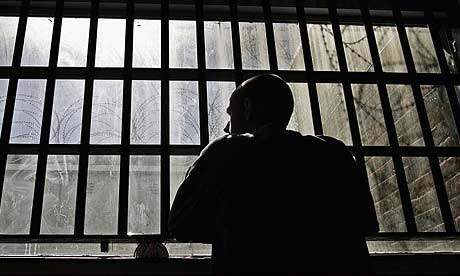 Photo Credit: static.guim.co.uk Good Morning Delegate Haynes,
I pray this email finds you and your family well. I'm writing because I just finished reading an article in today's Baltimore Sun by Julie Bykowicz entitled, "Maryland Detention Center Plans Move Forward" which details how the state is prepared to spend $100 million dollars to build two new prisons - one for youth and the other for women in East Baltimore.
To be honest, I am disturbed by this news because the perception is that money is readily available to build prisons or to support repressive enforcement measures in Maryland's African American communities; but it always seems that we beg for resources that would support our public schools and direct investment to our neighborhoods. In a state where the Governor is proposing cuts to the budget for the second year in a row; I am beyond befuddled that $100 million is found to build more prisons in Black neighborhoods anticipating an escalation in the incarceration of youth who will be charged as adults and women.
You are quoted in this article as calling this plan a "good investment." As one of the 6 African Americans on the House Appropriations Committee; I would like to believe that you would have a better grasp of what a "good investment" is in the big picture of the health of our community.
However, I'll give you the benefit of the doubt because I am well aware of how mainstream media sometimes misquotes and/or publishes statements out of context in order to support their pretext. Instead of relying on The Sun; I'd rather hear your position straight from you.
Can you please share your views related to this project and its impact on our community.
I look forward to hearing from you.
Rev. Heber Brown, III
|
New detention centers planned 
PSA-Dewberry / August 17, 2009
An artist's rendering by PSA-Dewberry of Fairfax, Va., shows the design for the proposed juvenile detention center.

PSA-Dewberry / August 17, 2009
The proposed five-story, 200,000-square-foot Baltimore Youth Detention Center will accommodate youths charged criminally as adults and will enable the state to increase services for youth offenders.
Baltimore Sun photo by Karl Merton Ferron / August 17, 2009
A view looking west on East Monument Street shows the site of the adjoining juvenile and women's detention centers in East Baltimore.
|
Md. moving forward on detention center projects
Two planned $100 million facilities in E. Baltimore would hold youths, women
Downtown Baltimore's campus of ancient-looking prison buildings, several of which date to the 1800s, is slated for a major face-lift as the state moves forward with plans for two new detention centers that would cost more than $100 million each.
A state architectural board is scheduled to review today the design for a five-story, 180-bed detention center for teens facing adult criminal charges. Construction of the glassy, modern building along East Monument Street could begin next summer.
Meanwhile, design of an 800-bed detention center for women began about a month ago.
The buildings would keep adult male detainees separate from women and teens as required by federal law, addressing long-standing Justice Department complaints. Now, men, women and teens share hallway, classroom and booking space, creating conditions that Benjamin Brown, deputy commissioner of the state Department of Public Safety and Correctional Services' pretrial division, calls untenable.
"It definitely is a difficult place to manage today," Brown said.
The state agency has overseen Baltimore pretrial services, including the city jails, since the 1990s.
This week, the state settled a decades-old federal lawsuit over health and safety conditions at the Baltimore City Detention Center, parts of which are 150 years old, though prisoner rights advocates said plans for the new facilities were not a factor in that agreement.
The two projects are expected to cost the state more than $280 million. State lawmakers have approved money for design but not construction. They're expected to vote on the youth center construction during the next legislative session, which begins in January.
Although Maryland is strapped for cash amid a national economic downturn, lawmakers do not expect to postpone the projects, in part because the state's top bond rating enables it to borrow money cheaply.
Del. Keith E. Haynes, a Baltimore Democrat on the capital budget subcommittee, called the buildings "a good investment" because they would create jobs in construction and lead to the hiring of more state employees.
|
|
Prison Expansion Pushed Forward While Massive Cuts to Education Proposed

While the Governor and legislature propose massive cuts to education and 2,000 public works projects are on hold, a bill to propel a $12 billion prison construction project was sent to Governor Schwarzeneggar. This bill is designed to fix problems with AB900, the largest prison construction plan in history.
"The Governor and our legislature were supposed to be reducing California's budget deficit. Instead, the legislature passed ABX1-10 - clean up language necessary to implement 2007's massive prison construction plan," says Debbie Reyes of the California Prison Moratorium Project, members of the statewide coalition, Californians United for a Responsible Budget (CURB).
|
A New Slavery
The U.S. war on drugs is big business -- a multi-billion dollar public/private venture that radically inflates the value of illegal drugs and criminalizes the poorest people of color, trapping them in a vicious cycle of addiction, unemployment and incarceration:
$27 billion for interdiction and law enforcement, $1.3 billion for Plan Colombia in 2000.
$9.4 billion in 2000 to imprison close to 500,000 people convicted of non-violent drug offenses, 75% of whom are Black.
$80 to $100 billion in lost earnings.
Untold billions in homeless shelters, healthcare, chemical dependency and psychiatric treatment, etc.
Black women are the fastest growing segment of the prison population and Native American prisoners are the largest group per capita.(1) Approximately five million people -- including those on probation and parole -- are directly under the surveillance of the criminal justice system. The prison industrial complex profits from racist practices in arrest, conviction, and sentencing patterns. Black and brown bodies are the human raw material in a vast experiment to conceal the major social problems of our time.
The racially disproportionate demographics of the victims of the war on drugs will not surprise anyone familiar with the symbiotic relationship between poverty and institutionalized racism. Economic inequality and political disenfranchisement have been inextricably intertwined since the Trans-Atlantic slave trade. The racist enforcement of the drug laws is just the latest example of institutionalized racism.
As political economist John Flateau graphically puts it: "Metaphorically, the criminal justice pipeline is like a slave ship, transporting human cargo along interstate triangular trade routes from Black and Brown communities; through the middle passage of police precincts, holding pens, detention centers and courtrooms; to downstate jails or upstate prisons; back to communities as unrehabilitated escapees; and back to prison or jail in a vicious recidivist cycle."(2)
|
A Portrait of Prisoner Re-Entry in Maryland

| |

|
|
The Hard Sell
The nation's 2 million inmates and their keepers are the ultimate captive market: a $37 billion economy bulging with business opportunity.
The nation's 2 million inmates and their keepers are the ultimate captive market: a $37 billion economy bulging with business opportunity.
Upon his release in 2002, Prins founded Outside Connection in a bid to undercut the collect-calling services that contract with prisons. Those contracts create virtual monopolies that charge a big premium - as much as four times the standard rate for collect calls.
With Outside Connection, family members and friends buy discounted phone time, and prisoners are given a direct-dial local number that routes calls straight to a family's chosen phone. Calls can also be sent to cell or Internet phones, which isn't possible with traditional collect calls.
Because it's a prepaid service, Outside Connection is never stuck with the bill, avoiding one of the major reasons traditional services charge inmates exorbitant rates. Inmate calls are a $1 billion market, so wresting just a small portion of that business from the major providers could give Prins's 12-person shop a solid payday.
Although Prins won't reveal his current revenue, he says his customer base has grown 100 percent a year for the past two years, mainly through word of mouth: "If you're helping these families, the inmates are going to pass the word around."
Read More |
|
The prison industry in the United States: big business or a new form of slavery?
Human rights organizations, as well as political and social ones, are condemning what they are calling a new form of inhumane exploitation in the United States, where they say a prison population of up to 2 million - mostly Black and Hispanic - are working for various industries for a pittance.
For the tycoons who have invested in the prison industry, it has been like finding a pot of gold. They don't have to worry about strikes or paying unemployment insurance, vacations or comp time. All of their workers are full-time, and never arrive late or are absent because of family problems; moreover, if they don't like the pay of 25 cents an hour and refuse to work, they are locked up in isolation cells.
There are approximately 2 million inmates in state, federal and private prisons throughout the country. According to California Prison Focus, "no other society in human history has imprisoned so many of its own citizens." The figures show that the United States has locked up more people than any other country: a half million more than China, which has a population five times greater than the U.S. Statistics reveal that the United States holds 25% of the world's prison population, but only 5% of the world's people.
From less than 300,000 inmates in 1972, the jail population grew to 2 million by the year 2000. In 1990 it was one million. Ten years ago there were only five private prisons in the country, with a population of 2,000 inmates; now, there are 100, with 62,000 inmates. It is expected that by the coming decade, the number will hit 360,000, according to reports.
What has happened over the last 10 years? Why are there so many prisoners?
|
Will Maryland Correctional Enterprises Compete with Private Sector Companies?
Maryland Correctional Enterprises, the prison industry arm of the Maryland Division of Correction, is discussing plans for another attempt this year to expand the use of inmate labor by removing the ban on competing with private sector services on the open market in Maryland.
According to several Annapolis sources, the new bill modifies the bill that last year passed the state Senate, but died in the House Health and Government Operations Committee, by adding a layer of public notice, input and oversight, and permit MCE to sell goods directly to state employees.
Labor unions are already rebuking the proposal.
"In the midst of the greatest economic crisis since the Great Depression, the last thing we need is to take jobs from working men and women to give them to prison inmates," declared Harold L. Bock, regional director, UNITE HERE Mid-Atlantic Joint Board.
Saying he was unfamiliar with any planned bill, Division of Corrections spokesman Rick Benetti declined to comment.
The measure would expand the current program to include call centers, commercial laundry contracts, and food service preparation, according to a lobbyist familiar with it.
Del. Joseph J. "Sonny" Minnick (D-Dist 6), chairman of the MCE Management Council, last year praised the expansion before the Senate Judiciary Committee. "By placing offenders in working conditions that mirror the private industry, these individuals have been able to develop job skills and a consistent work ethic."
However, Donna Edwards, secretary-treasurer of the Maryland State and DC AFL-CIO, offered a different viewpoint. "We support apprentice training that allows people to come out with marketable skills, but this proposal that would expand into commercial laundry, call centers and food service is just crap. They're just using people."
Read More
|
|
About Us

... You will raise up the age-old foundations; And you will be called the repairer of the breach, The restorer of the streets in which to dwell. (Isaiah. 58:12)
Kinetics mission is to develop new ideas that work to strengthen social movements within the African-American community; providing them with the tools and skills to pursue justice and better address the needs of those whom they serve.
Kinetics is a project of Fusion Partnerships, Inc. | |


