|
|
|
"And afterward, I will pour out my Spirit on all people. Your sons and daughters will prophesy, your old men will dream dreams, your young men will see visions.
Joel 2:28
| |
|
Greetings,
The role of women in church leadership can be a controversial subject. I was raised in the Church of God In Christ where women are not able to become pastors or hold the position of elder. I have watched as newly converted, unqualified men have been appointed to leadership bypassing spiritually mature women who have faithfully served their churches for years. Within the last five years I have seen many women leave mainline denominations and launch out on their own. This is a trend that I believe will only increase.
When I first moved back to Baltimore from New York my wife and I searched for a year for a new church home. We both were raised in the church and had grown tired of church as usual. On the advice of my mother I decided to visit a new church that was pastored by a woman. We were instantly won over and excited about the vision of the pastor to Set The Captives Free. She was bold, direct and wanted to make an impact on this city and nation. This church rapidly grew to one of the largest woman led churches in city, maybe in the entire state. We are no longer members of this church, but believe the pastor did as good of a job as her male counterparts, maybe even better.
In love and service,
"Wisdom shouts in the street, She lifts her voice in the square; At the head of the noisy streets she cries out; At the entrance of the gates in the city, she utters her sayings" (Proverbs 1:20-21 NASB).
|
The Role of African American Women in the Black Church
Women Outnumber Men in the Pews, Yet Are Rarely Seen in the Pulpit
By Linda Lowen, About.com
 Faith is a strong guiding force in the lives of many African American women. And for all that they receive from their spiritual communities, they give back even more. In fact, black women have long been regarded as the backbone of the black church. But their extensive and significant contributions are made as lay leaders, not as religious heads of churches.
The congregations of African American churches are predominantly women, and the pastors of African American churches are nearly all male. Why aren't black women serving as spiritual leaders? What do black female churchgoers think? And despite this apparent gender inequity in the black church, why does church life continue to be so important to so many black women?
Daphne C. Wiggins, former assistant professor of congregational studies at Duke Divinity School, pursued this line of questioning and in 2004 published Righteous Content: Black Women's Perspectives of Church and Faith. The book revolves around two main questions:
"Why are women so faithful to the Black Church?"
"How is the Black Church faring in the eyes of women?"
|
|
History of Women in the Pentecostal Movement
Dr. Cheryl J. Sanders
1996 PCCNA National Conference
Memphis, Tennessee, October 1, 1996
Picture: Women of the Church - Pamela Harris
On the whole, the Holiness-Pentecostal movement in the United States has made a distinctive contribution to the historical evolution of religion in America by involving blacks, women, and the poor at all levels of ministry. There are well over 100 church bodies listed in the Directory of African American Religious Bodies which can be identified as Holiness or Pentecostal. These churches were led by black Christians around the turn of the century who "came out" of the black Baptist and Methodist churches, seeking "the deeper life of entire sanctification" and Spirit baptism; "Their initial concern was not so much to start a new denomination as to call the existing ones back to the wells of their spirituality."(1) What the Holiness and Pentecostal churches have in common is an emphasis upon the experience of Spirit baptism. Although some of these churches have adopted the sexist and racist norms of white mainline Protestantism, others have produced compelling models of cooperation between male and female leaders. Read More |
|
Women's Leadership in Southern Religion (and American Religions)
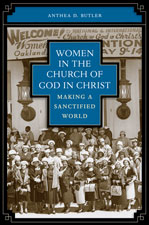 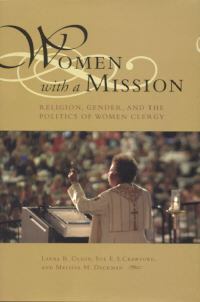
Reviewed by Kelly J. Baker, for the Journal of Southern Religion
Women in the Church of God in Christ: Making a Sanctified World by Anthea D. Butler
Women with a Mission: Religion, Gender, and the Politics of Women Clergy by Laura R. Olson, Sue E. Crawford, and Melissa M. Deckman
In The Religious History of American Women, Catherine Brekus argues for the inclusion of women's history into larger narratives of American religious history. For Brekus, "many historians have written as if only male leaders-and a small number of elite female leaders, usually white Protestants-have had the political, economic, or religious power to bring about change."(1) These large, or perhaps grand, narratives of American religious history (as well as American history), in some ways, have remained impervious to the religious lives of women and their impact on their congregations, religious leaders, families, and wider social worlds. Unfortunately, the presence/influence of women has been overlooked, willfully ignored, or, perhaps, discounted as somehow unimportant because women have not historically gained entrance into leadership roles within their religious communities. Women have more often been the "people in the pews" rather than people of the pulpit. Some women have gained access to religious leadership, and they appear sprinkled in narratives as unique case studies or forerunners to change. In her work, Brekus and her contributors sound the call for inclusion as well as the embrace of women's history in religious history. How do our narratives change or remain the same with the entrée of women? What kind of stories bubble to the surface rather than remain hidden in the depths? Anthea Butler's and Laura Olson et al's works, in some ways, provide answers to this charge. Both Women in the Church of God in Christ and Women with a Mission present case studies of women's leadership primarily in Christianity (though Olson's work includes Reform and Conservative Judaism). These both examine how women become leaders, their styles of leadership, and how they understand their particular circumstances. Both works present a complicated relationship between gender and leadership that for historical actors and contemporary clergy can be fraught with tension, can provide empowerment, and can reify traditional gender norms.
| |

|
|
Jimmy Carter's Stand on Women in Church Leadership
by Valerie Weaver-Zercher 07-22-2009
An autographed photo of Jimmy Carter sits on our piano. A friend of ours wrote to Carter and told him that he was one of our sons' favorite presidents, and would he please send them a signed photograph. When Keith gave our sons the Carter picture last Christmas, my 8-year-old actually teared up. Hours later I found him sitting silently on the hearth, gazing at the photo and his own name at the bottom, awestruck that it had been written with the pen of a former president.
Jimmy Carter recently proved himself even more worthy of my sons' devotion. In moving op-ed pieces in the Australian newspaper The Age and the British Observer, Carter widely publicizes his 2000 decision to withdraw from the Southern Baptist Convention because of its stance that women are subservient to men and its refusal to allow women to serve as pastors or deacons. "The truth is that male religious leaders have had-and still have-an option to interpret holy teachings either to exalt or subjugate women," Carter writes.
|
|
Black Women's Bumpy Path to Church Leadership
By ARI L. GOLDMAN
NYTIMES.COM JULY 1990
Caroline Ann Knight was the assistant pastor at one of Harlem's major churches for nearly seven years when she began to look around for a church of her own, a path that many men before her had taken. But Ms. Knight found that none of the big Baptist churches in Harlem were willing to put a woman in the top job.
Instead, Ms. Knight took a handful of members with her from Canaan Baptist Church and founded her own congregation, Philadelphia Baptist Church, a few blocks away. She went from preaching to 1,200 people on Sunday mornings to preaching to fewer than 100.
Advocates for women in the ministry say that Ms. Knight's story is typical of the experience of black female ministers around the country who find an assistant pastor's job a track to a dead end.
Female Ministers See Sexism
Increasingly, many such women are establishing their own churches or taking over small, struggling congregations that men have passed over.
''This is certainly not a story about lack of ability,'' said the Rev. Dr. Jacquelyn Grant, director of Black Women in Church and Society, an educational organization based in Atlanta that advocates the full participation of women in the church. ''Some of the most competent people in the ministry today are women.''
''The issue is the same as it is in the larger society: sexism,'' she added. ''Men don't have to make it in the same way women have to make it. Women have to create their own.'
A survey of female ministers by the National Council of Churches showed that as of 1986, there were 20,736 women, representing almost 8 percent of the nation's clergy. This was double the figure for 1977. The survey did not give a racial breakdown.
Read More
|
|
About Us

... You will raise up the age-old foundations; And you will be called the repairer of the breach, The restorer of the streets in which to dwell. (Isaiah. 58:12)
Kinetics mission is to disseminate information and develop new ideas that work to strengthen social movements within the African-American community; providing them with the tools and skills to pursue justice and better address the needs of those whom they serve.
Programs
Faith in Life Speaker Series
| |
|
|
|
Join Us

Kinetics Faith & Justice Network mission is to provide the faith community with the tools to advocate and mobilize on local, national, and international issues, to build capacity to solve our own problems, and to use dialogue as a catalyst for social change. Members include clergy, scholars, lawyers, social justice advocates, and nonprofit and business professionals.
| |
|


