Greetings!
Greetings from your farm. Thankfully the heat wave has taken a leave but we are in a serious drought. The Governor has declared a State of Emergency and we're watching the commodity row crops like corn and soybeans drying up and dying. We've been able to keep our crops alive by trucking our low tech irrigation wagon from crop to crop. Things aren't growing as quickly as we'd like but everything is surviving. What this means for our shareholders is a little less variety than we'd like and when we finally DO get rain, an onslaught of our stalled crops like carrots, beets, onions, cucumbers etc. Some good news from drought land; heat loving crops like tomatoes, peppers, summer squash, and basil are thriving. The pepper and tomato plants are LOADED and we have the first peppers this week. The variety is Hungarian Hot Wax and they are still a little small but very tasty. Also new this week is our Thai Basil. See Chef Jon's piece on basil varieties for more info. We also have more heirloom summer squash. After trying several varieties over the past 5 years we've decided these 4 varieties are our favorites; especially the French heirlooms Ronde de Nice (aka Provincial Pumpkin) and Vert et Blanc. We've perfected our recipe for summer squash caponata so give it a try. You'll be getting one of our greens this week, either a chard or a kale. One of the major changes we have made for this season is expanding our wholesale offerings. We decided to grow 3 chard varieties and 2 kale varieties along with our heirloom tomatoes on a larger scale to sell to stores like Whole Foods and Mariano's. This required setting up a branded twist tie with a PLU bar code which was WAY more complicated than it sounds. You might find that your greens have one of these fancy twist ties as we sometimes harvest a bit more than we need to fill the wholesale orders so we use these bunches for CSA boxes. You might see our products in Chicago area stores...when you do you can say "Hey, that's MY farm." Friends and fellow CSA farmers Todd and Julia McDonald of Peasant's Plot farm are hosting an event on Thursday August 9th at the Hideout in Chicago. We probably can't make it but it sounds like a great time to meet other CSA members, share recipes and enjoy some great treats from the farms. CSA Potluck at the Hideout Where: Hideout, 1354 West Wabansia Avenue Chicago, IL 60642
When: Thursday August 9th, 5:30 - 8:00pm This event is open to all Harvest Moon Farms CSA members. Please feel free to bring a dish to pass along with a recipe to share. This is a great opportunity to meet many like minded CSA members from Harvest Moon Farms' CSA and other Chicago area CSA programs. Also, we wanted to share a piece our friend and CSA member, Jamie DeCaria of Savorra Fresh Recipes put together.
Jamie runs the food blog www.savorra.com, which features simple, fresh recipes to encourage people to cook with real food more often. She is a stay at home mom raising two pint-sized food critics.
Top 5 Tips for a Happy CSA Experience
After a few years as a CSA member, I feel like I am starting to master the challenge of using large amounts of seasonal produce against the clock of impending mushiness. I have learned a lot; developing a taste for many new vegetables that I had never seen before, and mastering unfamiliar cooking methods. So, to the uncertain "what did I get myself into?!" first time CSA members, I say: Do not give up! Do not let the vegetables win! You can do this! At the end of the year, you will have a repertoire of new recipes and techniques that you never would have learned had you not been given two bunches of chard, an armful of kale, and four pounds of onions. And you will be eager to sign up again next year. On to the tips!
1) Become a meal planner
I used to be a "Hmmm, it's six o'clock and I'm hungry, what should we eat for dinner?" kind of girl, but I have found that a little planning goes a long way in using a CSA share. As soon as you find out what will be in this week's box, start thinking about ways to combine the veggies into four or five meals and shop for any additional ingredients you might need. Try to use the most perishable items, like ripe tomatoes, early in the week, knowing that hardy greens and onions will be just as fresh in five days. And exactly how do you keep those greens fresh?
2) Storage makes a difference
Don't let your lettuce/spinach/chard turn into a mushy mess by the end of the week. A well-stored head of lettuce or bunch of chard can still be crispy and fresh for at least a week, sometimes more than two weeks if needed. And no special produce bags or other gadgets are required! As soon as you bring the greens home, wrap each bunch in a paper towel or two and store them, unwashed, in an air-tight container or zippered bag in the refrigerator. Store them away from the cold air inflow (in my fridge this is the top shelf) or they will freeze and mush despite your careful wrapping.
3) The 4 S's: Stir-fry, Salads, Smoothies, Soups
There are lots of creative ways to combine seasonal veggies in recipes (see www.savorra.com for ideas!), but sometimes you want to do something simple without a fancy new recipe to learn as you go. That's when I turn to basic techniques that can accommodate a wide variety of vegetables with great tasting results. Take the time to experiment and learn your favorite ways to make stir-fry, salads with vinaigrette dressings, green smoothies, and vegetable soups. You will be rewarded with a base of knowledge that can transform many CSA vegetables and herbs into a tasty meal with very low effort and no recipe required.
4) Just grill it!
A few summers ago I tried grilling asparagus and I have not looked back since. Almost any vegetable tastes great grilled. It is so easy, and perfect for the summer when you do not want to heat up the kitchen. Just add olive oil, salt, and pepper. Grilled green beans--amazing! Grilled cabbage--loved it! This summer I think I will try grilling broccoli and kale. I'll let you know how that goes.
5) Don't be afraid to share
If the CSA has had a particularly good week and you are daunted by the amount of produce in your refrigerator, make a friend happy and healthy by sharing an extra head of lettuce or bunch of kale before it goes bad. Studies have shown that generosity makes us happier, while my own personal analysis has shown that throwing away mushy unused produce makes me sad. |
|
|
Hungarian Hot Wax Peppers

The heat of peppers varies from variety to variety and they also gain or lose heat depending on the growing conditions. We have experienced a hot and dry season so far and this has caused the Hungarian peppers in your shares this week to be hotter than usual. This pepper is generally rather mild but these ones we have for you pack a touch more heat. Serving Ideas: Quick Pickle - 3,2,1 - 3 parts Vinegar, 2 parts Sugar, 1 part Water
Roasted Peppers - Lightly coat in oil and char on the grill, allow to steam while covered for 10 minutes
Dice and sauté with your other vegetables for an additional kick |
|
Summer Squash
 We grow a variety of different summer squashes. Summer Squash is an excellent source of manganese and vitamin C, a very good source of beta-carotene, and a good source of zinc. All parts of summer squash are edible, including the flesh, seeds and skin. Summer squash is very fragile and should be handled with care, as small punctures will lead to decay. It should be stored unwashed in an airtight container in the refrigerator, where it will keep for about seven days. Unlike winter squash, summer squash are more fragile and cannot be stored for long periods of time unless frozen. Slicing Tip for Patty Pan Squash: Slice the patty pan squash through the diameter instead of pole-to-pole, this preserves the scalloped edges. Slice into rounds, roughly 1/4-inch thick. Summer Squash Caponata This Mediterranean dish is usually made with eggplant but we've created this recipe using our heirloom summer squash. 2 T butter 2 T olive oil
2 summer squash, cut in to ¼ inch dice (skin on)
1 large yellow onion, chopped 2 to 4 garlic cloves, minced
Kosher salt and freshly ground black pepper, to taste
3 T. tomato paste, thinned with 1/4 cup water
1 C crushed canned tomatoes
6 oz. green olives, pitted and roughly chopped
1/2 C rice wine vinegar
1/2 C raisins, chopped
3 T capers
2 T sugar
1/2 cup finely shredded basil
2 T pine nuts Heat oil and butter in a large sauté pan over medium-high heat. Add garlic and onion and fry, tossing occasionally 3-4 minutes. Add summer squash and raise heat a bit and cook until tender but not mushy, about 15 minutes. Add tomato paste, and tomatoes. Reduce heat to medium and cook, stirring, until caramelized and almost evaporated, 1-2 minutes. Stir in olives, vinegar, raisins, capers, sugar, and cook, stirring occasionally, until thickened, about 15 minutes. Transfer to bowl and add basil and pine nuts, Season with salt and pepper, and let cool to room temperature before serving. Capanota is best when it's made a day in advance. Serve on toasted baguette slices. |
|
Cucumbers
 Cucumbers are 95 percent water and contain small amounts of vitamins A, C, and a few minerals.
Store cucumbers in a hydrator drawer of the refrigerator. Cucumbers that are cut or peeled will deteriorate quickly. No need to peel these cucumbers. The skin of the cucumber is rich in fiber and contains a variety of beneficial minerals including potassium and magnesium. Conventionally grown cucumbers, like other fragile vegetables, are typically waxed to protect them during shipping. The most commonly used wax is a plant based carnauba palm. Other compounds, such as ethyl alcohol or ethanol are added to the waxes for consistency, although the sources of these waxes are hard to determine. So good to know that these are locally and organically grown. Braised Cucumbers Hot cucumbers, really??? Yes, it's really good 3 c peeled, seeded cucumbers cut into medium chunks 1 T canola oil (any neutral oil will do) 1 T rice wine vinegar 2 t sesame oil 1 T minced cilantro 1 chile pepper minced (any pepper is fine (jalapeno, Serrano, Hungarian wax etc.)-leave the seeds in for hot, take them out for less heat) 2 t minced ginger 1 t minced garlic 1-2 t sugar toasted sesame seeds, salt and pepper to garnish Heat a medium sauté pan, put canola oil in pan, when a film forms add the garlic, ginger and chile peppers to pan, cook for 3-4 minutes until they are soft and aromatic but not browned. Add cucumbers and cook for 1 minute until heated through, add vinegar, minced cilantro and sugar and cook until sugar dissolves-taste the dish now, it should be a bit sweet and sour, adjust seasoning, top with toasted sesame seeds and sesame oil. Great as a side dish or top with a pieces of grilled halibut. |
|
Kale or Chard
 Chard is very low in calories and fats. Like spinach, chard, is a storehouse of many phytonutrients that have health promoting and disease prevention properties. Chard is an excellent source of anti-oxidant vitamins C, K, and A. It is also rich in minerals like copper, calcium, potassium, iron and phosphorus. Chard is very low in calories and fats. Like spinach, chard, is a storehouse of many phytonutrients that have health promoting and disease prevention properties. Chard is an excellent source of anti-oxidant vitamins C, K, and A. It is also rich in minerals like copper, calcium, potassium, iron and phosphorus.
Kale is widely recognized as an incredibly nutritious vegetable for its low fat, no cholesterol and powerful anti-oxidant properties. It is an excellent source of calcium, iron, vitamins A, B-6, C and k, chlorophyll, copper, folate, sodium, potassium, manganese and phosphorus.
Kale and chard are extremely perishable. Wrap in a damp cloth and place them in plastic bag. Store in the refrigerator and preferably in the crisper drawer with a high humidity level.
Kale and chard freeze well. Blanch chopped leaves for 3 minutes, rinse under cold water to stop cooking process, drain, squeeze lightly, and place in a airtight container or a freezer safe bag.
Marinated Kale or Chard
* This recipe will work with both chard and kale.
Yield: 2 cups
2 bunches Lacinato Kale
2 cloves Garlic, minced
1 T Dijon Mustard
2 T Honey
1 oz. Red Wine Vinegar
3 oz. Olive Oil
Place a stock pot with water on the stove and bring to a boil, for blanching. While waiting for water to boil you can prepare the marinade for the kale.
Mix the minced garlic, mustard, honey, and vinegar in a small bowl with a whisk. Slowly drizzle the oil into the bowl while whisking vigorously. Adjust the seasoning of your vinaigrette with salt and pepper.
Prepare the kale by removing the stems. The best method for this is to turn the leaf upside down, soft the whitish green side is up. Grab the stem near the base and slide your fingers along the stem to pull it out.
Once the water is boiling blanch the kale for 2 minutes and then place in the refrigerator to cool.
After the kale is cooled, it needs to be lightly rung out to remove excess water. Then place the kale on a cutting board and cut it into a large dice. The kale can then be tossed with the vinaigrette and allowed to marinade up to 8 hours.
Wine pairing courtesy of LUSH Wine & Spirits:
Azienda Santa Barbara Verdicchio, Italy $16.75
|
|
Thai Basil
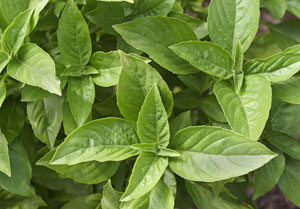
There are over 150 known varieties of basil, and here on the farm we have the opportunity to grow three of those types. It is quite interesting and fun to experience the differences that each variety of basil has. The varieties that we have the pleasure of growing include Genovese basil, Thai basil, and Sacred basil. Each variety can play a different role in the culinary realm.
Genovese basil is one of the most popular varieties of basil alongside Sweet basil. Its popularity can be attributed to its great culinary uses which include pesto and a chiffonade cut. Each individual plant also provides great yields. The leaves are large yet very delicate and smooth. The larger the leaf becomes the more the subtle the flavor becomes. Freshly harvested and freshly cut Genovese basil will smell like the spice, clove, which has been grated. A larger quantity of fresh basil can provide a very strong flavor, i.e. pesto. Genovese basil is very delicate and is best suited to freshly cut uses and short cooking times.
Thai basil is somewhat of an opposite of Genovese basil. It is a durable and distinct variety. Thai basil is most commonly cultivated in, you guessed it, Thailand. It is actually quite popular throughout all of Asia. The leaves are smaller and shaped like the head of a spear. The base of the leaves and up the stem may be striped with a noticeable purple color. The flavor of Thai basil is most commonly associated with anise or sweet licorice. It stands up to longer cooking times and is a good variety for being cut and placed in a marinade or braise.
Sacred basil, also known as Holy basil, is somewhat of an heirloom variety if you will. It produces very small leaves, up to two inches, which are quite pungent. This characteristic has led this variety to be good for religious and medicinal uses. The small leaves grow into tear drop shapes and may have slightly tooted edges. The flavor of Sacred basil is similar to Genovese basil which is a rich, clove-like flavor. Although, the leaves of Sacred basil are much more pungent than that of Genovese basil. This makes Sacred basil great for culinary uses such as sauces, teas, and roasted produce.
Basil packs a lot of flavor and it is important to enjoy that flavor at its peak. When adding fresh basil to your salad, sandwich or whatever else, make sure it's one of the last steps. Basil bruises and wilts very quickly, as well as loses its flavor. If you chop or tear your basil, make sure you use a sharp knife and add it at the end of your culinary creation.
Thai Basil Dipping Sauce
Yield: 1 Cup
½ C Thai Basil Leaves
2 T Hoisen Sauce
2 T Chili Sauce
2 T Brown Sugar
1 T Fish Sauce
2 T Water
Cut all the basil leaves into thin strips. Combine basil with the rest of the ingredients.May be refrigerated for up to 2 days. Great for egg rolls, spring rolls, and any vegetable stir-fry. Wine Pairing Courtesy of LUSH Wine & Spirits: Thorle semi-dry Riesling, Germany |
|
Garlic Scapes
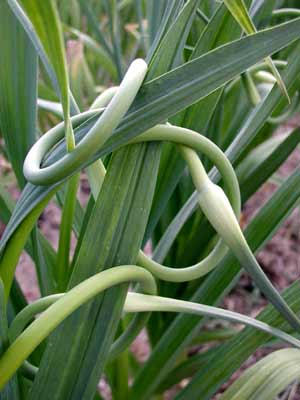 The scape is the seedpod of the garlic plant. They spring out in early June, swooping and curling elegantly in the middle of the plant. We remove them to send more energy in to the bulb production but they're also delicious and versatile. We even use them in flower arrangements. They store fantastically as well and will keep in your fridge for weeks. They can also be pureed with a little olive oil and frozen in Ziploc bags or ice cube trays. This will be the last of the garlic scapes for this season. Garlic Scape Risotto ½ c onion minced 1 c garlic scape finely chopped 1 c white wine 2 c risotto rice 1 T minced ginger 2 T olive oil Butter, parmesan cheese to taste About 6-8 c vegetable or chicken stock (hot)-more or less depending on how soft you want the rice. In a sauté pan heat 1 T oil til hot and add the garlic scape and quickly sauté until slightly charred and bright green-pour contents onto a plate and reserve. In a large stainless or enameled pot add 1 T olive oil and the onions, ginger and cook slowly until the onions are translucent. Add the rice and continue to cook until rice starts to turn translucent (about 5 minutes) keep stirring so it does not stick, add the wine and reduce til dry then start to add the stock in ½ c increments stirring all the while. Keep adding the stock and stirring until the rice is creamy but not gloppy, al dente but not crunchy-its all about finesse here. Adjust seasoning and add the garlic scape to heat through. Add as much butter and cheese as you like-you can also add just about any fresh herb you like-tarragon and basil are nice. Serve as a main course or side dish-there will be enough for a good group. |
|
Tomato
 Tomatoes are cold sensitive. Store tomatoes at room temperature out of the direct sunlight. To accelerate the ripening process, place them in a paper bag with a banana or apple since the ethylene gas that these fruits emit will help ripen the tomato. Do not store tomatoes in the refrigerator.
A few tomato tips:
- To remove skins, dunk whole tomatoes into boiling water for 30 seconds, lift out with slotted spoon, and remove the skins.
- Whole or chopped tomatoes as well as tomato sauce freeze well for future use in cooked dishes.
- When cooking tomatoes do not use aluminum cookware the high acid content will interact with the metal.
|
Juicer Share 
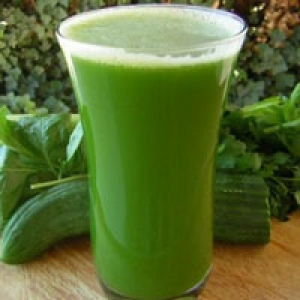
Green Cucumber Juice
2 cucumbers
kale or chard
A pinch of salt
½ cumin powder and pepper powder
Spicy Cucumber Tomato Juice
Tomatoes
Pinch of cayenne pepper
Cucumber
|
|
|
|
|
Juicer Share
|
This week in your juicer share: Kale Chard Cucumbers Tomato Hungarian Pepper Basil
|
|
|



