Greetings!
Greetings from your farm. The nights are getting chilly here, last night it dropped in to the 40s. Brrr. The fall crops are looking great, fall radishes and beets should be in your shares next week with winter squash and pumpkins then Brussles sprouts following a few weeks later.
I feel like we're forever apologizing for our greens having holes in them. Kale, Swiss chard, collards, beet greens, radish greens, mustard greens! All holey. This week we have our first purple top turnips. Guess what? Holey greens. Turnip greens (like beet greens) are really delicious so if you haven't eaten them before be sure to try one of the recipes below. We realize that many of you are well educated on pesticide use and that's why you chose to get vegetables from an organic CSA farm. We also know that we have many members who are new to the CSA model and are used to their organic vegetables looking like something that you buy at Whole Foods where the quality level has to be perfect. We don't want our newsletters to be depressing so we usually forgo including negative information. This week I'm choosing to share some facts about a very commonly used vegetable and fruit pesticide, Sevin, manufactured by Bayer Chemical. So, your turnip greens might have holes but they don't have any Sevin. Here are a few samples of what a quick internet search yielded...
"We do know that carbaryl is quite toxic to honey bees, certain beneficial insects such as lady beetles, and parasitic wasps and bees, certain species of aquatic insects, and some forms of shellfish such as shrimp and crabs. Care must be taken when using carbaryl in areas where these organisms exist."
-Penn State University Extension Pesticide Specialist, Winand K. Hock
One Canadian environmental organization in a letter addressed to local citizens cites some of the documented effects of carbaryl.
- It causes birth defects in mammals, especially dogs.
- It worsens the condition of people with hypertension and people on anti-depressant drugs.
- It impairs the function of the pituitary gland, the thyroid gland, and the reproductive system.
- It causes hyperactivity and learning disabilities in mammals.
- It could increase the chance of heart attack in people with weak hearts.
- The main break-down product, nitrosocarbaryl, which is easily created in the human gut, is a potent cancer-causing agent.
- It causes irreversible chromosomal damage to human DNA (the genes in our cells).
And, in case you'd like to read Bayer's own product information on Sevin (in all of it's 37 page glory) click here.
Our summer crops are peaking so you'll all be getting good amounts of heirloom summer squash and tomatoes. We're not going to bag the tomatoes this week so handle your boxes gently! We're taking a week off of the popular Sungolds but they should be back next week.

Tomatoville Residents: Tim, Keegan,and Sandra
|
|
|
Turnips

Turnips are a good source of vitamin C, potassium, and calcium. Turnip greens are especially nutritious; rich in vitamins A, C and B-complex. The noticeably bitter taste of turnip greens has been linked by researchers to its calcium content.
Scrub turnips with a stiff-bristled vegetable brush - No need to peel - simply trim away damaged areas.
Serving Ideas:
Create a delicious raw snack - Slice or shred into salads or slaws
Steam 1/2 to 1 inch slices or cubes for 12-15 minutes
Dice or cube turnips into hearty soups or stews, or thinly slice for stir-fries.
Mash or scallop turnips, just as you would potatoes
Storage:
Store turnips unwashed in a plastic bag in the refrigerator for 1-2 weeks.
Turnip Green Tart Cornmeal Tart Shell: 2 1/4 cups all-purpose flour
1 cup spelt flour
scant 1 cup medium coarse corn meal
3/4 teaspoon fine grain salt
1 1/4 cups unsalted butter, cut in cubes
1 large egg yolk
1/4 cup cold water * This recipe makes two tarts. They freeze well so just wrap well and freeze. Turnip Green Filling: 1/4 lb turnip greens, de-stemmed
1 small clove of garlic
2 large eggs + 1 yolk
3/4 cup veg. broth
1/4 cup heavy cream
scant 1/4 teaspoon salt
2 teaspoons Dijon-style mustard
1 1/2 teaspoons herbs de Provence
gruyere cheese & a bit of crushed red pepper flakes, for topping Dough Combine flours, cornmeal, and salt in food processor. Pulse in butter, 20+ pulses, or until the mixture is crumbly. Add the egg yolk and 1/4 cup water. Pulse, trickle in more water if needed, just until dough comes together. Turn out onto a floured countertop and form into a ball. Divide the dough into two equal pieces, shape each into a ball, press into 1/2-inch thick disks, and wrap in plastic, or place in baggies. Chill for at least an hour. Preheat the oven to 350F. Place a rack in the middle of the oven. Line the tart pans with dough, place one of the dough disks on a lightly floured surface and roll out until the dough is large enough to line your tart pan. Dust underneath with flour to discourage sticking throughout the rolling process. Carefully transfer the dough to the pan. Work quickly to ease the dough into place, taking care not to stretch the dough. Press it along the bottom of the pan, out to the walls, and against the sides. Trim any excess dough. Chill in the refrigerator for thirty minutes. Partially bake the tart shell before filling it, pull the shell out of the refrigerator, dock it with a fork, making small holes along the bottom of the shell. Line the shell with parchment paper and fill to the rim with pie weights or a smaller baking dish. Bake for 25 minutes. Carefully remove the pie weights and finish baking for another 5 minutes, or until the crust is dry and just barely starting to brown. Remove from oven and let cool completely. Filling
Chop the greens and garlic in a food processor. Add the eggs and yolk, pulse. Then the broth and cream. Lastly, incorporate the salt, mustard, and herbs. When you're ready to bake, fill the tart shell and bake for 30 minutes or so, or until the center is set, and has firmed up to the touch. About 2/3 of the way through sprinkle with a bit of gruyere cheese. Finish with a sprinkling of crushed red pepper flakes.
Recipe courtesy of 101 Cookbooks Turnip Greens Soup
1 lb. Turnips, with greens 2 Tbsp. unsalted butter, plus more for garnish 1 medium onion 1 large clove garlic, minced Salt and freshly ground black pepper 4 cups vegetable or chicken Separate turnips from their greens. Trim greens, removing tough stems, and wash well. Chop unpeeled turnips into 1 inch cubes Melt butter in a large saucepan over moderate heat. Add the onions and saute until softened, 3 to 4 minutes. Add the garlic and saute briefly to release its fragrance. Add the turnips, season with salt and pepper, and stir to coat with the butter. Add 3 cups of stock and bring to a simmer. Cover and adjust heat to maintain a gentle simmer. Cook until the turnips are almost tender, about 15 minutes. Stir in the turnip greens, cover and cook until the greens are tender, about 5 minutes. Puree the soup in batches in a blender. Strain through a sieve, if desired, to remove any threadlike shreds of turnip greens. Return to the saucepan and stir in enough additional stock to thin soup to desired consistency. Adjust seasoning with salt and pepper. Reheat soup. Divide among warm bowls. Top each portion with a slice of butter. Serves 4. Sesame Roasted Turnips 1 Tbsp sesame oil
1 Tbsp honey (or brown sugar)
4 turnips, peeled and cut into wedges
1/2 tsp salt
1/4 tsp dried red pepper flakes
1 tbsp sesame seeds Preheat oven to 400 degrees. Place sesame oil and honey in a baking dish. Add turnips, salt and red pepper flakes, then toss to coat the turnip pieces. Roast uncovered for 20 minutes, stirring twice. Sprinkle on sesame seeds and roast 10 minutes more. Serve warm, chilled or at room temperature. Serves 4.
|
|
Summer Squash
 Summer Squash and Walnut Pilaf 1 1/2 cup rice 1 3/4 cup water 1 tbsp olive oil 1/2 cup walnuts 1 medium sized summer squash 2 cloves garlic 1 tsp sea salt dash of ground pepper 1 tsp thyme In a small pot, bring water to a boil and stir in the olive oil. Pour in the rice and to cook. Pull from the heat once the rice has become light and fluffy.
Grate the summer squash with a large hole grater. Put to the side.
Pull out a pan on medium heat and pour a bit of olive oil. Allow this to heat up and then pour in the walnuts. Allow them to cook for 2 to 3 minutes. Be diligent, like most nuts they will burn easily, so stir frequently. When they have about a minute let, stir in the garlic.
Next, add in the thyme, sea salt, pepper, and grated summer squash. Cook until the squash begins to shrivel slightly (about 1 to 2 minutes). Stir the squash mix into the cooked rice and serve.
*This recipe works well with couscous and quinoa as well.
Is your summer squash starting to pile up? Roasted Garlic and Summer Squash Sauce A tasty sauce that freezes well, easy to make and store, it's a great way to utilize large amounts of squash. 1 bulb of roasted garlic per 1 pound of summer squash. We use any summer squash other than zucchini but zucchini would work as well. Preheat oven to 250 degrees. Cut top end or garlic bulb to expose the cloves and drizzle with olive oil. Season with salt and pepper and wrap in foil. Roast for 45 to 60 minutes, until garlic is soft and squeezes easily from the bulb. While garlic is roasting prepare squash. If using large squash with tougher skin cut in half length wise and place cut side down in a baking pan with ¼ inch of liquid (water, chicken stock, or vegetable stock) You can roast squash with garlic but may have to increase heat to 350 if your squash doesn't scoop out easily from the skin. It should be cooked through and creamy. If using younger squash simply chop and sauté in butter until lightly caramelized. Add water or stock and cook until fork tender, about 15 minutes. Reserve cooking water. When cool enough to handle place garlic (squeezed from bulb wrapper) and squash in a food processor or blender (work in batches if necessary) and blend, adding enough of the cooking water to create a creamy sauce. Season liberally with salt and pepper. Let sauce cool. If freezing ladle in to storage bags then place on a cooking tray so they lay flat. Place in freezer once frozen remove from tray and stack. Remember to label and date bags with a sharpie. Use as the sauce for chicken or shrimp or with rice or pasta and top with chopped fresh herbs. If using with pasta blend about 1/8 c pasta cooking water until emulsified. Some variations include adding a few tablespoons of prepared red or green curry sauce (we like Trader Joe's), Sriracha hot sauce, or more stock to thin out and serve as soup. |
|
Onion

Gorgonzola and Sweet Onion Flatbread
1 (10 ounce) can refrigerated pizza crust *
2 teaspoons plus 1/4 cup extra-virgin olive oil, divided
2 large sweet onions
Salt and pepper
1 cup crumbled gorgonzola cheese
Heat oven to 425 degrees F.
Lightly coat a 13 x 9-inch baking pan
with 1 teaspoon olive oil. Unroll dough and place in pan. Starting at center, press dough to edges of pan. Brush with 1 teaspoon olive oil. Bake crust for 8 to 10 minutes or until light golden brown.
Cut onions in half and slice thinly. Cook onions in 1/4 cup olive oil in a large skillet over medium heat, stirring often until soft and translucent (about 15 minutes). Add salt and pepper to taste. Remove from heat.
Spread onions and cheese over crust. Return crust to oven and bake 8 to 10 minutes until toppings are lightly golden. Cut into small squares and serve.
* Pillsbury makes a dough a good pizza dough, also Trader Joe's has a good pre-made pizza dough. |
|
Bell Peppers
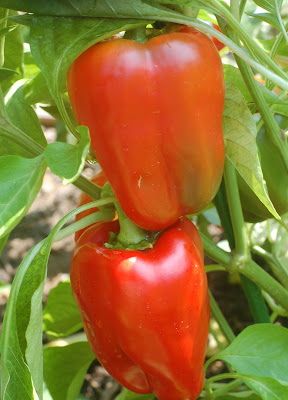 Bell peppers an excellent source of vitamins A, C and B-6. Bell peppers are also a great source of fiber, folate, manganese and are rich in antioxidant and anti-inflammatory phytonutrients. The green bell peppers you purchase from the grocery store may actually be immature, non-ripe versions of a colored variety. Not all bell peppers start off green, however, nor do green bell peppers always mature into other basic colors (yellow, orange, red). Bell peppers can be eaten at any stage of development, however, are typically more flavorful when optimally ripe. The bell peppers developed blight and we have sprayed them with a trace amount of copper. Copper spray is approved for organic production and we have washed them but we suggest that you do so as well. Roasting Peppers: There are 3 easy methods for roasting and peeling peppers
1. put peppers on a pre heated grill and turn them around until the skin is blackened all around the flesh (about 10-15 minutes). 2. put peppers on a sheet tray and broil them (about 5 inches from the heat) turn them until they are blackened all around the flesh (7-12 minutes). 3. put peppers directly on a gas flame and turn them around until the skin is blackened all around the flesh (5-10 minutes). After the peppers are blackened, put in a stainless or glass bowl, cover with plastic wrap and let them sit until they are cool enough to touch. Then slide the charred skin off, cut out the seeds and proceed from there. Suggestions from here are endless... -cut them into strips, pour some olive oil and salt over them and serve with crusty bread as an antipasti -cut into thin stripes, mix with an equal amount of caramelized onions, a touch of wine vinegar (I like sherry) and serve over grilled steaks or salmon -cut into thin strips and use as a filling for vegetarian tacos -puree with a little roasted garlic, olive oil, wine vinegar, salt and pepper to create a quick sauce for grilled chicken **Notes
-Method 1 provides the best flavor. Also, do not rinse the peppers under water-this takes away all the flavor.
Fusilli Bucati Lunghi with Roasted Red Pepper Sauce
2 Tbs. garlic-flavored olive oil
1 cup roasted red bell pepper, chopped
1/2 medium onion, finely chopped (1/2 cup)
1 large carrot, finely diced (1/2 cup)
8 oz. dry fusilli bucati lunghi Roast pepper (see directions above). Heat oil in saucepan over medium-high heat. Add roasted peppers, onion, and carrot; sauté 5 minutes, or until onion begins to brown. Add 3/4 cup water, cover, and reduce heat to medium-low. Simmer 20 minutes. Meanwhile, cook pasta in pot of boiling salted water according to package directions. Remove roasted pepper mixture from heat, and purée in blender until smooth. Season with salt and pepper, if desired. Drain pasta and reserve 1/4 cup of pasta water, set aside. Return the pasta to the pot and stir in red pepper sauce. Add pasta water until desired consistency. |
|
Cantaloupe
 Cantaloupe Smoothie2 Cups cubed cantaloupe (Freeze cubed cantaloupe for thicker texture) 3/4-1 Cup milk 1/3 Cup yogurt 1/4 Cup rolled oats 1/2 banana 1/4tsp vanilla extract 1tsp honey Add everything to the blender and blend until smooth. Add more milk if desired. |
|
Tomatoes

This week we'll have a variety of heirloom tomatoes in your share. As we mentioned above we will not be putting them in bags this week, so handle with care. We typically rinse and wipe them down with a clean rag; this week to help them ship better and to give us more time in the tomato field harvesting you may find some of the tomatoes may have a little leaf residue left on them. Simply rinse the tomato and take clean rag and wipe off any of the remaining leaf residue.
Our favorite way to enjoy heirloom tomatoes is simply sliced sprinkled with a little sea salt, cracked pepper, fresh herbs and cheese of your choice. We recommend a crumbled goat feta, a fresh mozzarella or and bleu cheese.
Hummus with Tomato Mint Salsa Tomato Mint Salsa:
2 medium tomatoes, diced (1 1/2 cups)
1/4 cup diced white onion
2 Tbs. olive oil
2 Tbs. chopped fresh mint
1 1/2 Tbs. lemon juice
Stir together tomatoes, diced onion, oil, mint, and lemon juice in small bowl; season with salt and pepper. Let stand 5 minutes. Spread Hummus in shallow dish, and mound salsa in center.
Hummus Recipe: 2 15-oz. cans chickpeas, rinsed and drained twice
1/3 cup lemon juice
2 cloves garlic
1/2 cup tahini Purée chickpeas, lemon juice, garlic, and 2/3 cup water in food processor 3 to 4 minutes, or until smooth, scraping down sides of bowl if necessary. Add tahini, and purée 2 minutes, or until mixture has the consistency you prefer. Season with salt and pepper. Fresh Tomato Ketchup Makes about 1 1/2 pints 4 pounds very ripe tomatoes, peeled, seeded, and coarsely chopped 1 large onion, 8 ounces, chopped 2 large cloves garlic, minced 2/3 cup dark cider vinegar 2 tablespoons dark brown sugar 1/2 teaspoon crushed dried red pepper flakes 1 large bay leaf, broken in half 1 1/2 teaspoons salt (optional) 1 teaspoon ground cinnamon 1 teaspoon paprika 3/4 teaspoon ground mustard 1/2 teaspoon ground coriander 1/4 teaspoon ground allspice dash ground cloves dash cayenne pepper freshly ground pepper to taste Place all ingredients in a large nonreactive pot. Stir and bring to a boil over medium high heat. Lower heat to simmer and continue to cook, partially covered, for 1 hour, stirring often. Remove and discard the bay leaf halves. Working in batches, transfer the tomato mixture to a food processor or blender. Process until smooth. Return to the pot and continue to simmer, uncovered, until thickened, about 20 to 15 minutes. Stir frequently to prevent scorching on the bottom. Ladle the mixture into three sterilized canning jars. Wipe the rims and set the kids, screwing on the bands loosely. Let cool at room temperature until lids are sealed (compressed). Tighten the bands and refrigerate for up to 6 months. * This recipe can easily be halved. |
|
Have a great week!
Jen, Bob & The Harvest Moon Crew
|
|
|
|



