Greetings!
Greetings from your farm. Another beautiful week here and the crops are in full swing. This week brings our first delivery of cantaloupe and they are delicious! Like most vegetable crops melons taste best when they have perfect growing conditions. This year (so far) has been about perfect for melons. If they get too much rain they are juicy but lack flavor. Not enough rain, they have OK flavor but can have a mealy texture. This year they have gotten a good balance of moisture and sunshine and yields are good so hopefully we'll have more for you in the weeks to come.
Also, new this week is celery. Most celery available in the grocery store is grown in very controlled conditions and irrigated daily. Doing this mellows the flavor and the texture. You'll see that our celery is greener and has a more pronounced flavor. It's also a bit tougher so you might want to strip the outer layer with a vegetable peeler.
We also have our first jalapeno peppers in shares this week. The plants are healthy and yielding well. When we have them pile up at the farm we roast/char them in a dry cast iron pan then puree them with olive oil and store in the refrigerator to add to salsa, soups, and sauces. The puree can also be put in to freezer bags and frozen. You'll see some of the peppers have light brown stripes on them which might make them look past their prime but in fact is how they look when they are perfectly ripe. They vary in heat so if you don't want a dish to be super spicy slice the jalapeno lengthwise and remove the seeds; that's where most of the heat is. Put the seeds aside and add back to recipe to control the heat level.
Of course, how could we forget the heirloom tomatoes. Below in the tomato section there are a few photographs and descriptions to help you identify the tomatoes in your share.

Chef Katie starting the first round of tomato canning
|
|
|
Jalapenos

Jalapenos have 2,500 - 8,000 scoville heat units. The seeds of the jalapeno have the heat, the flesh has mild flavor close to a green bell pepper. So if you're looking to spice something up we recommend keeping some of the seeds in.
Handling fresh jalapenos may cause skin irritation. If you have sensitive skin we would recommend wearing gloves while cutting, skinning or seeding jalapenos. While preparing the peppers avoid touching your eyes and/or face as this leads to burning and redness.
Jalapeno Hushpuppies
Serves: 2-4
2 cups flour 1/2 cup cornmeal 2 tsp.baking powder 1/3 cup sugar ½ tsp salt ½ tsp baking soda ¼ cup dried onion ¾ tsp Cajun seasoning (paprika, cayenne pepper, garlic powder, black pepper) 1 1/2 cups whole milk 2 eggs 1/8 cup vinegar 1/2 cup fresh jalapenos, seeded and finely diced Oil for frying In a large bowl, mix all the dry ingredients.
In a smaller bowl, mix all other ingredients. Add the wet ingredients to the dry mixture all at once. Stir until just blended.
Heat a large pot of oil to 375 degrees F. Drop the hushpuppy mix by the spoonful into the hot oil. Cook for about 4-5 minutes or until golden brown. Check the first few for doughy-ness. Repeat with the rest.
Scoop out of the oil and place on paper towels. Salt if needed. Roasting Peppers:
It's simple really; the idea is to blister the thin, cellophane-like skin on the surface of the peppers and then remove it. This process also enhances the flavor of the peppers. So, put your peppers, whole, onto your barbecue grill. Or if you have a gas stove this can easily be done by placing the pepper over the flame on med-low. Cook them, turning as needed, until mostly blackened and blistered on all sides.
Once the peppers' skins are blistered, put them inside a paper bag and close it up. Set it somewhere to rest 10 - 15 minutes or so. This does two things: the heated moist flesh of the peppers 'steams' the skins, further loosening them, plus the wait allows the peppers to cool enough for you to handle.
Next, remove the stems and seeds (we like to leave them in, since roasting them sweetens the taste). Remove the blackened skin.
Slit one side of the pepper, open it up and lay it out skin-side up, then with a knife or fingers, scrape/peel the skin away. Sometimes you can grab an edge of skin and peel off largish pieces. To dry roast jalapenos: Place a good quality cast iron pan over medium high heat (don't try this with anything other than a cast iron pan). When the pan is hot (about 2 to 3 minutes) add whole peppers (stem trimmed off) and char, shaking pan every few minutes, until outer skins are blackened, about 10 minutes. Whichever way you choose to roast your peppers let the peppers cool slightly then place in a blender or food processor and blend with a bit of olive oil so the puree is about the consistency of pesto or humus. This sauce added to other sauces to spice it up or can be used for a sauce over pasta, dipping sauce for bread or rice. |
|
Cantaloupe
 Cantaloupe is an excellent source of vitamin A, it provides about 112% of the recommended daily levels, one of the highest among fruits. Also, a good source of potassium, vitamin C, E and B-complex vitamins. Like many fruits it is is important to wash the whole fruit prior to cutting. Storage: Keep in a cool, well-ventilated place. However, once you cut the melon it should then be refrigerated. The cantaloupe is very sweet this year; simply wash, slice into wedges and enjoy! Chilled Cantaloupe Soup 1 medium cantaloupe, cut into chunks
¼ cup to ½ cup plain yogurt
1 to 2 TBS grated fresh ginger
Juice from one lemon plus zest from 1/3 to 1/2 lemon
1 or 2 pinches of sea salt
Dash of ground cinnamon
A few basil or mint leaves
A drizzle of honey Garnish with small melon balls, basil leaves and drizzle of yogurt. Place all ingredients to blender and blend until well combined. Refrigerate until well chilled, garnish if desired and enjoy!
|
Tomatoes 
 Tomatoes are a member of the nightshade family as well as eggplant, bell peppers, and white potatoes. Tomatoes are very versatile - saute, bake, broil, or grill them... and, best of all, eat them raw! Tomatoes are an excellent source of vitamin C, vitamin A, and vitamin K.
An heirloom tomato is an open-pollinated (non-hybrid) tomato. Heirloom tomatoes have become increasingly popular and more readily available in recent years. Heirloom tomatoes can be found in a wide variety of colors, shapes, flavors and sizes. They are very fragile and can be prone to cracking, which is cosmetic and doesn't affect the flavor, simply cut off the cracked portion. Below are a few photos and descriptions of tomatoes that could be in your share to help you identify them.  Japanese Black Trifele - This tomato is of Russian origin. In Russia the Trifele varieties of tomatoes (of which there are several colors) are highly prized. This short potato leaf plant yields The fruit looks like a beautiful mahogany-colored Bartlett pear with greenish shoulders. Very tasty flesh with a meaty core. The Black Trifele is one of the blackest varieties available. Japanese Black Trifele - This tomato is of Russian origin. In Russia the Trifele varieties of tomatoes (of which there are several colors) are highly prized. This short potato leaf plant yields The fruit looks like a beautiful mahogany-colored Bartlett pear with greenish shoulders. Very tasty flesh with a meaty core. The Black Trifele is one of the blackest varieties available.  Black Krim - This heirloom tomato originates from the Isle of Krim in the Black Sea, near the Crimean Peninsula of Ukraine. It is believed that soldiers returning home from the Crimean War, in the late 19th century, gathered these seeds and began sharing them. As a result these seeds were later widely distributed throughout Europe.This tomato can vary in color ranging from a reddish brown hue towards the bottom of the fruit, then darkening to greenish-dark purple shoulders. Black Krim - This heirloom tomato originates from the Isle of Krim in the Black Sea, near the Crimean Peninsula of Ukraine. It is believed that soldiers returning home from the Crimean War, in the late 19th century, gathered these seeds and began sharing them. As a result these seeds were later widely distributed throughout Europe.This tomato can vary in color ranging from a reddish brown hue towards the bottom of the fruit, then darkening to greenish-dark purple shoulders.
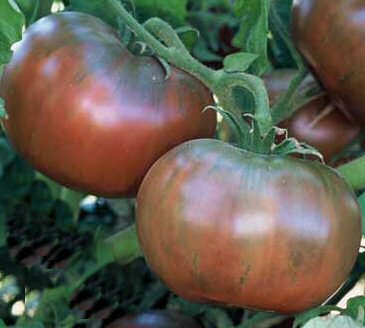 Cherokee Purple - This variety is thought to have been saved and passed down from the Cherokee Native Americans. Cherokee Purple tomatoes are beefsteak in style, with green "shoulders" across the top. They are also notable for having a dense, juicy texture, with complex and sweet flavors. Cherokee Purple - This variety is thought to have been saved and passed down from the Cherokee Native Americans. Cherokee Purple tomatoes are beefsteak in style, with green "shoulders" across the top. They are also notable for having a dense, juicy texture, with complex and sweet flavors.
 Sungolds - The Sungold ripens to a golden orange, with a very sweet flavor. One of our favorite snacks here at the farm. Sungolds - The Sungold ripens to a golden orange, with a very sweet flavor. One of our favorite snacks here at the farm.
 Jetsetter Tomato - The Jetsetter tomato has a very rich tomato taste. Excellent in salads or sandwiches. Jetsetter Tomato - The Jetsetter tomato has a very rich tomato taste. Excellent in salads or sandwiches.
 Red Zebra - A meaty red fruit with light yellow striping and red-yellow flesh. It has great flavor, retains its juices when sliced and cooks well. Red Zebra - A meaty red fruit with light yellow striping and red-yellow flesh. It has great flavor, retains its juices when sliced and cooks well.
A few tomato tips:
- To remove skins, dunk whole tomatoes into boiling water for 30 seconds, lift out with slotted spoon, and remove the skins.
- Don't refrigerate tomatoes, store at room temperature out of direct sunlight.
- Whole or chopped tomatoes as well as tomato sauce freeze well for future use in cooked dishes.
- When cooking tomatoes do not use aluminum cookware the high acid content will interact with the metal.
|
|
Basil
 Our Basil crop has been doing really well this summer. This week we have a nice size bunch in the shares. It may not be the prettiest basil ever but is nonetheless delicious! You may find that some of the leaves have a little bit of bug damage (holes in the leaves) and some minor sun damage, all of which is purely cosmetic. If you are interested in freezing some pesto to use at a later time. Simply place the pesto into a freezer safe container and pour a little olive oil on top of the pesto to help ensure it doesn't dry out once you place it in the freezer. Basil Pesto 1/3 cup pine nuts or walnuts 2 cups fresh basil, leaves plucked 4 medium garlic cloves, peeled 4 tsp lemon juice 1/4 tsp of Sriracha 1/4 tsp anchovy paste 1/2 tsp lemon zest 1/3 cup Parmigiano Reggiano cheese, grated
1/4 cup Pecorino Romano cheese, grated 1/3 cup olive oil Salt and ground black pepper to taste Toast the nuts by placing them in a single layer in a pot over medium heat. Stir and shake the pot occasionally to evenly distribute the nuts until they become fragrant, about 5 minutes. Careful not to burn, it can happen fast! Set aside to cool. In the bowl of your food processor, add the plucked basil leaves, garlic cloves, nuts, lemon juice, sriracha, and anchovy paste. Process until your desired consistency is obtained. Tip the basil mixture into a medium bowl then add the lemon zest, and stir in the grated Parmigiano Reggiano and Pecorino Reggiano and olive oil in stages, letting each addition incorporate fully before adding the next. Season to taste with salt and pepper.
* If you are going to use the pesto for a pasta sauce don't forget to add about 1/4 cup of the pasta cooking liquid right before tossing the sauce and pasta. Note: We keep tweeking our recipe and have found that adding ¼ t of Sriracha adds a brightness without heat and ¼ t of anchovy paste (the secret of many Italian chefs and cooks) adds a briny saltiness that is a bit more complex than just adding sea salt. If you think you don't like anchovies give them a try. In small amounts they add a nice note to many dishes. Basil butter Take one cup of picked basil leaves and drizzle 1 TBS of olive oil over the top-then chop the basil as finely as you can. Put 1 stick of salted butter in a bowl, when soft use a wooden spoon and beat in the chopped basil-add a touch of ground pepper and lemon juice if you like-reserve This is something that you can keep in your freezer and will add great flavor to just about anything you put it on-for example, put 1 TBS on top of a bowl of tomato soup, put on mashed potatoes, on any steamed or grilled vegetables (sweet corn), toss with pasta, put on top of grilled fish, spread on good bread instead of plain butter-and so on and so forth..... topping for grilled lamb burgers!!! Basil-Garlic Vinaigrette
2 TBS. champagne vinegar
6 TBS. extra virgin olive oil
1/2 cup fresh basil leaves
1/2 tsp. salt
1 clove garlic, coarsely chopped.
Combine everything in a blender and blend until smooth. |
|
Celery
 Despite celery's common appearance, it is not easy to grow. Its special soil and water requirements can prove challenging. Large scale celery growers constantly irrigate their celery resulting in light green, tender stalks. You'll notice our celery is darker green than what you're likely to see in the grocery store and not quite as tender but we think it has a better flavor and crunch.
Celery is 94% water, however, does contain vitamins A, C, E, B-Complex and is high in fiber. Celery is very low in calories, and makes a great snack. Just chewing celery burns nearly as many calories as the celery contains.
Fun tidbit: The Ancient Greeks used celery leaves as laurels to decorate their renowned athletes.
Celery Storage: Refrigerate the celery as soon as possible, as it will go limp quickly. Store in stems upright in a container with an inch of water. Ideas for stuffing Celery: Soft goat cheese blended with chopped arugula or dill Egg salad
Softened cream cheese mixed with chopped green olives and walnuts Crunchy-style peanut butter, topped with dried cherries or cranberries Braised Celery with Aromatic Cream Sauce 6-8 stalks of celery
2 cups chicken or vegetable stock 1 dried bay leaf 1/2 tsp chopped fresh thyme
1/3 cup heavy cream salt and pepper to taste Peel the rounded side of each celery stalk lengthwise with a peeler. Cut crosswise into 4-inch pieces. Place in a large skillet over medium flame, add stock, bay leaf, and thyme. Bring to a simmer, cover, and cook until celery is tender, 15-20 minutes. Uncover skillet, remove celery to a platter, and keep warm. Raise heat to high, add heavy cream, and cook, stirring occasionally, until liquid is reduced to a slightly thickened sauce. Season to taste with salt and pepper arrange celery pieces in a spiral, rounded side down, on the platter. Strain the sauce through a fine-meshed strainer and spoon over the middle of the celery pieces. Serves 6. |
|
Mustard Greens
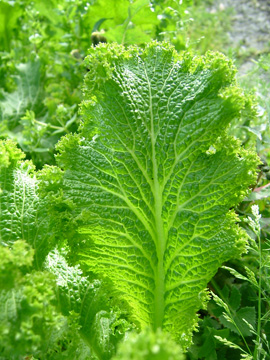 Mustard Greens are an excellent source of vitamin A,C, E, K, beta-carotene,manganese, zinc, iron, and potassium. Mustard greens have a pungent peppery flavor. The mustard plant is native to sub-Himalayan plains of India. The plant is commonly cultivated for its winter season leaves and oil seeds. Mustard greens are delicious simply sauteed with a little olive oil and garlic. Storage: Place mustard greens in a plastic bag, removing as much of the air from the bag as possible. Store in the refrigerator. Balsamic-Glazed Chickpeas over Mustard Greens 1 cup cooked chickpeas, rinsed and drained
1 bunch mustard greens
1/2 large red onion, thinly sliced
4-6 tablespoons vegetable broth, divided
4 cloves garlic, chopped
1 pinch red pepper flakes
1/2 teaspoon salt
2 tablespoons balsamic vinegar
1/2 teaspoon soy sauce
1/4 teaspoon honey
Remove any large stems from the greens and discard. Tear the leaves into bite-sized pieces.
In a deep pot or wok, sauté the onion in a tablespoon or two of vegetable broth until mostly faded to pink, about 4 minutes. Add the chopped garlic and red pepper flakes and another tablespoon of broth and cook, stirring, for another minute. Add the mustard greens, 2 tablespoons of broth, and cook, stirring, until greens are wilted but still bright green, about 3-5 minutes. Stir in the salt. Remove greens and onions from pan with a slotted spoon and place in a serving dish, leaving any liquid in pan.
Add the balsamic vinegar, soy sauce, and agave or sugar to the liquid in the pan (if there is no liquid, add 2 tablespoons of broth). Add the chickpeas and cook, stirring, over medium heat until the liquid is reduced by about half. Spoon the chickpeas over the greens and drizzle the sauce over all.
|
|
Cabbage

You'll want to remove the outer few leaves, which may look a little damaged. These wrapper leaves help protect the cabbage during storage and transportation; just simply peel back and you will find the center leaves beautifully intact.
Cabbage Salad with Toasted Coriander Mayonnaise
Serves 4 1 teaspoon coriander seeds
1 teaspoon cumin seeds
3 cups thinly shredded cabbage 1 1/2 cups shredded carrot
1/2 c. chopped fresh cilantro
1 large egg yolk
3 tablespoons apple cider vinegar, or more to taste
1 clove garlic, minced
2 shallot lobe, minced
2 tablespoons thinly sliced chives
Sea salt and ground black pepper
1 1/4 cups vegetable oil In a small skillet over high heat, toast coriander seeds and cumin seeds just until fragrant. Grind together using a mortar and pestle, and set aside. In a large bowl, combine cabbage, carrots, and cilantro, and set aside. To prepare mayonnaise: In a small bowl, whisk together egg yolk, vinegar, garlic, shallot, chives, reserved coriander and cumin, and large pinches of salt and pepper. Beginning a drop at a time, whisk in oil. As it emulsifies, add oil a little faster, in a slow steady stream. When mixture is thick, whisk in more vinegar to taste; mayonnaise should be highly seasoned. (You can also make the mayonnaise in a blender or food processor.) Fold 1/3 cup mayonnaise into cabbage. There should be enough to coat cabbage generously; add more if necessary. Cover, and refrigerate for at least an hour. Before serving, adjust seasonings, adding more salt or vinegar as needed. Recipe adapted from The New York Times
|
Sweet Corn
 Avocado-Corn Salsa Serves 4 2 ears corn 2 avocadoes ½ medium white onion, cut into ¼-inch dice ½ Serrano chile, seeded and finely chopped ¼ cup cilantro, finely chopped 1 lime, juiced Tabasco to taste Kosher salt Shuck corn and remove the kernels. Toast the corn in a dry, medium-size skillet over medium heat until tender, approximately 5 minutes. Halve and pit avocadoes. Cut into ¼-inch dice. Mix together avocadoes, corn, white onion, Serrano chile, cilantro and lime juice. Season with kosher salt and Tabasco. Serve immediately with tortilla chips Recipe courtesy of Melissa Graham the founding executive director of Purple Asparagus, a non-profit that educates children, families and the community about eating that's good for the body and the planet. She is also the author of the popular blog Little Locavores, which focuses on family fare fresh from the farm. In recognition of her contributions to the community, Melissa was awarded a 2011 Good Eating Award from the Chicago Tribune. |
|
|
|
|
|



