|
FALL SALE
Autumn leaves are falling, falling . . .
. . . and so are our prices! Check out our Fall Sale, with 30% off selected books and clothing items.

Want to help the bears? Your symbolic adoption will help real polar bears worldwide.
|
VOLUNTEER SPOTLIGHT
Conference Staff | |
Fired up and inspiring change
in their communities.
That's the spirit of the hard-working volunteers who recently pitched in
 | |
Volunteer Gena Vazquez helped attract attention to the PBI exhibit booth at the AZAD conference in Memphis this month by wearing a SpiritHood. A U.S. Fish & Wildlife Service employee, Gena also volunteers at the Memphis Zoo.
|
|
|
SCIENTIST PROFILE
EVAN RICHARDSON
University of Alberta

What's it like to work with renowned
polar bear scientists Ian Stirling and Andrew Derocher? Evan Richardson,
a Ph.D. student at the University of Alberta, has had the good fortune
of studying under both.
The young scientist's research focuses
on understanding how year-to-year changes in the sea ice environment
affect the polar bear's life history and population dynamics.
You can meet him in this short video on the effects of climate change
on polar bears.
|
|
FLICKR PHOTO
OF THE MONTH
|  |
This touching photo by Ruud van Empel shows two polar bear cubs paddling behind their mother as they navigate the summer ice melt in Svalbard.
A new study finds that as the sea ice retreats, long distance swims are negatively impacting cub survival,
with many cubs unable to
keep up with their mothers.
You'll find more great polar bear
photographs in our Flickr group, as
well as a place to share your own.
|
GO BEHIND THE SCENES
with Tundra Connections . . .
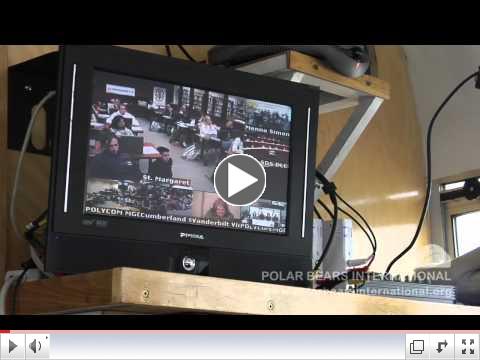 . . . . in this short video. The program links scientists in the field with students in remote locations. . . . . in this short video. The program links scientists in the field with students in remote locations.
|
|
|
|
A Summer in Review: Historic Sea Ice Losses, Polar Bear Encounters
 The summer of 2011 was one of remarkably low sea ice coverage in the Arctic, 50% lower than it was just forty years ago. It was also a summer filled with unusual and tragic reports involving polar bears. Among them were: - A polar bear attacked a group of campers in Svalbard, Norway, fatally mauling a teenager and injuring four others
- Policemen in a Russian village fatally shot three polar bears after one of the bears attacked and killed a 33-year-old man
What's going on?
Our chief scientist, Dr. Steven C. Amstrup, says that while we don't know all the factors involved in each case, we can be 100% sure that more and more events like these will occur as the polar bear's sea ice habitat declines, with shorter hunting seasons leading to nutritionally stressed-and hungry-polar bears. |more . . . including what we can do
|
|
Tundra Connections
Do you have a question for our scientists? Or would you simply like to meet them in a virtual setting? If so, make plans now to join our Tundra Connections broadcasts by checking out our schedule and list of panelists.

Every fall during the polar bear migration, leading scientists and educators join us on the tundra for free, LIVE broadcasts where you can ask questions and receive answers in real time.
Discovery Education will once again team up with us for these unusual broadcasts, which take place in a Tundra Buggy® with polar bears just outside.
|
|
Arctic Species of the Month
| |
Sporting long ivory tusks and a blubbery body, the walrus uses its sensitive whiskers to nuzzle the bottom of ocean beds in search of mollusks, sea cucumbers, and other small prey. Its life cycle is closely linked to the sea ice, which it relies on for access to food, resting, giving birth, and nursing young.

Scientists expect walrus populations to decrease as the Arctic warms and believe their numbers may have already dropped substantially in some areas. The walrus featured here were photographed by Daniel J. Cox/Natural Exposures as part of the PBI Arctic Documentary Project.
|
|
Composting Power
 | | Did you know: Compostable materials make up 26% of the trash in U.S. landfills--and create landfill methane, a greenhouse gas 20 times more potent than carbon dioxide? The good news is that more and more communities now offer curbside pick-ups of vegetative waste, turning it into rich garden compost. |
How can you help polar bears just by taking an annual fall chore a step further?
This year, after you've raked your leaves, why not compost them along with food scraps and other vegetative waste?
Kara DeLanty, right, one of our Leadership Camp grads, has taken the concept beyond her own backyard by launching a compost program at the Milwaukee Zoo. The zoo now composts herbivore waste, bedding, uneaten food, and fruit and veggie scraps. Growing Power, a nonprofit, uses the finished compost on local urban farms.
Inspired by Kara's action? You can launch your own composting program in your school, business, or community!
|
|
A Forest Grows
Hali O'Connor, one of our Leadership Camp grads, and Bob Cisneros, president of the American Association of Zoo Keepers (AAZK), teamed up with other volunteers to create a tree-planting carbon offset option at the recent AAZK Conference in San Diego.
 | |
From left to right: Hali O'Connor; Maureen O. Duryee, who created the tree model; and Rachel Junke, who helped staff the booth. Not pictured are Bob Cisneros and Kindra Mapes. All are affiliated with the San Diego Zoo. What a team!
|
For each purchase of a $7 tree, participants could "plant" a model tree along the San Diego River where the grove will be located. The team raised enough money to plant 317 trees--and educated conference attendees in the process.
The outreach is just one aspect of the many activities PBI Leadership Camp students and AAZK chapters engage in, including the AAZK Trees for You & Me fundraising campaign to plant trees in our Polar Bear Forest and encourage public involvement.
|
|
Help us celebrate the fall migration
with a monthly donation

Your tax-deductible DONATION helps
us do our work. Give as a GIFT or in
HONOR or MEMORY of someone special. Or, add us to your monthly budget with an ENDURING PLEDGE.
You can also join us on your favorite
community sites and share PBI with
your friends and family.
   
We thank you for your continued support.
Conservation through research, education, and stewardship
|
PHOTO CREDITS
| |
Melting Arctic, Walruses,
Daniel J. Cox NaturalExposures.com;
Composting courtesy of Kara DeLanty;
Tree Model courtesy of Hali O'Connor;
Evan Richardson courtesy of Evan Richardson;
Flickr Photo of the Month, Ruud van Empel
|
© 2011 Polar Bears International. All Rights Reserved.
Marks and text appearing in this newsletter including, but not limited to,
Polar Bears International name, logo, and programs are trademarks,
registered trademarks, or service marks of Polar Bears International.
|
|
|
|
|



