|
|

News From Jim
Hello All, Prepare yourselves for an information-packed newsletter this month. In addition to a lot of education stuff, a lot of exciting media stuff is also going on. For your continuing education, the video clip; The Masterson Minute (or a little longer!) deals with refining your sense of feel while doing Masterson Method Techniques. By learning how to soften before the horse begins to brace, you'll be more effective with these techniques, especially when working with difficult or very sore horses. Primo, the model  for the Masterson Minute, took a snooze after taping. As you can see from this picture, stardom can be exhausting! for the Masterson Minute, took a snooze after taping. As you can see from this picture, stardom can be exhausting! The "Ask Jim" question this month is a very good one about reading the horse's responses and behavior, poll issues, and primary vs. secondary issues. I even learned something from it! This month we have a very helpful "Tip of the Month" from Masterson Method™ Certified Practitioner, (MMCP) Mary Ridgely in Wisconsin. The tip is about being aware of where your horse might be sore. There is even something to learn from this month's "Testimonial" about success with the Bladder Meridian. For those of you who remember the Testimonial on Lisby's horse Seven in May's newsletter, in this newsletter, Alice Dobb's horse, Denny has made incredible progress from "Walking Like a Crab." Follow the link to read my response to Alice posting on the Testimonial page on the website. Alice lives just down the road which makes it easy to work with her in helping Denny's rehabilitation. For entertainment - and education - sit back, relax, and watch my interview with Rick Lamb on RFD TV's "The Horse Show" below. This show, replayed last month on RFDTV, was originally shot in 2009. We have another interview coming up on "Horse Talk Live" with Lizzie Iwerson on Rural TV (a sub station of RFDTV.) It will air on August 6th (Monday) at Eastern Time: 3pm and rebroadcast at 9pm and midnight. Rural DVD is on Dish network, channel 232, one channel up from RFDTV. If you get it watch it! If you don't, get it! Next time you're in your local tack store pick up a copy of the July/August issue of Warmbloods Today. There are two great articles about us in the magazine. One is an informative article by Editor, Liz Cornell, and another by MMCP, Coralie Hughes, who talks about how she successfully integrates The Masterson Method™ principles into Dressage riding; a very interesting concept that could easily cross over into any riding discipline - except maybe bronc-riding. We still have slots available at the 5-Day Advanced Course in Navan, Ireland in August. If anyone is contemplating a trip to Ireland, now is the time to do it. The Ireland courses are always fun, and this will be no different. The end of the Saturday - Wednesday Advanced Course marks the start of the Dublin Horse Show. We scheduled the course this way (normally it is Monday - Friday) so that it wouldn't overlap this prestigious horse show. Lastly, for all our Canadian friends, we have just scheduled a weekend seminar-workshop near the Seattle, Washington area (Kent, Washington.) We hope you will come across the border and participate in a workshop! Until then, like me, Enjoy Your horses! Jim
|
The Masterson Minute In a minute (well, sometimes a little longer) Jim demonstrates a Masterson Method™ Technique. This month, Jim talks about softening prior to the horse's bracing response 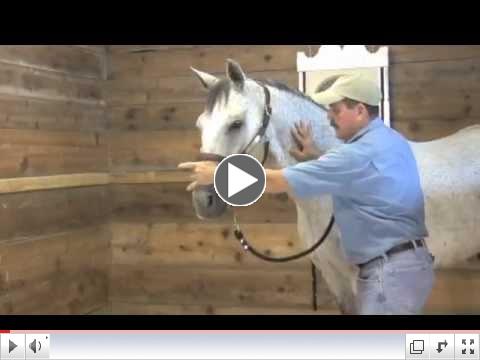 | | Tips to helping the horse move through a range of motion in a relaxed state |
|
Great Article in "Warmbloods
Today" Magazine!  A great article has just been published on The Masterson Method, in Warmbloods Today July/August issue. The title, "The Horses Spoke, Jim was Listening," by Liz Cornell is an informative article on Jim's journey and how the Method works. The thoughts of Peter Atkins (Australian Event Rider and member of the Australian Team at the World Equestrian Games) and Jane Savoie (American Dressage Rider and Coach) on Jim's work are an added bonus. It's really worth picking up and reading! As Liz points out, "While so many factors affect our horse's performance that include diet, turnout, saddle fit, bits, shoeing, training, etcetera, The Masterson Method incorporated into your program may be a simple and less expensive way to enhance your horse's comfort and improve your relationship with your horse at the same time." We agree. Thanks Liz! Additionally, an article written by our own Coralie Hughes, MMCP, and dressage "L" judge graduate with distinction, on "The Masterson Method's Influence on My Riding," was also published in the same issue. Coralie's article is an insightful look into applying the principles of the Masterson Method while riding. As Coralie said at the conclusion of her article: "Combining The Masterson Method with my dressage training is a fascinating process that promises to last a lifetime." Click here to read the article =>Click here for more information on "Warmbloods Today" magazine. |
Ask Jim
 Hello Jim, Hello Jim,
I love your site and have read the May 2012 issue of "Equus" magazine.
I am trying to practice these moves on my horse. He yawns (a huge eyeball rolling yawn) every time I so much as touch his Atlas and Axis. He also moves his jaw as he does this and his tongue makes some spectacular movements. His throat also constricts and releases as do most of his neck muscles. There is a real serpent effect going on, which is great, but it has been going on for three days now and reactions are getting stronger not lesser.
In addition at C3 downwards he clicks his teeth, then grinds his back ones and screws up his mouth, usually just before walking around me in
a circle, then yawning and releasing. I now get these massive reactions at each vertebrae all the way down both sides of his neck, in addition to pawing and fast walking.
Interestingly, he does this teeth clicking and grinding when I gently touch both his TMJ joints and I get massive released there soon after.
He is lovely and giving and really seems to enjoy it all, and is more than happy to bend his neck wherever I lead his nose and his eyes are very soft. Yesterday both his eyes were streaming tears after one lot of yawning!!
Why am I doing this is? He bucks at canter, both leads, but more violent on left lead - free schooling and saddled but riderless. His canter looks really stiff and he breaks to trot as soon as he can and he holds his neck in a funny position - sort of exaggerating each curve and head up, ears back - till he bucks, then he goes quite mad bronking.
The vet has been out to see him in action and isn't sure what is going on and has suggested x-rays. The X-ray machine broke down, so we haven't done that yet. The vet is due back out this week.
If he has a bit in his mouth, he puts the bit in his back teeth and grinds it, similar to what he is doing when I am attempting to release his neck.
I am concerned he has a major trauma in both his poll area and base of neck. Can I possible do more damage by doing all this? Is it best to get an x-ray or just keep working away at it? Do you know why he would be clicking and grinding his teeth in certain positions? He isn't stiff when he does this and is usually very pliable and leaning into my hold on him.
Regards, Renee
Hi Renee,
Your horse is now letting you know that he has been holding tension in these areas, and you are helping him start the process of releasing it.
Regarding whether what you are doing is hurting your horse or not, as long as you are getting positive reactions from your horse, meaning he's giving you release responses, and he isn't pinning his ears and swishing his tail, then this won't hurt the horse. You are helping him to release tension accumulated from something, and the responses he is giving you are signs that he is releasing tension. The question is what's is causing it (the primary issue), and how can you take care of that, and then help him release the tension it has created. I would say that this tension could be something that he is holding from some past issue, but his movement and behavior under saddle seems to point to something that is bothering him now.
As far as having his neck x-rayed, it's something that you and your vet need to decide, but it might help you to rule out any type of fracture or skeletal changes such as arthritic changes in the vertebrae of the neck. However, there are other things that can be causing him to be uncomfortable, sore or 'not right'.
When it comes to trying to find what might otherwise be the cause of his soreness or discomfort, I can only give you some ideas from my experience. There are a number of common things that I have found create the kind of tension that your horse is demonstrating in his behavior and from his release responses. Here are some thoughts and observations; please let me know if any of them ring any bells to you:
Read more of Jim's response at the webpage: Questions and Answers, and click on Bodywork Questions and then: "Horse that Bucks Like a Bronc" =>
|
Rick Lamb's, The Horse Show, Episode on RFDTV highlighting Jim and the Masterson Method.
If you haven't seen Rick Lamb's, The Horse Show, episode interviewing Jim on RFDTV, here is your chance! It's now out on You Tube.
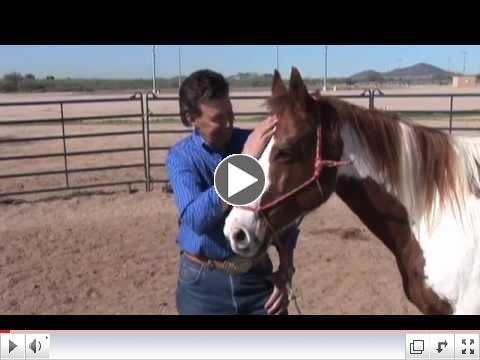 | | Episode 395 of The Horse Show with Rick Lamb "Masterson Method" |
|
Walking Like a Crab - by Alice Dobbs
Denny - October of 2011 something happened to my horse, Denny. I was in the throes of packing to move and one morning when I went to the pasture, he was walking with his spine in a C - like a crab! Alarmed, I called the vet and he suggested I give him some bute and see what he looked like the next morning. Next morning he was fine so, very relieved, I continued madly packing. A couple of weeks later when I was loading up the horses to actually move, he was walking like a crab again though not as bad. So when I got up to my new home I did the whole vet thing - he was negative to EPM (3 different tests), Neg to Lyme and other neurological diseases. Because he looked neurological - wobbly on his hind end, pasterns buckling, sometimes his hind end would sort-of buckle - although he didn't seem to be in pain.
I went to Univ hospital in Ames - they Xrayed his whole spine and didn't find anything conclusive. Their best guess was that he had arthritic changes that were impinging on his spinal cord and wanted to do the dye in the spinal cord to see. Which was going to be another $800! Gulp. I asked what we would find out from that? They said if there was some impingement I could take him to KY for a $10K operation which had a 50% chance of helping him!! So I declined that route! They suggested (for a lot less moola) injecting a couple of joints in his neck which was the most likely location of the problem and could help. I agreed to that but after watching it be done, I would never do that again! So I brought him home, hoping he would get better but steeling myself to the very real possibility that he would continue to decline (who knows how fast) and would probably need to be put down at some point when he was going down and couldn't get back up.
Denny was actually getting better prior to going to Ames but he definitely could never be ridden, so I had retired him until he (hopefully) improved on his own (he is a very athletic, off the track thoroughbred - raced till he was 7 and we had advanced to training level eventing).
Read how Jim and the Masterson Method continues to help Denny =>
|
|
|
|
|

|


|
 |

Calendar of Events
For Prices of each course, follow the link for more information to the Calendar Page on the website. There you will find each course's price, location and registration information
July 14th - 15th
Versailles, KY (near Lexington, KY) Only a couple spots left! Weekend Seminar Workshop with Coralie HughesFor more information or call 641-472-1312 July 16th - 20th Versailles, KY (near Lexington, KY) FULL
5 - Day Advanced Course
Prerequisites applyFor more informationor call 641-472-1312 August 4th - 5th
FULLPalo Alto, CAStanford University Weekend Seminar Workshop Lisa Haldane. For more informationor call 641-472-1312 August 11th - 15th (Saturday-Wednesday) Navan, Ireland5 - Day Advanced Course - 3 spots left!
September 1st - 2nd Totnes, Devon, UKThree spots left!
Weekend Seminar-Workshop with Jim Masterson For more informationSeptember 3rd - 7th Devon, UK - FULL5 - Day Advanced Course Sign up for waiting list or sign up for Navan, Ireland (Aug 11th - 15th) 5-day, spots available
September 8th - 9th Hobart, Indiana4 spots left!
Weekend Seminar-Workshop with Coralie Hughes For more informationor call 641-472-1312 September 8th - 9th Three Forks, MTThree spots left!
Weekend Seminar-Workshop with Yvonne Ohlensehlen For more informationor call: 641-472-1312 September 22nd - 23rd Grass Valley, CAWeekend Seminar-Workshop with Lisa Haldane For more informationor call 641-472-1312 September 22nd - 23rd Fairfield, Iowaone spot left!
Weekend Seminar-Workshop with Jim Masterson For more informationor call 641-472-1312 September 24th - 28th Fairfield, Iowa5 - Day Advanced Course - FULL
For more informationOctober 6th - 7th Kent, WashingtonWeekend Seminar-Workshop For more informationor call 641-472-1312 October (early) Palo Alto, CAStanford UniversityWeekend Seminar Workshop with Jim Masterson Tentative, watch Calendar webpage on website for updatesOctober (early) Palo Alto, CAStanford UniversityTentative, watch Calendar webpage on website for updatesOctober 13th - 14th The NetherlandsOud-Zuilen Weekend Seminar Workshop with Diane Howard For more information October 13th - 14th Harwood, MD3 spots left!
Weekend Seminar-Workshop with Marie Riley Or call 641-472-1312 October 15th - 19th Harwood, MD
5 - Day Advanced
November 3rd - 4th Jacksonville, FLWeekend Seminar Workshop with Coralie Hughes. For more informationor call 641-472-1312 November 5th - 9th Dade City, FL5 - Day Advanced Course - 2 spots left!For more informationor call 641-472-1312 January 12 - 13th Tucson, ArizonaWeekend Seminar-Workshop with Lisa Haldane For more informationor call 641-4721312 January 14th - 18th Tucson, Arizona5 - Day Advanced Course
For More Informationor call 641-472-1312 April 27th - 28th Clinton, OKWeekend Seminar-Workshop with Yvonne Ohlensehlen For More Informationor call 641-472-1312 All courses are certified by the National Certification Board for Therapeutic Massage & Bodywork for continuing education credits for massage therapists.
|
"Tip of the Month" from Mary Ridgely, MMCP
Even if you ride but don't own a horse, learn about equine anatomy. If you understand the skeletal and muscular structure of the horse, you'll have a better appreciation for where the horse might get sore when asked to do certain types of work.
|
Testimonial
I read your article in a magazine. WOW - my mare has recently been limping off and on and throwing her head when riding. She is normally a very easy going sound mare. I watched the video and tried the Bladder Meridian and the bringing her head around with little wiggles. Then, I used the release for the shoulder with the leg back and then forward. On her right side when I pulled it gently forward I heard a pop, I think she was out in her from shoulder. She is not as vocal as the horse on the video but she did let me know a couple of times with a yawn, she reached down to her chest and then to her cannon bone. WOW and these moves were very slow and soft.
Thank you, I will keep watching the video and get better at doing this. It is great for me and her. I just did a little at at time.
Thanks ever so much for the great information
Calleen Sweeter
|
"Horse Talk Live" TV Show Interview with Jim, August 6th air time

Jim will be interviewed for "Horse Talk Live" with Lizzie Iwerson on Rural TV (a sub station of RFDTV.) It will air on August 6th (Monday) at Eastern Time: 3pm and rebroadcast at 9pm and midnight. Rural DVD is on Dish network, channel 232, one channel up from RFDTV.
|
We're moving!
Yep, we are expanding rapidly and need more office space. We've added another employee who we will be highlighting in the next newsletter.
The good news is that we are staying in the same building, but moving to larger offices.
Our new address will simply be a change from Suite #8 to
Suite #5.
|
|


