|
|
News From Jim,  I packed my bags and left sunny Florida and headed to Texas to teach a Phase I/Phase III course on my way home to Iowa. I have mixed feelings about leaving the Winter Equestrian Festival, on the one hand, the Festival provides me with great opportunity to try new things and get immediate feedback on my work. Being able to work on the same horse multiple times, trying even harder to make him feel and go better in the show environment, is also a big plus. On the other hand, it's nice to leave the show environment with its packed schedule and get back to what I love best, which is to teach. As always, the best part of this job is meeting the horse owners, riders, grooms, vets and those that simply love being around horses. This winter I was happy to meet three time Olympic Dressage Coach, Jane Savoie and work on her horse, Moshi. Not only is she a great teacher and rider, but a lot of fun. Check out the interview with Jane Savoie I did for her website and for the group of students in her Dressage Mentor Program. By the time you read this, I will be back home in Iowa for a couple of weeks. My "honey-do" list is long and my horses are fat and out of shape. I'm not sure which I will try and tackle first. Below, I've taped, "The Masterson Minute" which is a short video (about a minute) on one technique to release the tension in the shoulder. If you want to see more videos of me teaching particular techniques, head over to the website and click on the Training Videos webpage. With a nod to Jane Savoie, we thought we would reprint an excerpt from the May, 2010, "Dressage Today" article that Jec Ballou and I wrote. You can read that article in it's entirety and other articles written from magazines specializing in Barrel Racing, Standard Bred Trotting, among others, and watch videos shot for online equestrian magazines. Click here for the In the Media Page of the website. It's Spring, and like me, enjoy your horses. Jim
|
|
The Masterson Minute
with Jim Masterson
Jim takes about a minute (well a little bit more) to show the shoulder releases with the leg forward and leg back. For a more video clips, go to Training Video Clips on the website.
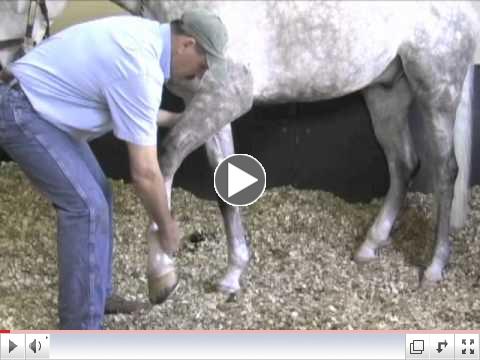 | | The Masterson Minute |
|
|
Changing Muscle Memory
excerpted from "Dressage Today"
article May, 2010 by Jec Ballou and Jim Masterson
As Dressage has grown in popularity, horses of different breeds and disciplines have entered the sport. Many were not bred specifically for dressage, while others have conformational limitations or years of training in different disciplines to overcome, particularly many years of carrying themselves in a posture that doesn't resemble a dressage frame.
Asking a horse to round his topline and stretch onto the bit as we do in dressage can turn into a time consuming and painstaking process when a horse already has a "muscle memory" to stiffen or brace his neck in response to a request to carry his topline in a certain way.
Nerves in the horse's neck and the "attitude" of the neck itself govern the entire body and it's movement. These nerve centers in the horse's poll act as a control panel for reflexes through out his body. So, when a horse, either through former training in other disciplines or previous injuries, braces his neck, his entire body is locked. This physical pattern needs to be addressed-through body therapy as well as systematic gymnastics--just as much as his training in dressage aids the rider's seat, etc.
Body therapists call this "neuro-muscular re-education." Without this, muscles will contract and relase in a pattern that has become habitual through training and discomfort. Eventually, a horse's nervous system will limit or restrict his soft tissues (muscle, ligament, tendon) from contracting or releasing in any manner outside this pattern.
Even after periods of rest and body therapy, such as massage, the nervous system retains this memory pattern, continuing -- in the case of dressage -- to restrict a muscles range of motion. The nerves keep signaling the muscle to move the way it always has in its previous state. In order to change this, a rider must re-educate the horse's nervous system to recruit all the muscle fibers available, not just he ones it has memory of. One way to do this to to move the horse's joints through their full range of motion while the horse is in a completely relaxed state. This way you release the restriction in the joint and accompanying muscles, plus show the nervous system that it can move through and beyond that point.
To improve your chances of success, perform all exercises and stretches intended to release trouble spots (rather than manipulate areas through massage) when the horse first comes from his stable prior to work. This way, his body is "cold" and not yet accessing his muscle memories. So, he is much less likely to guard his sore or restricted areas, and your chances of having him release are far greater.
Read the rest of this article and more articles on the Masterson Method™ on the In the Media page on the website =>
|
Ask Jim: 
Dear Jim, I have ex racehorse which is very head shy and 9 out of 10 times I cannot put a halter on him. There does seem to be a pattern, he is worse in the summer than winter, also he is starting to get stiff in the shoulder. Can you help? Kay
Hi Kay,
Hi Kay,
Almost without fail, horses that I have worked on who are seriously head-shy have tension/pain in the poll area. I work on a lot of horses, and almost never find it to be just a behavioral problem. This can be due to past trauma such as pulling back against a solidly tied headcollar, or having hit the poll against something, but it also can come from front
foot pain that tightens the muscles in the lower neck, the neck/trunk junction underneath the shoulder blades, and the poll.
If your horse is also becoming stiff in the shoulders, this may be something to look at as a possible cause. As far as relieving the pain in the poll, the techniques I use in the DVD help to relieve stress and pain in the poll, neck and
shoulders junction.
It takes patience to get feel of the work and to get the horse to start to relax the tension, but if you follow the steps it may help. In the meantime, it would be good to make sure that the cause of the problem is dealt with also.
I'm sure that if you have patience and use the techniques in the DVD, you will see some improvement. Sometimes the horse just needs a little help to start the release process.
Good luck,
Jim
|
Tips of the Month from Jim  1) If your horse fidgets when your hand is at a certain point, don't be tempted to move away - it's usually a sign of tension he's about to release. Lighten the pressure and "stay, stay, stay." 2) All horses are individuals. If your horse is "nippy" and has a lot going on around his poll, it may take him more time to release. Throw away the clock and lighten up! 3) Let your horse touch the back of your hand with his lips to help him relax. Some horses need to, "check in" with you. It's a nice connection. When your horse reaches around to see what you are doing, reach out the back of your hand and let him sniff or touch it. Horses do that to each other to "check in" Sometimes this is all they need to relax and release. 4) Start softly and go slowly. Enjoy the time you are spending with your horse. Do the work and figure out the "why's" later. Trying to figure out why a horse is stuck or is restricted at a certain place just keeps you in your head. Follow the horse's blink and let him lead. |
|
|
|
|

|
 |

|

Calendar of Events
For more detailed information, go to the Calendar Page of the website and click on the events listed
All courses are certified by the National Certification Board for Therapeutic Massage & Bodywork for continuing education credits for massage therapists. April 16th - 17th Little Compton,
Rhode IslandWeekend Seminar-Workshop Contact Ron Bouchard Registration and Information or call: 860-564-7759 Click here for flyerApril 30th - May 1st Ocala, Florida
Weekend Seminar-Workshop
NEW with Stefanie Reinhold Click here for flyer Contact us for more information, or call 641-472-1312, M-F 9am-noon Central Time May 14th - 15th Columbus, North CarolinaWeekend Seminar-Workshop Click here for flyerContact us for more information, or call 641-472-1312, M-F 9am-noon Central Time May 16th - 20th Columbus, North Carolina5-day, Phase I Certification Course. FULL May 28th - 29th Deerfield, OHWeekend Seminar-Workshop with Stefanie Reinhold Click here infoContact Us for more information, or call 641-472-1312, M-F 9am-noon Central Time June 4th - 5th County Navan,Ireland Weekend Seminar-Workshop Click here for flyerFor more information Contact Us June 6th - 10th County Navan, Ireland FULL! 5-day, Phase I Certification Course. June 12th, 13th and 14th Hertfordshire, UK
Phase III course
Only for those that have completed Phase II. Contact Us for more info June 13th - 14th Mequon, WI Weekend Seminar Workshop with Stefanie Reinhold. Click here for flier Contact us for more information, or call 641-472-1312, M-F 9am-noon Central Time June 16th - 17th Cambs, Wittering, UKWeekend Seminar-Workshop Contact Penny Gunter Equine Sports Therapy07974 250098 Click here for flierJune 18th - 19th Bristol, UK Weekend Seminar-Workshop. Click here for flierPenny Gunter: Equine Sports Therapy07974 250098 June 25th - 26th Devon, UK Weekend Seminar-Workshop Click here for flier For more information Contact Us June 27th - July 1st Devon, UK FULL 5-day, Phase I Certification Course. Prerequisites apply. August 13th - 14th Alberta, EdmontonCanada Weekend Seminar-Workshop Click here for flierContact Us for more information, or call 641-472-1312, M-F 9am-noon Central Time August 20th - 21st Oahu, HawaiiWeekend Seminar-Workshop. Contact us for more information, or call 641-472-1312, M-F 9am-noon Central Time September 17th - 18th Terre Haute, INWeekend Seminar-Workshop Click here for flierContact Us for more information, or call 641-472-1312, M-F 9am-noon Central Time September 19 - 23rd Terre Haute, IN5-day, Phase I Certification Course. Prerequisites apply. Click here for flierContact Us for more information, or call 641-472-1312, M-F 9am-noon Central Time October 1 - 2 Philadelphia, PAMasterson Method Weekend Seminar-Workshop Click here for flierContact Marie Riley to register and for more info or call: 215-370-4879 Contact Tami Parr if you would like to schedule a workshop in your area: atparr@charter.net |
|


