|
Newsletter Team
Editor
Lenny Bernstein
Copy Editor:
Carolyn Keefe
Design/Production
Katie Cavert
Writers
Tim Ballard
Lenny Bernstein
Katie Cavert
Sherry Vaughan
|
|

Mission Statement:
The Blue Ridge Sustainability Institute drives knowledge into action, solving societal problems today and for generations to come by harnessing world-class environmental, economic, and energy research to collaborations among researchers, educators, entrepreneurs, government officials, and community activists.
|
|
BRSI's
Definition of Sustainability
The Blue Ridge Sustainability Institute is an advocate and catalyst for actions that make the earth more sustainable. Sustainability means creating and maintaining conditions under which humans and nature can exist in productive harmony, that permit fulfilling social, economic and environmental requirements of present and future generations. |
|
Board of Directors
Paul Bellows
Chair
Retired Chief Operating Officer, Kilpatrick Stockton LLP
Patricia S. Smith
Treasurer
Retired President, The Community Foundation of Western North Carolina
W. Louis Bissette, Jr.
Secretary
Partner, McGuire, Wood & Bissette
Becky Anderson
Consultant; Founder and Former Director, Hand Made in America
Jack Haiden Britt
Blackwell Britt & Associates; Retired Executive Vice President of The University of Tennessee
Susan Fox
Assistant Director of Research, Southern Research Station, US Forest Service
Holly Jones
Buncombe County Commissioner; Director, YWCA of Asheville
Robert K. McMahan
Dean, Professor of Engineering, The Kimmel School, Western Carolina University
|
|
BRSI Profile
We have an amazing collection of talented professionals who contribute their time and resources to the management and development of BRSI projects and programs.
This month's featured member is:
Sherry Vaughan
BRSI Administrative Assistant
Thank you, Sherry, for your contributions!
|
|
BRSI Sponsor Profile
We owe much appreciation to our sponsors who are instrumental to our existence and development.
This month's featured sponsor is:
Mack Pearsall
Thank you, Mack,
for your support!
|
|
Partnerships and/or Collaborations
AdvantageGreen
AdvantageWest
Asheville Buncombe Sustainability Community Initiative
Asheville Buncombe Technical Community College
Asheville Chamber of Commerce
Asheville Design Center
Asheville Green Drinks
Asheville Green Opportunities
Asheville HUB
Asheville Independent Restaurants (AIR)
Biltmore Farms
Blue Ridge Biofuels
Buncombe County
City of Asheville
Conrard Industries
FIRC Group
Global Institute for Sustainability Technologies at Asheville-Buncombe Technical Community College
Green Jobs, ABCCM
Hickory Nut Gap Farm
Land-of-Sky Regional Council
North Carolina Department of Environmental and Natural Resources
Oak Ridge National Laboratory
Progress Energy
PurpleCat Networks
Push Designs
Self-Help Ventures Fund / Self-Help Credit Union
Southern Energy & Environment Expo
Sundance Power Systems
Sustainability Advisory Committee on Energy and the Environment
The Community Foundation of Western North Carolina
The Nauhaus Institute (NHI)
U.S. Forestry Service's Southern Research Station
University of North Carolina - Asheville
Warren Wilson College
Waste Reduction Partners
Western Carolina University
Western North Carolina Clean Energy Leadership Group
Western North Carolina Green Building Coalition
|

LEADERSHIP GROUP
Tim Ballard
Energy Campaign Manager
Paul Bellows
Chair of Board of Directors
Lenny Bernstein Projects and Programs Director
Brandee Boggs Advisor on Collaborations
Sue Brown EcoTourism Advisor Jennifer Cory Administrative and Financial Advisor
Katie Cavert Communications Coordinator
Steve Cochran Principal
Paul Dezendorf Business Manager
Rebecca Efroymson Senior Advisor on Natural Environments
Alan Escovitz
Director of Government Relationships Jordan Elaine Special Assistant for Development
Georgi Kostov Information Technology Advisor
Chris Fargo-Masuda
Researcher on Wind Generation Ed Mayer EcoTourism Advisor
Bill Hargrove
Senior Science Advisor
Tom Hatley
Special Advisor on Rural Development
David Johnson
Senior Advisor on Built and Natural Environment
Drew Kitt
Special Advisor on Renewable Energy Russ Martin
Co-Chair Advisory Board
David Mosrie
Advisory on the Built Environment
Teresa Matthews
Manager of BRSI's Contacts
Jonathan Robert
Advisor on Capacity Development
Jon Snover
Senior Advisor on Sustainability
John Stevens
Executive Director
Sherry Vaughan Administrative Assistant David Wallace Co-Chair Advisory Council Kevin Locke Wilson Special Assistant to the Executive Director
Noah Wilson Manager of Information Technology |
|

Asheville Green Drinks is a networking party and part of the self-organizing global grassroots movement that connects local communities with environmental ideas, media and action.
Come out to Posana Cafe every Wednesday
at 5:30 pm.
Program begins at 6.
Click here for a 2012 schedule and topics
Looking ahead!
Mark your calendars!
March 14, 2012
Asheville's 400th
Green Drinks
|
|
ADVISORY COUNCIL
(Co-Chair)
(Co-Chair)
(Owner, Hickory Gap Nut Farms)
(Director of Smith Mill Creek Permaculture School)
(Director of the North Carolina Arboretum)
(Western North Carolina Marketing Director, Self-Help Ventures Fund)
(RLCape Consulting, Inc)
(Robert J. Deutsch, PA)
(Green Jobs Director, Asheville Buncombe Community Christian Ministry)
(Principal, Glazer Architecture)
(Partner, Integritive)
(Owner, Sundance Power Systems)
(President, Ridgetop Associates)
(Director, FLS Solar Technologies)
Janell Kapoor
(Spokesperson and Coordinator, Ashevillage)
(Transit Project Manager, City of Asheville)
(Director of Integrative Healthcare, Mission Hospitals)
(EcoBuilders Founder)
(Vice President, Entrepreneurship & AdvantageGreen)
(Research Director of the Bent Creek Institute)
(Managing Director, The Nauhaus Institute)
(Director, LGS, Land of Sky Regional Council of Government)
|
|
Become a
Friend of BRSI!
We hope you consider investing in the Blue Ridge Sustainability Institute as we continue to grow and expand!
Your contribution is invaluable to the development and implementation of programs and projects that further our mission of Knowledge into Action.
You can become a Friend of BRSI for $25/year.
Your name will be displayed in recognition on our website. With your gift, you are investing in the future of sustainability in our region.
Together, we can make a difference!
Blue Ridge Sustainability Institute is a 501(c)(3) non-profit organization. Your donation is tax deductible.
Become a Friend of BRSI!
Make a tax deductible donation now!

Donate online or fill out this form and send it in. Thank you!
|
|
Comments Welcome
We, at BRSI, strive to provide useful, accurate information to residents of Western North Carolina.
If any errors exist in this publication we invite you to notify Newsletter Staff as a means of quality control.
We appreciate your assistance.
Click here to submit feedback
|
|
BRSI's New Website
| |
Same old address,
Brand new look!
Check it out! |
|
|
|
Renewables, Efficiency, and Conspicuous Conservation:
A Lesson in Sustainability
Tim Ballard, Energy Campaign Manager
No one can deny: solar installations are eye-catching. What sustainability-minded business or individual wouldn't want a solar array on their roof proclaiming their environmental commitment to the world? However, studies overwhelmingly show that using solar and other renewables are not the most cost-effective approaches for achieving sustainability.
From a sustainability perspective, the primary goals of renewable energy efforts are to reduce the use of non-renewable fossil fuel resources , to reduce greenhouse gas emissions to slow the progression of global climate change, and to reduce emission of other air pollutants with negative health effects. However, there aremany energy efficiency opportunities for both homeowners and business owners that are much more effective at reducing fossil fuel use and carbon emissions than renewable energy installations. The recently completed BRSI/AIR Green Restaurant Initiative offers a useful comparison of investments in energy efficiency and solar. Both were made, but investments in solar were made only in conjunction with energy efficiency.
For example: a comprehensive lighting retrofit in a typical small Asheville restaurant would cost about $2500 and would prevent 5 tons of CO2 emissions each year saving the business $900 per year. Rebates from the utility company can lower this cost. If the restaurant is heating their water with natural gas, a 6-panel solar installation would cost nearly $20,000 and could prevent 6 tons of CO2 emissions each year saving the business $1000 per year. This cost could be reduced up to 65% through tax credits if, and only if, the business has enough of a tax liability to take advantage of the credits.
So: prior to rebates and tax incentives a lighting retrofit is more than six times as effective as a solar installation at reducing CO2 emissions. If all potential rebates and tax incentives are taken into account, a lighting retrofit is still three times more effective at reducing CO2 emissions.
Despite this fact, many businesses and individual look to solar before addressing efficiency opportunities. Why is this? Is it the most sustainable option?
There appear to be two reasons. Lack of information is a primary challenge. In the absence of concrete information on the relative costs and benefits of energy efficiency and renewables, renewable energy installations always seem much more attractive to consumers. This emphasizes the responsibility sustainability-minded individuals and businesses have to seek out and share concrete information on the benefits of various sustainability solutions. Second, gathering concrete information on energy efficiency opportunities often requires paying for an energy audit, an upfront cost not present for renewable energy that, while relatively small, is often a deterrent.
 | | Conspicuous conservation at its best - a highly visible four collector solar installation at Luella's BBQ on Merrimon Avenue. |
While energy efficiency is a more cost-effective approach to sustainability, renewable energy does possess a number of additional benefits that warrant its inclusion in any comprehensive sustainability project. Renewable energy installations, unlike efficiency, are often highly visible. Economists have recently discovered that many consumers are willing to pay a premium for environmental goods that clearly display their environmental commitment for all their peers to see, termed conspicuous conservation. [1] The classic example is the iconic Toyota Prius, which clearly identifies the driver as an eco-conscious individual. According to one recent analysis, consumers are willing to pay anywhere from $400-$4000 for the green visibility of a Toyota Prius, environmental benefits aside. While for an individual the benefits of conspicuous conservation are limited to social status, businesses seeking to differentiate themselves from competitors can often reap economics benefits from conspicuous conservation. There may be significant incentives for businesses to pursue conspicuous sustainability options over more cost-effective options.
So yes, start saving up for those solar panels and yes, give those who have made installed solar a pat on the back. But first, change your light-bulbs and get an energy audit for your home or business and find out how large a dent you can make on your carbon footprint through efficiency!
[1] Sexton, Steven E. and Alison L. 2011. Conspicuous Conservation: The Prius Halo and Willingness to Pay for Environmental Bona Fides. University of California Center for Energy and Environmental Economics.
|
Sustainability Community has a New Partner
Lenoir-Rhyne University
finds a (second) home in Asheville
The Blue Ridge Sustainability Institute has a new partner and sponsor to help drive knowledge into action. Lenoir-Rhyne University is making Asheville its home-away-from-Hickory when it debuts its new Center for Graduate Studies of Asheville this fall. The Center will be located on the second and third floors of the Chamber of Commerce building at 36 Montford Avenue, where the university purchased a part of the facility.
Starting August 2012, the Center will offer nine new graduate programs including a Master of Science in Sustainability. "This program is unique and is designed to extend the classroom into the community through collaborative networks and community commitments," says Center director Dr. Paul Knott. "Faculty and students will engage in research, dialogue, and community projectsfocused on issues such as climate, population, and energy. Our students will engage in study across traditional disciplines and the program will continually evolve with partners like BRSI. The program will focus on climate, energy and population studies, policies and programs in business, government and community arenas. Students will be prepared to contribute to reshaping traditional economic development into sustainable development."
These programs will be offered through live (face-to-face) classroom instruction, videoconferencing/ distance education, and online delivery. Class meetings typically will be held during the evenings and/or weekends to allow accessibility for adult students and programs will be dynamic, responding to the needs and interests of the Asheville community.
Center renovations will result in the "highest quality classroom space and the most advanced technology of any graduate program in the region," Knott says, "with fully integrated instructional technology, a computer lab, an audio-visual studio, and easy online access to library and other University resources."
A critical driving force behind the establishment of the Center in Asheville has been the University's desire to establish partnerships between the University and the community. "We are thrilled to partner with Blue Ridge Sustainability Institute, a leader in the sustainability community," says Paul Knott. "We look forward to collaborating on projects that provide real, sustainable solutions for Asheville and Western North Carolina."
Mr. Knott will be presenting at the March 19th Green Mondays event and you are invited to stop by to visit the Center after the meeting. The administrative offices are located right next door to the Chamber of Commerce Board Room.
Other programs that will be offered at the Center include: Master of Science in Nursing, Dietetics Internship, Master of Arts in Clinical Mental Health Counseling, Community College Administration, Teaching, and Writing, several Master of Business Administration specializations (Including Business and Sustainability), and a Master of Public Health program. More information about all Masters programs can be found at www.asheville.lru.edu or by calling the Center office at 828-258-6136.

|
Meet Sherry Vaughan: BRSI Administrative Assistant

Sherry Vaughan joined BRSI as an administrative assistant two years ago. She learned of BRSI during her attendance at a Green Mondays where she responded to the call for volunteers. Currently, Sherry serves on the BRSI Leadership Council, is the liaison between BRSI and Asheville Green Drinks, and represents BRSI on the housing committee for the Land of Sky Gro WNC initiative. Sherry enjoys living her strong passion for caring for the environment. She has begun recycling programs wherever she has worked. Over the years, she joined New Hampshire community leaders to plan and implement various climate action initiatives. In her Londonberry, NH community, she organized an Earth Day clean up for businesses in exchange for donations to the United Nations Landmine Clean Up Program. Currently she 'walks the talk' to leave as small an environmental footprint as possible by living in an Asheville shared housing community with four others. Sherry grew up on beautiful Mount Desert Island/Acadia National Park in Bar Harbor, Maine. She graduated from the University of Maine with a BS in Early Childhood Development. Moving with her husband Larry to Pittsburgh, PA, where he did his master's work, Sherry worked in inner city schools where she realized her need to better understand young children with special needs. She completed her masters at the University of Pittsburgh, receiving her MS degree in Early Childhood Education of the Multiply Handicapped. Her graduate work included a research project investigating the effects of illicit drug use, specifically marijuana, on the newborn child. Working with the director of pediatrics at Magee Women's Hospital in Pittsburgh, then the fifth largest women's hospital in the country, Sherry designed and set up one of the earliest birthing rooms and collaborated in a study investigating the effects of skin-to-skin contact at birth on mother/infant bonding and later childhood behavior. Her beloved husband served as aconsultant and mentor on these projects. With four children, Sherry and her husband responded to the call to return to their New England roots to live closer to family. They bought a home and settled in close range of the beautiful New Hampshire beaches and White Mountains. Sherry was blessed to be able to stay home with her children until her last born was in kindergarten. She then worked in the local schools so that she could be home when her children were home. Seeing the need for family support programs, Sherry established a 501c3, writing successful grants to state and local foundations and creating The Londonderry Family Network. Serving as the Network's coordinator, Sherry implemented parenting classes and parent/child playgroups and established Good Beginnings,a home visiting program for new mothers and babies. As a special educator, Sherry has served young children with special needs for 15 years as an early intervention home visitor. During her home visits with developmentally delayed children, she spent as much time as she could out in nature with the children and their families, experiencing the many developmental benefits. She became influenced by Richard Louv's work and his book Last Child in the Woods, Saving Our Children from Nature-Deficit Disorder. Richard linked the absence of nature in the lives of today's children to the rise in obesity, attention disorders, and depression. Sherry's observations of and experiences with the positive impact of children in nature validated Louv's research indicating that direct exposure to nature is essential for healthy childhood development. Furthermore, when parents and children spend time together outside in nature, parents are more inclined to become better stewards of the environment. Inspired by Louv's work and a NH initiative called "No Child Left Inside," Sherry designed an Easter Seals NH Early Intervention "Children in Nature Outdoor Therapy Program."  | | Sherry with her grandson Max |
After three of Sherry's children moved to the NC area and her first grandchild was born in Asheville, Sherry sold her large NH family home and moved to Asheville. Currently in semi- retirement, she enjoys continuing her work with special needs children and making a difference in the lives of children and their families. She is grateful for the time to enjoy her two young grandsons and to engage in the regular practice of Tai Chi and yoga. She also had the pleasure of co-creating monthly Global Heart Meditations, a series that offers various venues to gather with the intention of creating a resonant field of heart coherence, enhancing both individual and global consciousness of peace. |
BRSI Sponsor Profile: Mack Pearsall

BRSI thanks Mack Pearsall for being one of our supportive donors. Hailing from Rocky Mount in Eastern North Carolina, Mack moved to Asheville in 1989. After sailing 28,000 miles (almost circumnavigating the world!), he rededicated his "land life" to public engagement in three areas: 1) joining the HUB, Asheville's strategic planning group for economic development, which spun off into his forming the Asheville Buncombe Sustainable Communities Initiative (ABSCI); 2) becoming a member of the Board of Trustees of Warren Wilson College; and 3) getting involved in the NC Progress Board (a statewide benchmarking initiative comparing NC's competitive position with 10 other Southern states). Through the creative efforts of Robin Cape, ABSCI created the program "Reading, Riding, Retrofit" which has developed metrics and curriculum for the NC Green School program (www.reading-riding-retrofit.org). Pearsall's passion for sustainability and his dedication to the smart growth of the Asheville community are palpable.
Pearsall developed a relationship with BRSI through his involvement with the HUB and shares a common philosophy with BRSI. In his words, "Sustainability is a force field and should be considered in every aspect of economic development." BRSI could not agree more. In our development of an Eco-Tourism Initiative, we recognize that people, profit, and planet go hand in hand. Pearsall supported BRSI's attendance at an International Eco-Tourism Conference in 2011 and hopes that BRSI can fully implement a "soft wear" program (to "wear softly on WNC"). Eco-Tourism fits beautifully with sustainable development.
Pearsall commented that BRSI and other organizations like ABSCI are working in complementary ways and that we are all better off trying to align our attention when it comes to sustainable initiatives in the community. "We are all working together," he said. "BRSI has become a substantive, effective entity, especially with the successes recently of the Green Restaurant Initiative," he added.
The Blue Ridge Sustainability Institute deeply appreciates the support of Mack Pearsall.
|
Sustainability Education at the
University and College Level
March 19, 2012
Western North Carolina's universities and colleges are at the forefront of education on sustainability. The Blue Ridge Institute's March 19th Green Monday will provide an opportunity to lean about the scope of their programs. We'll hear from:
- Dr. John Brock, Executive Director of Warren Wilson College's Environmental Leadership Center;
- Dr. Grace Campbell, a Lecturer in Humanities at University of North Carolina - Asheville;
- Ashley Edwards, a Sustainability Technology student at A-B Tech;
- Dr. Paul Knott, Director of Lenoir-Rhyne University's Center for Graduate Studies of Asheville; and
- Dr. Pamela McCown, Coordinator of A-B Tech's Institute for Climate Education.
Come join us for what promises to be a lively discussion!
Green Mondays are held in the Board Room of the Asheville Area Chamber of Commerce Building from 3:00-4:30 p.m. Green Mondays are funded by a grant from Progress Energy, with support from the Asheville Area Chamber of Commerce and Purplecat Networks.
Short presentations from speakers will be followed by a general discussion.
Special Note: You are invited to stop by and visit the Lenoir-Rhyne University Center for Graduate Studies after this month's Green Mondays. The administrative offices are located right next door to the Chamber of Commerce Board Room and will be open until 5pm.
Green Mondays are open to the public.
Join us on March 19th from 3:00 - 4:30 p.m.
Monthly Green Monday events take place at the Asheville Area Chamber of Commerce located at 36 Montford Avenue, Asheville.
|
Sustainable Management of Public Lands February 27, 2012 Review
Presentations of all speakers and the video can be found on our website.
www.blueridgesustainability.org/green-mondays-30
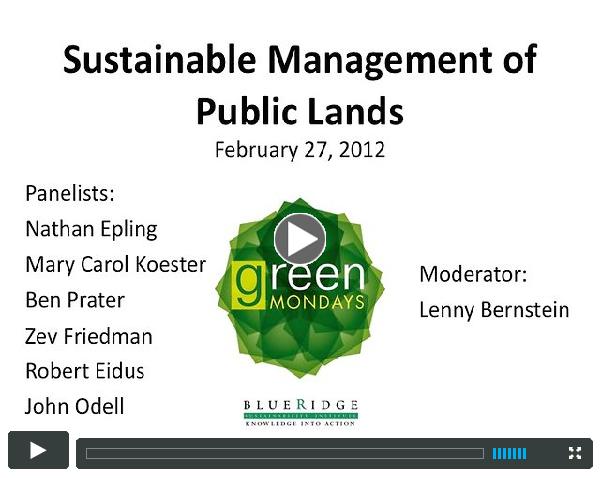 | | Green Mondays Video 2-27-12 |
Western North Carolina is blessed with large stretches of public land: national and state parks and forests, game lands, greenways, and watersheds. Using these lands today, while protecting their value for future generations, is a challenge for both land managers and the public.
Lt. Commander Nathan Epling, U.S. Public Health Service, assigned to the National Park Service's Blue Ridge Parkway (BRP), discussed the BRP's response to the laws and executive orders mandating lower greenhouse gas emissions from, and alternate fuel use by, federal government operations. An energy audit of BRP operations showed that vehicles accounted for 83% of the Parkway's energy use (60% gasoline, 22.5% diesel, and 0.4% E85) and 60% of its carbon emissions. The BRP's plan to lower these emissions includes:
- vehicle retirement and optimization - older high emission vehicles are being replaced with new lower emission models;
- appropriate use - reducing idling, carpooling, choosing appropriate vehicles for the task, and properly maintaining vehicles; and
- fuel management - using alternate fuels and tracking fuel usage.
Mary Carol Koester, National Forests in North Carolina, introduced the Western North Carolina Report Card on Forest Sustainability that the USDA Forest Service developed in partnership with University of North Carolina - Asheville's National Environmental Monitoring and Analysis Center (NEMAC) and Renaissance Computing Institute (RENCI). The report card evaluated both public and private forests in 18 counties using 26 indicators and 55 metrics grouped into seven categories. Indicators were ranked as improving, stable, uncertain or dynamic, unstable, or worsening. A summary of results showed:
- Socio-economic benefits were stable or improving.
- Policy indicators were stable or improving.
- Production indicators were uncertain, stable, or improving.
- Carbon cycle indicators were uncertain or stable.
- Soil, water, and air parameters were stable or improving, except for landslides, which were getting worse.
- Ecosystem health was mostly improving, except for invasive species, which were worsening.
- Biodiversity parameters were mostly unstable or worsening.
Ben Prater, Associate Director of Wild South, spoke about the role of volunteer stewardship and Wild South's belief that:
- the public has a role to play in public lands;
- collaboration and partnership are critical to forging constructive partnerships with land managers;
- people enjoy and take pride in working to protect the places they love; and
- those who invest their time and energy in the stewardship of their public lands invest in sustainability.
During 2011, 130 Wild South volunteers contributed 2,311 hours of time valued at nearly $50,000.
John Odell, Resource Management Coordinator for the Appalachian Trail Conservancy, talked about control of invasive, exotic (IE) plants. An IE plant is an aggressive species that exists outside its natural habitat, which means it has no natural enemies and causes ecosystem damage (species loss, reduced habitat biodiversity, reduced food for herbivores, etc.). IE plant management along the Appalachian Trail involves inventorying occurrences, controlling early infestation, communication and education, and collaboration with trail maintaining clubs, land-owning agencies, and other groups involved in control work. The public at large can help by becoming aware of this problem, removing IE plants from their gardens and replacing them with native plants, and taking steps to prevent seed dispersal.
Zev Friedman of Living Systems Design, outlined the opportunities for diverse forest cropping to create economic value and jobs from our forest lands. The majority of land in the mountain counties of Western North Carolina is forest, which contains a host of valuable products: ginseng, ramps, elderberries, wild turkey, etc. Besides food and medicines, these forests can also supply building and craft materials, animal fodder, charcoal, and firewood. Forest also can provide carbon sequestration, recreation, and green burial sites. Woodlands "entrepreneurs" can provide these goods and services and contribute to sustainability by careful stewardship of forest lands.
Robert Eidus, North Carolina Ginseng and Goldenseal Company, addressed the problem of over-harvesting of ginseng on public lands. The myth is that ginseng harvesting on public lands is part of our local culture and that it is a way for mountain families to earn a small amount of money. The reality is that, overwhelmingly, wild ginseng harvesting on public lands is conducted by people who treat it as a job and are out to maximize the amount of ginseng they can collect. They collect whatever roots they can find and do not practice repopulation or planting. Eidus argued for supporting local nurseries and educating public officials on the damage being done to ginseng populations.
|
|
BRSI's monthly newsletter Knowledge Into Action is made possible by a generous donation from the
James McClure Clarke Fund
Thank you for your dedication to sustainability in Western North Carolina!
|
|
|
|
|




