|
Newsletter Team
Editor
Lenny Bernstein
Copy Editor:
Carolyn Keefe
Design/Production
Katie Cavert
Writers
Tim Ballard
Lenny Bernstein
Katie Cavert
Paul Bellows
|
|

Mission Statement:
The Blue Ridge Sustainability Institute drives knowledge into action, solving societal problems today and for generations to come by harnessing world-class environmental, economic, and energy research to collaborations among researchers, educators, entrepreneurs, government officials, and community activists.
|
|
BRSI's
Definition of Sustainability
The Blue Ridge Sustainability Institute is an advocate and catalyst for actions that make the earth more sustainable. Sustainability means creating and maintaining conditions under which humans and nature can exist in productive harmony, that permit fulfilling social, economic and environmental requirements of present and future generations. |
|
Board of Directors
Paul Bellows
Chair
Retired Chief Operating Officer, Kilpatrick Stockton LLP
Patricia S. Smith
Treasurer
Retired President, The Community Foundation of Western North Carolina
W. Louis Bissette, Jr.
Secretary
Partner, McGuire, Wood & Bissette
Becky Anderson
Consultant; Founder and Former Director, Hand Made in America
Jack Haiden Britt
Blackwell Britt & Associates; Retired Executive Vice President of The University of Tennessee
Susan Fox
Assistant Director of Research, Southern Research Station, US Forest Service
Holly Jones
Buncombe County Commissioner; Director, YWCA of Asheville
Robert K. McMahan
Dean, Professor of Engineering, The Kimmel School, Western Carolina University
|
|
BRSI Profile
We have an amazing collection of talented professionals who contribute their time and resources to the management and development of BRSI projects and programs.
This month's featured member is:
Paul Bellows
BRSI Board Chair
Thank you, Paul, for your contributions!
|
|
BRSI Sponsor Profile
We owe much appreciation to our sponsors who are instrumental to our existence and development.
This month's featured sponsor is:

Thank you,
Advantage West,
for your support!
|
|
Partnerships and/or Collaborations
AdvantageGreen
AdvantageWest
Asheville Buncombe Sustainability Community Initiative
Asheville Buncombe Technical Community College
Asheville Chamber of Commerce
Asheville Design Center
Asheville Green Drinks
Asheville Green Opportunities
Asheville HUB
Asheville Independent Restaurants (AIR)
Biltmore Farms
Blue Ridge Biofuels
Buncombe County
City of Asheville
Conrard Industries
FIRC Group
Global Institute for Sustainability Technologies at Asheville-Buncombe Technical Community College
Green Jobs, ABCCM
Hickory Nut Gap Farm
Land-of-Sky Regional Council
North Carolina Department of Environmental and Natural Resources
Oak Ridge National Laboratory
Progress Energy
PurpleCat Networks
Push Designs
Self-Help Ventures Fund / Self-Help Credit Union
Southern Energy & Environment Expo
Sundance Power Systems
Sustainability Advisory Committee on Energy and the Environment
The Community Foundation of Western North Carolina
The Nauhaus Institute (NHI)
U.S. Forestry Service's Southern Research Station
University of North Carolina - Asheville
Warren Wilson College
Waste Reduction Partners
Western Carolina University
Western North Carolina Clean Energy Leadership Group
Western North Carolina Green Building Coalition
|
|

LEADERSHIP GROUP
Tim Ballard
Energy Campaign Manager
Paul Bellows
Chair of Board of Directors
Lenny Bernstein Projects and Programs Director
Brandee Boggs Advisor on Collaborations
Sue Brown EcoTourism Advisor Jennifer Cory Administrative and Financial Advisor
Katie Cavert Communications Coordinator
Steve Cochran Principal
Paul Dezendorf Business Manager
Rebecca Efroymson Senior Advisor on Natural Environments
Alan Escovitz
Director of Government Relationships Jordan Elaine Special Assistant for Development
Georgi Kostov Information Technology Advisor
Chris Fargo-Masuda
Researcher on Wind Generation Ed Mayer EcoTourism Advisor
Bill Hargrove
Senior Science Advisor
Tom Hatley
Special Advisor on Rural Development
David Johnson
Senior Advisor on Built and Natural Environment
Drew Kitt
Special Advisor on Renewable Energy Russ Martin
Co-Chair Advisory Board
David Mosrie
Advisory on the Built Environment
Teresa Matthews
Manager of BRSI's Contacts
Laura Piraino
Principal
Jon Snover
Senior Advisor on Sustainability
John Stevens
Executive Director
Sherry Vaughan Administrative Assistant David Wallace Co-Chair Advisory Council Kevin Locke Wilson Special Assistant to the Executive Director
Noah Wilson Manager of Information Technology |
|

Asheville Green Drinks is a networking party and part of the self-organizing global grassroots movement that connects local communities with environmental ideas, media and action.
Come out to Posana Cafe every Wednesday
at 5:30 pm.
Program begins at 6.
Click here for a 2012 schedule and topics
Looking ahead!
Mark your calendars!
March 14, 2012
Asheville's 400th
Green Drinks
|
|
ADVISORY COUNCIL
(Co-Chair)
(Co-Chair)
(Owner, Hickory Gap Nut Farms)
(Director of Smith Mill Creek Permaculture School)
(Director of the North Carolina Arboretum)
(Western North Carolina Marketing Director, Self-Help Ventures Fund)
(RLCape Consulting, Inc)
(Robert J. Deutsch, PA)
(Green Jobs Director, Asheville Buncombe Community Christian Ministry)
(Principal, Glazer Architecture)
(Partner, Integritive)
(Owner, Sundance Power Systems)
(President, Ridgetop Associates)
(Director, FLS Solar Technologies)
(Transit Project Manager, City of Asheville)
(Director of Integrative Healthcare, Mission Hospitals)
(EcoBuilders Founder)
(Vice President, Entrepreneurship & AdvantageGreen)
(Research Director of the Bent Creek Institute)
(Managing Director, The Nauhaus Institute)
(Director, LGS, Land of Sky Regional Council of Government)
|
|
Comments Welcome
We, at BRSI, strive to provide useful, accurate information to residents of Western North Carolina.
If any errors exist in this publication we invite you to notify Newsletter Staff as a means of quality control.
We appreciate your assistance.
Click here to submit feedback
|
|
|
BRSI's New Website Goes Live!
 | | Click to explore BRSI's New Website! |
The Blue Ridge Sustainability Institute invites you to explore our new and improved website! BRSI staff and volunteers have been working to make the site more user-friendly, dynamic, and eye-catching! New features abound, including the ability to make donations online, inquire about volunteer opportunities, connect on facebook, search for media, watch Green Mondays videos, read archived newsletters, published articles, link to supporters, and more! We hope you check it out!
Same old address, brand new look!
www.blueridgesustainability.org
|
Energy Upfit Campaign Update
 
 
The Green Restaurant Initiative
BRSI undertook the Green Restaurant Initiative in partnership with Asheville Independent Restaurants (AIR) with the $258,140 grant we received from the North Carolina Green Business Fund. With support from the grant and $100,000 in matching funds from the restaurants, BRSI:
- assisted 16 AIR member restaurants with energy efficiency, conservation, and renewable energy measures;
- created approximately 4200 hours of local jobs;
- will reduce restaurant energy consumption by over three billion BTUs per year; and
- will prevent the emission of over 200 tons of CO2 per year.
All of the restaurants listed below are seeking or have already obtained Green Restaurant Certification. Two other AIR restaurants who did not participate in the grant got on board with greening their restaurants as well - Tupelo Honey South and Burgermeisters!
You may be wondering, "What happens after BRSI implements this grant?"... "Will Asheville achieve the title of Greenest Dining Destination and then lose interest in the project?" Not the case. AIR members are fully committed to further promoting sustainable values and engaging in actions with or without grant support. In fact, many of the most important measures restaurants are implementing to green their operations are outside of the scope of our Green Business Fund grant: implementing composting programs and utilizing compostable take-out containers, for instance. BRSI is also fortunate to have the support in place to continue assisting restaurants. Through a partnership with UNCA's Student Energy Internship Program, BRSI will identify more opportunities to reduce restaurant energy consumption. We look forward to many more Asheville restaurants greening their operations in the near future.
We don't see this as the end though. There is currently a tremendous opportunity to capitalize on an untapped market of eco-conscious tourists looking for green destinations to visit. In the long-term, BRSI envisions Asheville becoming the Greenest Hospitality Destination in the country and tapping into this visitor market.
This will be in support of the great work being done around the state by projects such as the NC Green Travel Initiative, a project of the N.C. Division of Environmental Assistance and Outreach and the Center for Sustainable Tourism at East Carolina University.
As a next step , we have formed a partnership with the Asheville Brewers Alliance and look forward to working with them improve the sustainability of brewing operations in Asheville. The recent decision by Sierra Nevada-one of the greenest breweries in the nation and the EPA's 2010 Green Business of the year-to open an east-coast facility in Mills River emphasizes the opportunity Asheville has to become both Beer City USAand Greenest Brewing Destination in the USA.
We look forward to bringing more news of these exciting projects throughout 2012!
To read more about local breweries visit the ABA website (www.ashevillebrewersalliance.com).
As always: eat well, eat local, eat green!
The following restaurants participated in the Green Restaurant Initiative and we aim to have all be Green Certified by Earth Day 2012!
|
BRSI Sponsor Profile: Advantage West
BRSI would like to thank AdvantageWest, one of our dedicated supporters. AdvantageWest Economic Development Group has been a community supporter of the Blue Ridge Sustainability Institute since its inception. "AdvantageWest promotes and markets the region's strategic advantages through extensive outreach efforts with the purpose of generating opportunities for our communities" (AdvantageWest Annual Report, 2010). Last year, BRSI hosted a successful Finance Summit with the financial support and partnership of AdvantageGreen, an AdvantageWest initiative that supports the green economy. As noted on its website, "AdvantageWest [is] one of the most innovative and nimble economic development programs in North Carolina." Matt Raker, Vice President of Entrepreneurship and AdvantageGreen, sits on BRSI's Advisory Council and is an instrumental proponent of developing green entrepreneurial opportunities in the region. Asked why AdvantageWest believes in and supports BRSI, Matt responded, "The Blue Ridge Sustainability Institute brings a forward-looking and can-do approach to some of the region's most pressing challenges. As shown through the Energy Upfit Campaign and the Green Restaurant Initiative, BRSI knows how to bring people together around smart solutions that are good for the economy and the long term sustainability of our region."
Thank you, Advantage West, for your continued support of BRSI!
|
Meet Paul Bellows: BRSI Board Chairman

Paul Bellows grew up in a suburb of New York City, attending Trinity College in Hartford, Connecticut. His intention was to seek a master's degree in city management, but graduating at the height of the Vietnam War, he ended up serving three years in the Navy. After the Navy, he attended Wharton, receiving a master's degree in public administration. His first position was as the director of a small urban affairs research group in Atlanta. Atlanta turned out to be home for the next 35 years: he worked for the Georgia Medicaid Program after the research group and then in management (as opposed to practice roles) for several law firms. When Paul and his wife Bonnie began to think about retirement, they were most attracted to the Asheville area because of their daughter, Kimberly. Kimberly graduated from Warren Wilson College in 1999 and stayed in the area, marrying Charley Brophey; they now have two children of their own. Bonnie moved here in 2004, while Paul commuted back and forth to Atlanta. He finally tired of the commute, retiring in 2008. Paul and Bonnie have since built a house in Alexander with a sensational view of the mountains to the west. Paul's interest in sustainability was fueled as he and Bonnie began to consider the design and materials for their new house. He was very much involved in the detailed decisions about the materials to be used in the house. He and Bonnie achieved a Silver Healthy Built home designation as a result of using locally sourced hardwood for the floors and cabinets, solar hot water, conditioned crawl space, and other green features. Paul's connection to BRSI occurred when a friend introduced him to John Stevens just as BRSI was being formed. John thought Paul's business background would be valuable to the formative organization and Paul found John to have an incredible enthusiasm for the community and for sustainability. Their skills are complementary, and BRSI is the beneficiary. |
Become a Friend of BRSI! We hope you consider investing in the Blue Ridge Sustainability Institute as we continue to grow and expand! Your contribution is invaluable to the development and implementation of programs and projects that further our mission of Knowledge into Action. You can become a Friend of BRSI for $25/year. Your name will be displayed in recognition on our website. With your gift, you are investing in the future of sustainability in our region. Together, we can make a difference! Blue Ridge Sustainability Institute is a 501(c)(3) non-profit organization. Your donation is tax deductible. Become a Friend of BRSI! Make a tax deductible donation now!    Or send this form with payment to: Friends of BRSI Blue Ridge Sustainability Institute 1 Battery Park Ave, Suite M2 Asheville, NC 28801
Thank You!
|
Sustainable Management of Public Lands February 27, 2012
Western North Carolina is blessed with large stretches of public land: national and state parks and forests, games lands, greenways, and watersheds. Using these lands today while protecting their value for future generations is a challenge for both land managers and the public.
The Blue Ridge Sustainability Institute's next Green Monday on February 27 will address some of the issues involved in the sustainable management of public lands. It will include presentations by:
- Mary Carol Koester, National Forests in North Carolina, on the Western North Carolina Report Card on Forest Sustainability she helped develop;
- Ben Prater, Associate Director, Wild South, on how community involvement is critical to the success of sustainability issues on public lands;
- Lt. Commander Nathan Epling of the Blue Ridge Parkway, on the Parkway's fleet management strategies to reduce the carbon footprint of employee vehicles;
- John Odell, Appalachian Trail Conservancy, on volunteer efforts to monitor and control invasive exotic plant species; and
- Robert Eidus, Southern Appalachian School for Growing Medicinal Plants, on the challenges created by over-harvesting of wild plants.
Come join us for what promises to be a lively discussion!
Green Mondays are held in the Board Room of the Asheville Area Chamber of Commerce Building from 3:00-4:30 p.m. Green Mondays are funded by a grant from Progress Energy, with support from the Asheville Area Chamber of Commerce and Purplecat Networks.
Short presentations from speakers will be followed by a general discussion.
Green Mondays are open to the public.
Join us on February 27th from 3:00 - 4:30 p.m.
Monthly Green Monday events take place at the Asheville Area Chamber of Commerce located at 36 Montford Avenue, Asheville.
|
What are our kids learning about sustainability? January 23, 2012 Review
Achieving sustainability will require a fundamental change in the way we look at lifestyle choices. Just as we learned as children to turn off the lights when we left a room and not to litter, our children (or grandchildren) will have to learn about the choices they will have make about using sustainable energy, agriculture, and transportation. Much of this education will have to come from parents (and grandparents), but schools also have a role to play.
Robin Cape defined a green school as one which:
- Saves energy
- Reduces costs
- Features environmentally sustainable learning spaces
- Protects health
- Fosters wellness
- Offers environmental education to boost academic achievement and community
Robin described the North Carolina Green Schools Recognition Program she is trying to start as one that would recognize schools for achievement in six areas: (1) school ground enhancements, (2) school sustainability, (3) curriculum integration, (4) community involvement, (5) administrative support, and (6) innovation. Robin also invited audience members to become involved in evaluating schools and other volunteer activities.
Anna Littman, of the Appalachian Sustainable Agriculture Project (ASAP), described Growing Minds, a farm to school program that focuses on farm field trips, school gardens, local food in schools, and local food cooking. Its goals are to:
- Provide access to fresh, healthy food for ALL children
- Help children associate positive experiences with healthy, locally grown food
- Reconnect children (and their families) to where their food is grown
- Provide a market for farmers
- Provide hands-on/minds-on educational experiences for children
The program, part of a national farm to school network that began 18 months ago, is funded by a grant from the Kellogg Foundation.
Treasure Smith, a fifth grade teacher at Evergreen Charter School, and Rebecca Molaro, one of her students, outlined their experiences learning about the various aspects of sustainability. They visited Haw Creek Honey to learn about bee-keeping; Double Tree Farm, which does not use motorized equipment, to learn about traditional methods of farming; and Warren Wilson College and Hickory Nut Farms to see more modern versions of sustainable agriculture. They explored the environmental aspects of sustainability by studying stream water quality; they examined the social justice aspects through a project to provide hygiene kits for the children of migrant workers; additionally, they wrote letters to Congress advocating for migrant workers.
Kimberly Novak, who teaches science at Madison High School, described the Wind for Schools project her school participated in with Sundance Power, Mountain Valleys Resource Conserva-tion and Development, and the Western North Carolina Renewable Energy Initiative at Appalachian State University. A 1.8 kW Skystream wind turbine with 12 ft. diameter rotors mounted on a 34 foot monopole was instated at her high school in May 2009, but it is used more as a practical display than for power generation. Earth sciences students learn about (1) sources of energy, (2) how much energy we use, (3) what makes a good wind turbine, and (4) how to make positive changes at home and in careers. Madison High also has a small building that demonstrates sustainable building technology.
Erika Schneider, Sundance Power Company's Outreach Coordinator, described the renewable energy programs she runs for school-aged kids. Upon request, Sundance will provide energy education programs in schools to support the grade levels standard course of study. Sundance also makes its offices available to school groups, providing students an opportunity to see actual renewable energy operations and learn about career opportunities in the field. Additionally, Sundance has a mobile solar array that it uses to power many community events and festivals, providing solar energy information to kids in informal and fun settings.
Missed it? Watch the video of this Green Mondays below. Panelist Presentations can be found on our website here.
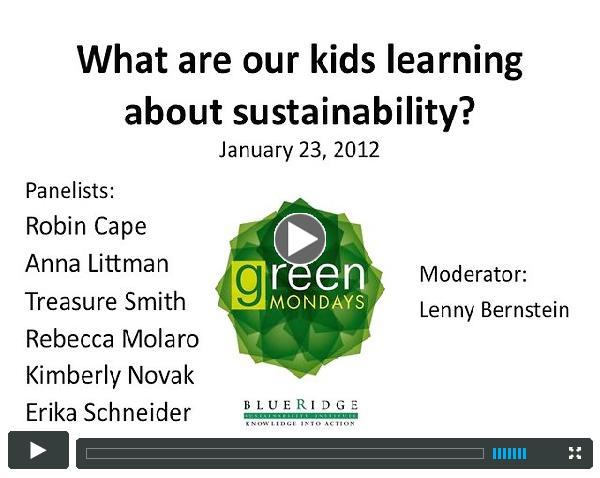 | |
Green Mondays Video, January 23, 2012
|
|
|
BRSI's monthly newsletter Knowledge Into Action is made possible by a generous donation from the
James McClure Clarke Fund
Thank you for your dedication to sustainability in Western North Carolina!
|
|
|
|
|







