|
Khalid Hadi, Curated by Ed Grazda
Exhibition Season: September 9 - December 16, 2011
Opening Reception: Friday, September 9, 6:00-8:00 pm
Artist's Panel Discussion: Friday, September 23, 6:00-8:00 pm
|
 © Khalid Hadi © Khalid Hadi |
"Khalid's stories were fascinating, and I believed him. He was soft-spoken, amiable, and shrewd, his manner matter-of-fact. Photography had given him an opportunity to brush shoulders with men of power...The more we spoke, the more Khalid himself came into clearer focus. He was a budding artist: he showed me a diary he had filled with reflections, poems, and colored-pencil drawings-portraits of past kings, AK-47s, cars. He was also a survivor, a crafty kid who had thrown in his lot with a fanatical cabal. His Taliban-era activities, indeed, nearly cost him his life." -Ed Grazda, excerpt from " Searching for Mullah Omar, Vanity Fair" |
ABOUT THE EXHIBITION
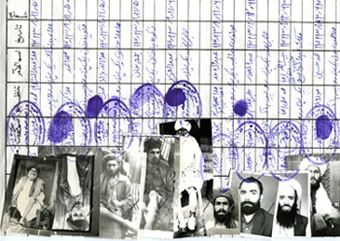
Men and young boys sit stoically, presenting their severed arms and legs to the camera as proof. Some sitters look resigned; others express an unadulterated anguish that can't be hidden. Many--especially the children--look scared and broken. Others emanate pure vitriol. Almost no one smiles. Men pose with long and short beards and, pre-Taliban, no beards at all. They wear tribal clothes and turbans wrapped carefully around their heads. Shirts and pants have been pushed away to reveal stumps of arms and legs.
Although small in size, the portraits have a timeless feel. The pictures, which resemble somber, 19th-century portraits rather than modern photographs, show men, women and children in native dress, often with amputated limbs and other injuries. The sitters - many having their picture taken for the first time - show their wounds or missing limbs to the viewer. Most of the subjects sit or stand in front of a dark curtain, which is sometimes surreally covered in a quaint flower print; behind one legless man, a painting of an English country scene is featured, complete with thatched cottage, wandering brook and daisy-covered meadow. |
|
These portraits of wounded fighters, orphans and children injured by land mines and bombs form a moving visual record of the toll taken on the population of Afghanistan during the Soviet occupation. A selection of nearly 60 images in the exhibition is drawn from more than 5,000 portraits produced by Khalid Hadi.
|
| 
© Khalid Hadi |
ABOUT THE PHOTOGRAPHER
"When I was a small boy," he [Khalid] said, "the war came to Kandahar. Russian air raids and mujahideen attacks. First I was scared of the bombs and blood. But it became natural. I would hold a [severed] leg or arm and not care." - Ed Grazda Khalid Hadi was born in Afghanistan in 1980. Living in Kandahar during the 1980's, he witnessed numerous attacks by the Mujahideen who were fighting against the Soviet invasion. During the early 1990's, a mullah in Kandahar started a foundation to help Mujahideen fighters who were wounded in battle. Kahlid was given a job of photographing the wounded fighters for the foundation's records - to show the foundation's backers where their money was going. Using a primitive, locally made, box camera Khalid made thousands of small paper-negative portraits of these wounded fighters. Some of these fighters later joined the Taliban, and in fact, one of the men he had photographed later became the founder of the Taliban - Mullah Omar. Khalid's portrait of him is one of the very few photos of the man who banned photography in Afghanistan when the Taliban took power. In the late 1990's Khalid and his family immigrated to the USA. Since 2001, he has traveled back and forth to Afghanistan - working as an advisor to CNN and other news agencies. He has started a cultural magazine in Kandahar and his web site: www.benawa.com - is very popular with Phustoon Diaspora worldwide. Another site www.surgar.net covers Afghan news. He has received numerous death threats from the Karzai family for articles published on the Surgan site. He lives in Albany, NY with his wife and young son.
All images are courtesy Ed Grazda. The Southeast Museum of Photography acknowledges the assistance of Ed Grazda in the development and presentation of this exhibition. For more information, visit our website.
|
 |  |  |
| All Images © Khalid Hadi | |