|
Capitol Notes
WI: Weekly Political and Legislative Update |
TO: Clients/Friends of Capitol Consultants, Inc./Wimmer & Company, S.C.
FROM: Capitol Consultants, Inc.
& Wimmer Company, S.C.
DATE: June 26, 2011
SUBJECT: Governor Walker Signs State Budget
|
|
Governor Walker Signs Budget
This afternoon Governor Scott Walker signed 2011 Assembly Bill 40 into law as 2011 Wisconsin Act 32. In doing so the Governor used his veto pen 50 times to either eliminate or modify provisions adopted by the Republican-controlled State Legislature.
In his veto message to the members of the Legislature, Governor Walker highlighted the positive outcomes of the bill that he introduced and the Legislature modified and sent back to his desk.
"This budget protects Wisconsin tax payers - including middle class families, seniors in their homes and small businesses. It does not raise taxes. It freezes municipal, county and technical college district levies. It reduces school district revenue limits in line with necessary state aid reductions and consistent with savings from cost-containment measures. It limits growth in property taxes on the median value home to less than 1 percent each year. It eliminates regional transit authorities and their potential to independently raise local taxes.
This budget promotes job creation. It provides tax incentives for investing capital gains in Wisconsin businesses and growing manufacturing jobs. It devotes $160 million to the new Wisconsin Economic Development Corporation in support of our state's economic prosperity. It promotes Wisconsin tourism by investing approximately $14 million annually in our state's marketing efforts, a nearly 40 percent increase. It supports business expansion by investing over $5.7 billion in our state's transportation system. It streamlines business licensing and regulation through a new Department of Safety and Professional Services."
Here are some additional specific provisions of note:
Economic Development
- Provides more than $160 million in funding over the biennium for the newly created Wisconsin Economic Development Corporation to support a concentrated focus on economic development in the state.
- Increases tourism marketing from $9.9 million in fiscal year 2010-11 to $13.8 million annually in part by redirecting arts spending to emphasize those activities that both support the arts and grow the economy.
- Ensures Wisconsin's meat processing industry can participate in national and global markets by authorizing 10.0 FTE positions for meat inspection activities.
- Reduces regulatory burdens on business expansion by streamlining reporting and eligibility requirements under the prevailing wage law.
- Improves the solvency of the unemployment trust fund by implementing a one-week delay in receiving initial benefits, similar to benefit programs in many other states.
Health Care, Children and Families
- Protects the state's most vulnerable citizens by preserving the health care safety net provided by Medicaid, BadgerCare Plus and SeniorCare while implementing significant program reforms to bring an end to the unsustainable rate of program growth.
- Requires a comprehensive review of the Family Care long-term care program to ensure that public dollars are used in the most effective way to support the needs of the elderly and people with disabilities. Over the past five years, the Family Care program has grown from five pilot counties to 56 counties covering 80 percent of the state's population. During that expansion, there has not been an adequate review of the effectiveness of the program in meeting the care needs of participants and providing services in a cost-effective and accountable manner.
- Redesigns the income maintenance eligibility determination system for public benefits to improve the accuracy and timeliness of eligibility determinations, while reducing total program costs by $40 million per year once fully implemented.
Transportation
- Strengthens the finances for Wisconsin's transportation infrastructure system by transferring $160.1 million in general fund revenue to the transportation fund, including an ongoing transfer of 0.25 percent of general fund taxes annually, with an annual minimum of $35.1 million.
- Makes progress toward addressing the state's critical highway infrastructure needs by providing $3.2 billion for highway construction and maintenance, an increase of $429.3 million over the biennium.
- Creates a new Southeast Wisconsin freeways megaprojects program to fund construction on the I-94 North-South corridor project and the Zoo Interchange in Milwaukee County. The budget provides a total of $420.0 million for those two projects, an increase of $229.9 million above current funding levels.
Natural Resources and Environment
- Requires the Stewardship program to focus only on the best value purchases by reducing bonding authority by $234 million through fiscal year 2019-20, saving Wisconsin as much as $80 million in total debt service costs.
- Modifies the formula for aids provided in lieu of property tax payments for lands purchased through the Stewardship program, saving the state $190,000 in fiscal year 2012-13, but reducing future payments by half or more. Total payments for aids in lieu of property taxes are estimated to be $13.2 million in fiscal year 2012-13.
- Ensures a balance between environmental protection and local costs by specifying that the Department of Natural Resources may not enforce an administrative rule for nonagricultural performance standards for runoff from urban areas if the provision has a reduction in total suspended solids exceeding 20 percent.
- Reduces bonding authority under the Working Lands program by $12 million and repeals the conversion fee for rezoning from a farmland preservation district. This will allow landowners to decide for themselves the best use of their property without paying a penalty if the use of the land will change.
The Governor vetoed or modified the following provisions of note:
- remove Joint Finance Committee oversight over the effective date of rules prohibiting UW System involvement in the telecommunications industry, because "there is no need to delay the prohibitions included in the bill beyond July 1, 2013."
- eliminate Board of Regents review and approval of UW-Madison compensation, personnel system plans and tentative labor agreements because "these plans will already require approval from the Joint Committee on Employment Relations" and "removing this level of approval will give the state's flagship campus the level of autonomy it needs to successfully compete in the global higher education environment."
- include all emergency medical services providers as exempted from collective bargaining changes enacted in Act 10.
- remove the scheduled increase in the minimum valuation factor for local property taxes, which had be scheduled to go up to 1.5 percent for levies set in 2013 and all subsequent years, "because I object to creating an automatic increase in the minimum valuation factor without knowledge of conditions in future years for taxpayers, counties and municipalities. The ongoing minimum valuation factor would continue to be 0 percent as a result of these vetoes."
- remove a provision restricting public access to officials' economic interest statements. "This violates the principles of transparency and open government that are fundamental to public oversight and a key tenet of my administration," Walker wrote of the provision he vetoed.
- de-fund a $10,000 earmark for the Wisconsin Aerospace Authority in Sheboygan
- allow nonprofits to host transitional jobs placements, and not just for-profit companies, adding: "Currently, 51 percent of transitional jobs placements are with nonprofit host sites, such as hospitals and community agencies. These placements provide valuable work experience to individuals and give these individuals the skills to move into unsubsidized employment."
- prevent fingerprinting for child care providers, saying "requiring fingerprints of all child care providers creates an unnecessary burden for small child care businesses."
Link to Governor Walker's Veto Message
|
|
Governor Walker Balanced Budget Signing Message (Video)
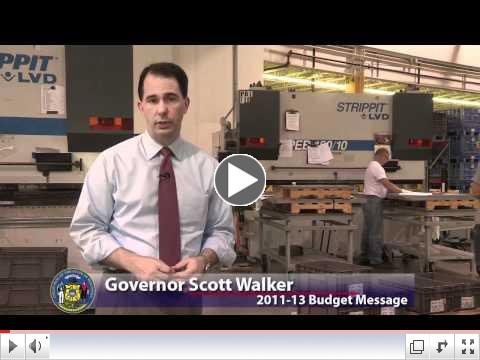 | | Governor Walker 2011-13 Balanced Budget Signing Message |
|
|
Wispolitics.com veto comparisons
Wispolitics.com released the following interesting veto statistics today to compare with Governor Walker's 50 vetoes:
- Jim Doyle issued 81 partial vetoes in his last budget, when his Dem Party had control of both legislative houses.
- During his tenure, Doyle's budget veto numbers ranged from a high of 139 in 2005 to a low of 33 in 2007.
- The lowest number of budget vetoes issued by a governor since 1971, when there were 12.
- The record high is Gov. Tommy Thompson's 457 partial vetoes in 1991.
- The last time a budget was signed by a governor without vetoes was 1967.
- The last time there was a legislative override of a governor's partial budget veto was 1985, when there were two.
|
|
Minority Reaction to Budget Signing
Asssembly Minority Leader Peter Barca (D-Kenosha)
|
"The theme of Gov. Walker's budget is that the middle class pays more and gets less. The vetoes only amplify these trends. This budget will further Gov. Walker's reputation as the most polarizing governor in the nation.
"His vetoes don't change the fact that his budget serves corporate special interests at the expense of Wisconsin's small businesses and middle class. Time and again, Gov. Walker has gone out of his way to limit public scrutiny of his extreme agenda and it comes as no surprise that the governor used many of his vetoes to take away public accountability and further consolidate power in his administration.
"With $2.3 billion in tax breaks to wealthy special interests and expanded loopholes that allow out-of-state corporations to dodge taxes, Gov. Walker's budget is lavish in giveaways to large special interests, but out of touch when it comes to the concerns of Wisconsin's middle class.
"The fact that Gov. Walker would use his budget signing to 'applaud' fellow Republicans for their efforts to force laid-off workers to wait longer for benefits that help them put food on the dinner table while they seek new employment in one of the worst economies shows just how out of touch Gov. Walker is with the concerns of struggling Wisconsin families."
|
|


