|
February 2010, Volume 2, Issue 1 | |
|
|
FEATURED PROJECT
2010 MNLA Award for Residential Installation
Private Residence, St. Paul, MN
Project Manager: Scott Frampton
 We are proud to announce that Landscape Renovations received a Merit Award for Residential Landscape Installation at the Minnesota Nursery and Landscape Association's annual Northern Green Expo in January. The project designed by Landscape Architects Coen + Partners is a comprehensive site redesign for an existing modernist house, built in 1956 by a University of Minnesota Architecture professor. The residence has had few modifications since and is largely faithful to the original architectural vision. The goal of the landscape plan is to create a series of linked site elements that respect and enhance the modernist architecture. Almost all of LRI's construction and planting teams participated in the construction process at some point. Project management was lead by Scott Frampton and assisted by Jim Kosowski, while site supervisor Mark Sauer handled day to day construction activities. Team members Todd Schumacher, Filberto Tores, Francisco Barajas, and partner Robert Palmer also had significant roles in completing the project. We are proud to announce that Landscape Renovations received a Merit Award for Residential Landscape Installation at the Minnesota Nursery and Landscape Association's annual Northern Green Expo in January. The project designed by Landscape Architects Coen + Partners is a comprehensive site redesign for an existing modernist house, built in 1956 by a University of Minnesota Architecture professor. The residence has had few modifications since and is largely faithful to the original architectural vision. The goal of the landscape plan is to create a series of linked site elements that respect and enhance the modernist architecture. Almost all of LRI's construction and planting teams participated in the construction process at some point. Project management was lead by Scott Frampton and assisted by Jim Kosowski, while site supervisor Mark Sauer handled day to day construction activities. Team members Todd Schumacher, Filberto Tores, Francisco Barajas, and partner Robert Palmer also had significant roles in completing the project.
NOTABLE ASPECTS
This project is a complete redesign of the entire 1.3 acre property to frame the 1950's architecture while providing dynamic, useable exterior space around the home, integrating a pool, and mitigating erosion stemming from a poor cut/fill balance when the home was originally constructed. The landscape architect, in collaboration with the client, conceived, designed, and detailed everything within the landscape. With the exception of the beautiful oak forest, not a piece of the property was left untouched.
 CONSTRUCTION PROCESS CONSTRUCTION PROCESS
Construction for this residential landscape is substantial. It includes the integration of a salt water swimming pool, a salt water spa, multiple areas for dining and lounging, a new entrance for vehicles and guests, addressing privacy concerns, mitigation of the slope in the rear yard to create useable space, integration of plant material which the owner can tend and trim, and most importantly, the development of a contemporary landscape which complements the modernist architecture.
Our company acted as the general contractor on this project, which charged us with responsibility for site supervision, permits, inspections and weekly site meetings. The owner and architect were involved with day to day site improvements and decision making. Many improvements to the original design were made during construction.
A series of walls mark this project. The concrete walls, two in the front yard and two in the back yard, were poured in place. The walls are board-formed with sanded fir plywood and custom cone ties. As these walls are critically important to the project, multiple on-site mock-ups using different types of plywood, top edge radii, and cone ties, were reviewed. The last wall, a 105-foot long Cor-Ten steel wall, runs along the east edge of the site. The Cor-Ten sheets are fastened to a Cor-Ten structure attached to a concrete wall.
This project could not have been possible without close collaboration with the client. The client regularly challenged design ideas and questioned everything from material selection and cost, to the spacing of plant material and cone ties for the concrete walls. Weekly meetings through the construction were imperative to the outstanding results that were achieved on this award winning installation project.
More pictures of this project
View Scott's Bio |
LANDCAPE MANAGEMENT Ice Melt for Natural Stone
& Pavers
 If you look at the calendar, winter accounts for three months out of each year. But, as we know in Minnesota, the cold, ice, and snow typically lasts much longer than that. Snow removal is a big part of our lives in the Land of 10,000 Lakes, and that regimen often includes some form of de-icing salts to assist with those extra slick spots. Use caution when applying salt to natural stone and pavers though, as many de-icing salts are highly corrosive and can damage your investment. If you look at the calendar, winter accounts for three months out of each year. But, as we know in Minnesota, the cold, ice, and snow typically lasts much longer than that. Snow removal is a big part of our lives in the Land of 10,000 Lakes, and that regimen often includes some form of de-icing salts to assist with those extra slick spots. Use caution when applying salt to natural stone and pavers though, as many de-icing salts are highly corrosive and can damage your investment.
When applied, de-icing salts mix with water or ice to form a solution that has a freezing point lower than 32 degrees. These solutions enter the pores in natural stone, pavers, and concrete and expand by 10 to 20% in volume when they eventually re-freeze. The pressure exerted by this expansion fractures the porus surfaces of natural stone, paving, or concrete, making them especially prone to damage. De-icing salts can also do damage to planting beds and lawn areas.
There are a few products out there that have different formulations than the commonly used de-icing products, and have been proven not cause damage to walkways, driveways, and even planting areas. One such product, recommended by Gino Pitera at Gertens Greenhouses is Landscapers Choice® Ice Melt Blend with Two Part Anti-Corrosion.
Be sure to read the package carefully when buying de-icing salts to make sure that you're getting a product that's safe for stone & pavers. Mixing sand with deicing salt helps with traction on slippery spots and cuts down on the amount of salt needed. If possible, avoid application to these areas all together to make certain that your investment is protected. |
|
PLANT HEALTH CARE
Treatment Facts for
 Emerald Ash Borer (EAB), an invasive insect species native to Asia, has killed tens of thousands of ash trees since it was discovered in southeast Michigan in 2002. In June, an EAB infestation was discovered within the City of St. Paul. This invasive pest poses a serious threat to Minnesota's forests as there are over 900 million ash trees in the state. EAB can be present in an ash tree for several years before it is detected. Damage is caused when EAB larvae bore through the bark of the tree and create tunnels or 'galleries' in the vascular system of the tree. This  tunneling destroys the nutrient and water movement capacity of the tree, therefore making it unable to feed itself. Early detection and treatment is critical in the fight against EAB. There are treatments available to prevent and control EAB damage in both non-infested trees and trees that already are showing signs of EAB damage. Below, we have outlined some methods to identify an EAB infestation and protect your ash trees from this devastating pest. Evidence that this pest is present include:
- Dieback in the tree canopy
- New sprouts forming from around the tree base and on the trunk
- Tiny "D" shaped exit holes in the bark of the tree
- Increased woodpecker activity and damage
Landscape Renovations can help protect your ash trees with trunk-injectable treatments that have been shown to be effective in the plant for to two to three years. Large, valuable, and specimen trees can be treated to help prevent infestation before it happens. For more information on treatment see the article at the bottom of this newsletter, or visit the EAB information website below.
More Information on Emerald Ash Borer in Minnesota |
|
We're Updating Our Website!
Check back often to see the changes we are making including more information on Construction & Landscape Management, updating our Portfolio, the Landformation e-news Archive and more...
www.landscaperenovations.com | |
|
|
|
 |
 |
|
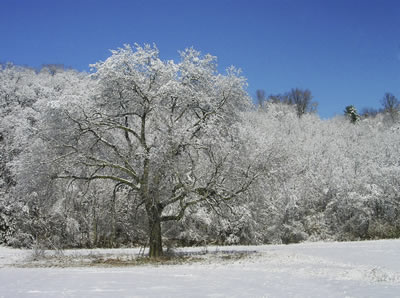
Winter Landscape Tips
LANDSCAPE PLANNING - This is a great time of year to begin plans for additions and changes to your landscape. By researching and starting the plans now, you can be ready to begin work on your project as soon as the ground thaws. That way you will be enjoying your new addition by Memorial Day!
DE-ICING SALTS - Mix sand with de-icing salt for application on walks and patios to reduce the amout of salt needed. Avoid excessive applications of de-icing salts and be sure you're using the proper type of salt for natural stone and pavers.
RABBIT DAMAGE -Check trees and shrubs for animal damage. If you see increased rabbit activity around shrubs and trees, apply a repellant spray or install wire mesh to prevent further damage.
TREE TRIMMING -Oaks, Honey Locusts, Crab Apples, Pears, and Hawthorns are just a few of the tree species that are best pruned now to prevent insects and disease from attacking the fresh pruning cuts.
EVERGREEN TREES - Keep evergreens free of heavy snow (especially Arborvitae and Juniper) to prevent branch breakage and crown splitting.
DESIGNING FOR WINTER INTEREST - Check out which plants are showing through in the winter landscape, and assess your own landscape to add winter interest for next year.
|
 |
 SHOP TALK SHOP TALK News from Landscape Renovations
***Landscape Renovations has been in busine ss for 10 years! Team members Mary Frampton, Jule Theiler, Chris Frampton, and Mark Sauer (and of course, owners Bob Palmer& Scott Frampton)were there for day one and are still with us today.
***Co-Owner Scott Frampton was recently re-elected to the MNLA Board of Directors & will also continue as the MNLA Landscape Contractor's Committee Chair. Scott was recently nomiated to join the MNLA Stormwater Management Task Team.
***Co-owner Bob Palmer recently completed training to maintain MnDOLI Power Limited Technician Certification.
***Site Supervisors Todd Schumacher & Mark Sauer recently attended training and passed testing to become MNDOT Certified Landscape Installers.
***Team Member Sarah Hartung recently completed training to maintain MnDOLI Power Limited Technician Certification and MDA Pesticide Applicator Certification. Sarah will also continue as a member of MNLA's Environmental Stewardship Committee and was recently nomiated to join the MNLA Stormwater Management Task Team.
***Team Members Kyle Claflin, Francisco Barajas Gerardo Fernandez, Jeremy Hogan, and Pablo Diaz each welcomed additions to thier families during the fall of 2009. Congratulations guys! |
|
Need Help With Maintenance This Season?
Contact our Landscape Management Department for assistance with all of your landscape management needs. Check our website for updates on services, projects, and maintenance tips. Or, you can contact us directly by calling | |
Expanded
Plant Health Care Services
Landscape Management Department
|
TREE TREATMENT TECHNOLOGY
New Service!
We are now offering the latest technology in the treatment of insect and disease problems in trees, including Emerald Ash Borer. The Arborjet injection system is environmentally friendly, is highly effective (a single treatment often lasts several years), and is  the safest option for keeping your property free of chemical residues. Unlike the traditional approaches of spraying and soil application, the Arborjet system keeps the treatment inside the tree, eliminating chemical exposure of the air, soil or groundwater. It is healthy for your trees and healthy for you, your family and your pets. This system allows us to perform both preventative and curative treatments for Emerald Ash Borer, Dutch Elm Disease, Bronze Birch Borer, Oak Wilt, & other common tree pests.
What is it and how does it work? The actual process is very similar to getting a shot from a doctor or a hospital intravenous. Small amounts of concentrated treatment formula are injected into the "veins" of the tree. Once inside the tree, the tree's natural processes distribute and diffuse the treatment throughout the tissues where insects and diseases typically try to invade or feed. The injection is performed through a special insert which facilitates the injection, prevents leakage or infection, and speeds the development of new woody tissue to "heal" over the site.
|
|
|
Thank you for checking out this edition of our e-newsletter. If you know of someone else who would enjoy receiving this newsletter, please use the "Forward to a Friend" link at the bottom of this page, and they will have the opportunity to 'opt-in' to receive future newsletters.
If you have any questions about Landscape Renovations or the services that we provide, give us a call at our Office (651-769-0010) or email us marketing@landscaperenovations.com.
We are looking forward to serving you in the upcoming season...
Sarah Hartung
Marketing, Landscape Management, & Design
Landscape Renovations
651-769-0010 |
|
|
|
|
|