 Feature Article: Natural Oral Hygiene Feature Article: Natural Oral Hygiene
"When the mouth stumbles, it is worse than the foot"--African Proverb
Oral Care is often overlooked, but it couldn't be more important to your health. Most disease enters through the mouth and nasal passages so keeping these areas free of bacteria and other pathogens can go a long way toward keeping you healthy. The Chinese even believe that the health of the body is mapped out on the tongue and use the condition of the tongue to identify trouble spots in the body. Keeping the mouth clean and healthy can improve not just dental but overall health.
A healthy tooth is a living structure nourished by blood vessels and supplied by nerves. The root is covered by a shock-absorbing periodontal tissue, and the base of the crown of the tooth is held in place by gums that are pale pink and do not bleed easily. The enamel that covers the crown of the tooth is one of the hardest substances in the body, and has a dentine layer beneath it. The dentine is somewhat softer and contains nerves and blood vessels that allow the tooth to detect sensations like cold and heat and also nourish the tooth.
Regular Oral Care
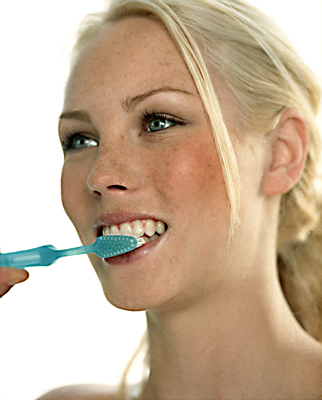
Most of us understand that good dental hygiene consists of brushing and flossing the teeth on a regular basis and regular cleanings by a trained professional. Tongue cleaning, with a specific tongue-scraping device, is a lesser known but important way of cleaning bacteria from the mouth. You simply scrape the device across the tongue a couple of times.
Just as important are the foods we eat. Chewy, fibrous, non-sugary and non-acidic foods keep teeth healthy. The bacteria that typically reside in the mouth feed on sugar and produce an acid by-product that erodes tooth enamel. Foods that contain citric acid can also be harmful to enamel if eaten in large amounts. This is one reason why it is not wise to take a chewable Vitamin C on a regular basis. Good dental habits can help overcome the lack of a good diet, but only for a period of time. Eventually the piper must be paid!
Many of the everyday oral care products we use are filled with sugar, chemical whiteners, and undesirable preservatives. Paying attention to the foods we eat, the gum we chew, the mints we use to freshen our breath, and the toothpaste we use can all improve dental health.
Xylitol--A Secret Weapon for Dental Health?
Caries is a bacteria in the mouth that acts on the sugar we eat and produces an acid that erodes tooth enamel, exposing the tooth to damage and decay. Caries is the most common reason for tooth decay. While we are not born with Caries bacteria in the mouth, most of us have acquired it by casual contact by the age of 18 months. Caries bacteria cannot feed on xylitol and thus is unable to thrive in the mouth. Studies have also shown that in the presence of xylitol, bacteria in the mouth and upper respiratory system lose their ability to adhere to the tissues, allowing the natural cleansing process to wash bacteria away. Xylitol is an alcohol sugar with 5 carbons that is used as a sweetener in everything from baked goods to gum to mints. It can be derived from either corn or birch bark. The corn derivative is from the corn stalk and thus free of the part of the plant that can produce allergy symptoms, according to the companies that make it from this source. Xylitol is also naturally found in the body.
The quality of dental health of a mother can also have a profound impact on the dental health of her child. Xylitol has been shown in studies to be more effective than flouride in protecting the teeth against caries and hence decay. These studies have shown that if a mother chews gum or uses mints that have xylitol 2-3 times a day during pregnancy, her child will have 70% less tooth decay than a mother that did not use xylitol. The key is that the xylitol be the #1 ingredient in the product, assuring that there is enough of it to have an impact. The brand Spry is one brand that can make this claim. We carry it here at Walsh and it is available in gum, mints, toothpaste, kid candies and even as a pacifier. The Spry baby tooth gel is a great way to protect infants and very young children as tooth brushing can be a challenge with them. The gum and mints are recommended in addition to the toothpaste because they stay in the mouth longer and thus provide more benefit. The mouthwash is also a great option, so long as you keep it in the mouth for several minutes.
Xylitol is also available in a nasal wash by Xlear as well as nasal drops, which are used to keep the nose free of bacteria. By using this wash we can improve the overall health of the mouth and nasal passages, eliminating the primary way for disease to enter the body. It has also been shown that the use of Xylitol has reduced ear infections in children, probably due to the common passages shared by the ear and the back of the throat.
Since Xylitol tastes very much like sugar it can be used as a sugar substitute in baking, cooking, or even your coffee or tea. Using Xylitol is a great way to reduce your glycemic load (it has a GI rating of only 7 versus 68 for sucrose) and hence improve blood sugar, as well as reduce the inflammatory effects of sugar on the body. It has about 40% fewer calories than sugar and can be used 1:1 in baking. Even if you still want to use some cane sugar for taste, substituting half or more would be a great improvement.
Know Your Toothpaste
Toothpaste may seem unimportant, but as our daily way of taking care of our mouth and teeth, it is important to our overall health. Toothpaste can improve oral health by using ingredients that enhance the condition of the mouth. Toothpaste comes in direct contact with the mouth, and ingredients can be absorbed into the bloodstream. Unfortunately with toothpaste is it a "lesser of evils" problem. Even many of the natural brands contain questionable ingredients like sodium lauryl sulfate (giving you the "sudsy" action you have grown accustomed to), parabens, titanium dioxide, and propylene glycol. Drug store brands may have these as well as added sugar, fluoride, mineral oils, colorants, detergents, and other preservatives. Probably the cleanest brand out there is Weleda toothpaste, which also has many of the ingredients that are beneficial Here are some good ingredients and their benefits:
· Sodium bicarbonate-good old baking soda. It neutralizes plaque acids, helping to prevent the build-up of plaque.
· Sea salt-encourages natural saliva production, keeping the gums and teeth strong. Also a good natural whitener for the teeth.
· Ratanhia-a plant ingredient that is a natural astringent, tonifying the gums and oral cavity
· Natural chalk-gently and thoroughly cleans the teeth.
· Silica-a natural component of teeth and bones, it also has a mild abrasive to help remove plaque build-up.
· Calendula-very soothing to the mucous membranes and healing any sores or cracks in the mouth.
· Tea tree oil-a natural antiseptic, it helps clean and tonify the mouth.
· Myrrh-an astringent that acts on the mucosa and cleanses rotten gums. It can also be helpful for excessive salivation.
· And of course xylitol-as noted above
Choose a natural brand of toothpaste for the best maintenance of the teeth and mouth.
Remedies for Common Tooth and Mouth Issues
Bad Breath-The causes of bad breath can be numerous, including having too much bacteria in the mouth, smoking, certain drugs, indigestion, and viruses. Chlorophyll or other "green" drinks are excellent cleansers of the breath. You can use it as a mouthwash, ingest it, or both. A probiotic will protect breath by replenishing the healthy bacteria in your system, which will also help the environment in the mouth. Udo Erasmus, formulator of the Udo's brand of supplements, actually breaks open a probiotic capsule each night and brushes his teeth with it after his regular brushing. Genius!
A new product by Garden of Life called Probiotic Smile has a patented blend of 3 probiotics that freshen breath and whiten teeth. Using a tongue cleaner to scrape bacteria from the tongue is another good habit and is much more effective than brushing your tongue. There are also many homeopathic medicines that can target bad breath which are, of course, particular to the symptoms you are experiencing. We can help you choose one if you would like to come in. Oil pulling (see below) can also help bad breath as it generally removes toxins from the body.
Gingivitis/Periodontal Disease-Gingivitis is a condition of infected or bleeding gums usually caused by a build-up of plaque. Gingivitis can lead to periodontal disease if left untreated. Periodontal disease is a more serious condition in which the bone supporting the teeth can start to erode as a result of infection. Abscesses can also result. It goes without saying that good daily oral care, as noted above, should be practiced. And while you should definitely seek dental care for these conditions, there are nutrients that can have a profound effect on healing and prevention:
· CoQ10 is very important for providing energy for gum cell growth and healing of gum tissue
· Vitamin C with bioflavanoidspromotes healing, especially of bleeding gums, and also retards the growth of plaque. Again, do not use a chewable form if your dental health is already compromised!
· Vitamin A is important for the healing of gum tissue.
· Applying aloe vera gel directly to the gums and teeth is very soothing and also has anti-viral properties
· Chamomile or Calendula tea are both soothing and can help to heal the tissues
· Goldenseal is a powerful antibiotic and kills the type of bacteria that causes periodontal disease. You can take an extract of the herb internally, or put some directly on a cotton ball and apply to the affected area. An alcohol-free form is best to avoid stinging. Because goldenseal is powerful it is not to be used as a preventative, but rather only if infection is present.
· Sage and Thyme are good herbs for gum disease, best used for inflammation and as an antiseptic, respectively
Decay of Tooth Enamel/Weak Teeth
Certain of the cell salts, a 6X potency of certain homeopathic remedies, can be very helpful for tooth decay. Silica is indicated in the case of generally weak teeth and other bone issues. It works more on the internal structures of the teeth, including the dentine and the root that connects to the jawbone. Calc Flour, on the other hand, is great for repairing the enamel, or outer protective coating, of the teeth. Calc Phos is best known for treating slow dentition in children and poor tooth quality due to a diet low in calcium and chewy, fibrous foods or high in refined sugars, carbohydrates, and soft drinks. These remedies can be combined for overall improvement in tooth decay.
Toothaches
Toothaches can be an indication of more serious gum disease, so if they persist they should be checked out by a professional. Clove oil, just a couple of drops on the affected spot, can be very effective at resolving a toothache. Homeopathic remedies like hypericum, kreosotum, chamomilla, belladonna and others can also be helpful depending on your specific symptoms.
Support for Dental Surgery
Two remedies are commonly recommended to support one through dental surgery, homeopathic medicines arnica and hypericum. A lower potency such as 9C or 12C is commonly recommended. Arnica acts to reduce inflammation and bruising while hypericum soothes areas with heavy concentrations of small nerve endings, like those in the teeth. You can begin taking the remedy before surgery and continue it afterward until the pain is resolved. Homeopathic medicines do not interact with prescription drugs and therefore will not affect any medicines your dentist feels are necessary.
If You Would Rather Pull Out Your Own Tooth Than Go to the Dentist...
Since homeopathic medicines work not only on the physical but also the emotional level, you can take a remedy to help you through the fear or anxiety of going to the dentist. The Family Guide to Homeopathy recommends the following: For a person who is simply very frightened, aconite 30C can be helpful. Gelsemium 30C is for those who are very apprehensive, have shaky legs and knees and feel weak. Chamomilla 30C is for fear based on extreme sensitivity to pain, or for a child who throws tantrums about going to a dentist.
Sniffing a calming essential oil like lavender, geranium, or rose can also take the edge off and make you calm enough to get through your visit.
Oil Pulling-The Newest Old Remedy
Oil pulling is all the rage right now and amounts to swishing organic oil in the mouth to pull toxins out of the body. Oil pulling has its roots in Ayurveda and was used by many ancient civilizations. The exact mechanism of oil pulling is not known, but there have been many reports of it healing various conditions in the body, including dental issues. Each morning before eating, you are to put 1 Tbsp of organic sesame or sunflower oil in your mouth, swish it around in the mouth for 15 minutes and then SPIT IT OUT! The whole point is to remove toxins so swallowing it would completely defeat the purpose. The oil should be watery by the time you spit it out. Oil pulling may be done by anyone over 5 years of age and will not interfere with any drugs according to www.oilpulling.org. Although I don't have much personal experience with oil pulling I did try it once. I didn't exactly enjoy doing it for 15 minutes, but it certainly makes sense to me. The fat in the oil would have the ability to pull fat-soluble toxins out of the mouth. Additionally, since many pathogens enter the body through the mouth, it would stand to reason that targeting this area could improve overall health. So if oil pulling sounds like something you want to try, I don't think it could hurt and it will likely be at least somewhat beneficial.
In summary, good dental health is important not just to your mouth but to your entire body. Using good oral care keeps the primary venue for germs clean and able to fight off disease. Stop by and we can recommend a good toothpaste, mouthwash and whatever else you may need to maintain your pearly whites!
| 







 Natural News You Can Use: